Best Ways to Pick Teams (Fair, Fast & Fun)
The best way to pick teams is the one that feels fair to everyone and doesn't leave anyone standing awkwardly at the end. For most groups, that means random selection: drop your names into a free team picker, choose how many teams you want, and let it shuffle. It's fast, unbiased, and skips the sting of "picking captains." Captain drafts, snake picks, and counting off all have their place too, and this guide walks through when each one shines.
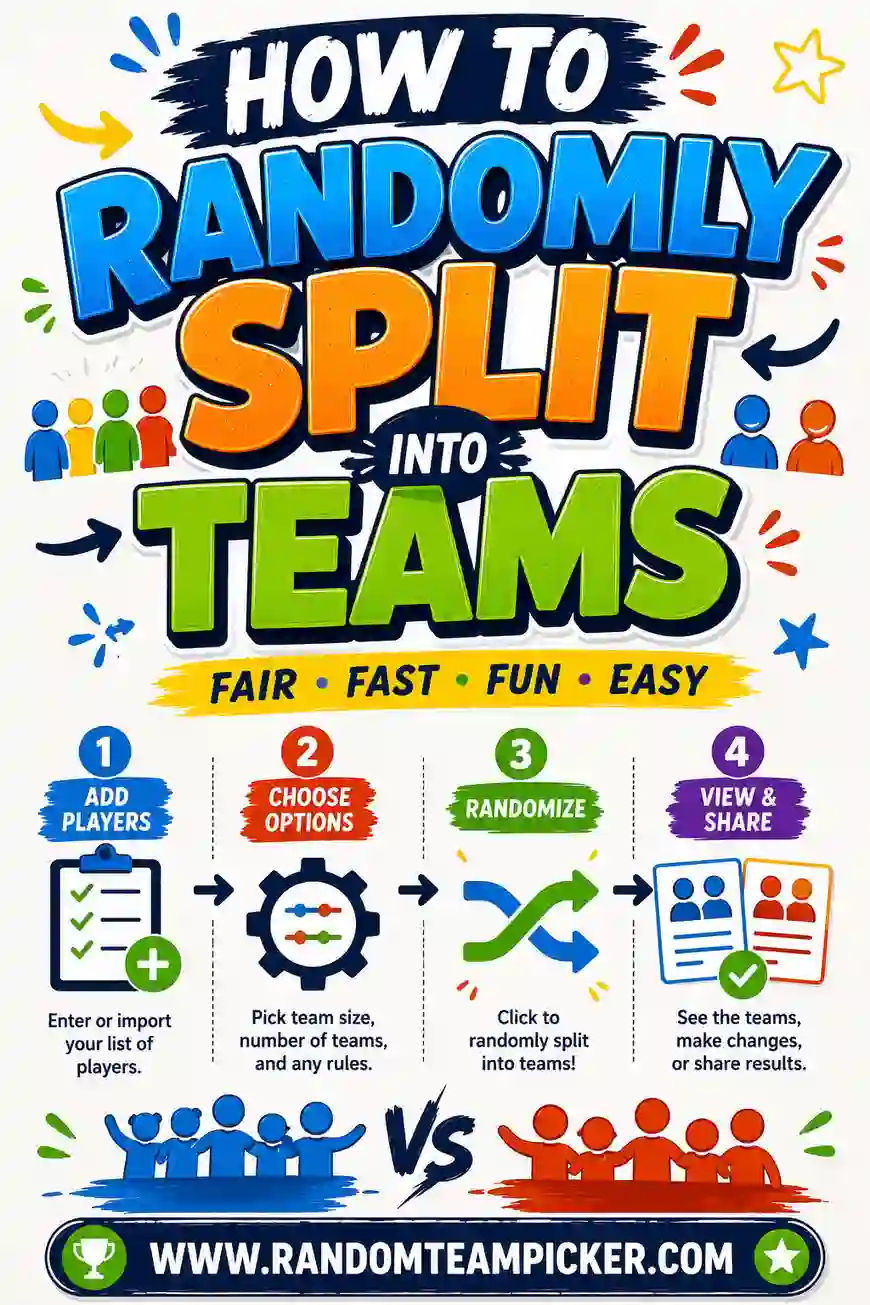
Want the quick route? Open the free team picker, paste your list of names, set the number of teams, and hit shuffle. No sign-up, and every split comes out fair.
What Makes a Team-Picking Method "Good"?
Before we compare methods, it helps to know what you're aiming for. A great way to pick teams hits three marks.
It's fair. No one feels singled out, and the sides come out roughly even. Fairness is what keeps a friendly game friendly.
It's fast. You want to be playing, not spending ten minutes arguing over who goes where. The quicker the method, the more time for the actual fun.
It fits the group. Kids, coworkers, competitive gamers, and party guests all want slightly different things. The best method reads the room.
Keep those three in mind and the "best" method for your situation gets obvious fast.
The Main Ways to Pick Teams, Compared
Here's the honest rundown of the most common methods, side by side.
| Method | Speed | Fairness | Best for |
|---|---|---|---|
| Random generator | Very fast | Very high | Any group, especially mixed ability |
| Captains pick | Medium | Low–medium | Skilled groups who don't mind a draft |
| Snake draft | Medium | High | Competitive balanced play |
| Counting off | Fast | High | Quick, low-stakes splits |
| Draw names from a hat | Medium | High | Small groups, no tech |
| Self-selected | Fast | Low | Casual friend groups |
The random generator wins on speed and fairness at once, which is why it's the default recommendation for most groups. The other methods earn their spot in specific cases, covered below.
Method 1: Random Team Generator (The Easy Default)
This is the go-to for a reason. You paste your names, tell it how many teams you want, and it shuffles everyone into even sides in seconds.
Why it works so well:
- It's genuinely unbiased. The tool doesn't know who's popular or who's the star player. Everyone has the same shot at every team.
- It's instant. No debating, no waiting. One click and you're done.
- It handles any size. Six people or sixty, the team picker splits them the same way.
- It kills the "last picked" problem. Nobody has to stand there watching captains skip over them.
Use it for classroom groups, casual sports, party games, trivia nights, and anytime you want fairness without fuss. It's the method this whole site is built around because it solves the most problems for the most people.
Method 2: Captains Pick Players
The classic playground draft: two captains take turns choosing players until everyone's on a team.
The upside: it can produce balanced teams when captains know everyone's strengths, and some competitive groups genuinely enjoy the strategy of it.
The big downside: someone always gets picked last, and that stings. For kids especially, being the final name called can sour the whole game before it starts.
If you do use captains, soften it:
- Pick players in secret (captains write lists privately, then reveal).
- Draft in reverse for the last few rounds so the "weaker" picks aren't spotlighted.
- Only use it with older, competitive groups who opt in.
For most casual and mixed groups, a random split is kinder and just as balanced.
Method 3: The Snake Draft
The snake draft is captains' pick, upgraded for fairness. Instead of both captains always picking in the same order, the order reverses each round.
So if Team A picks first in round one, Team B picks first in round two, then A again in round three, and so on. It "snakes" back and forth. This stops one team from grabbing all the top talent early.
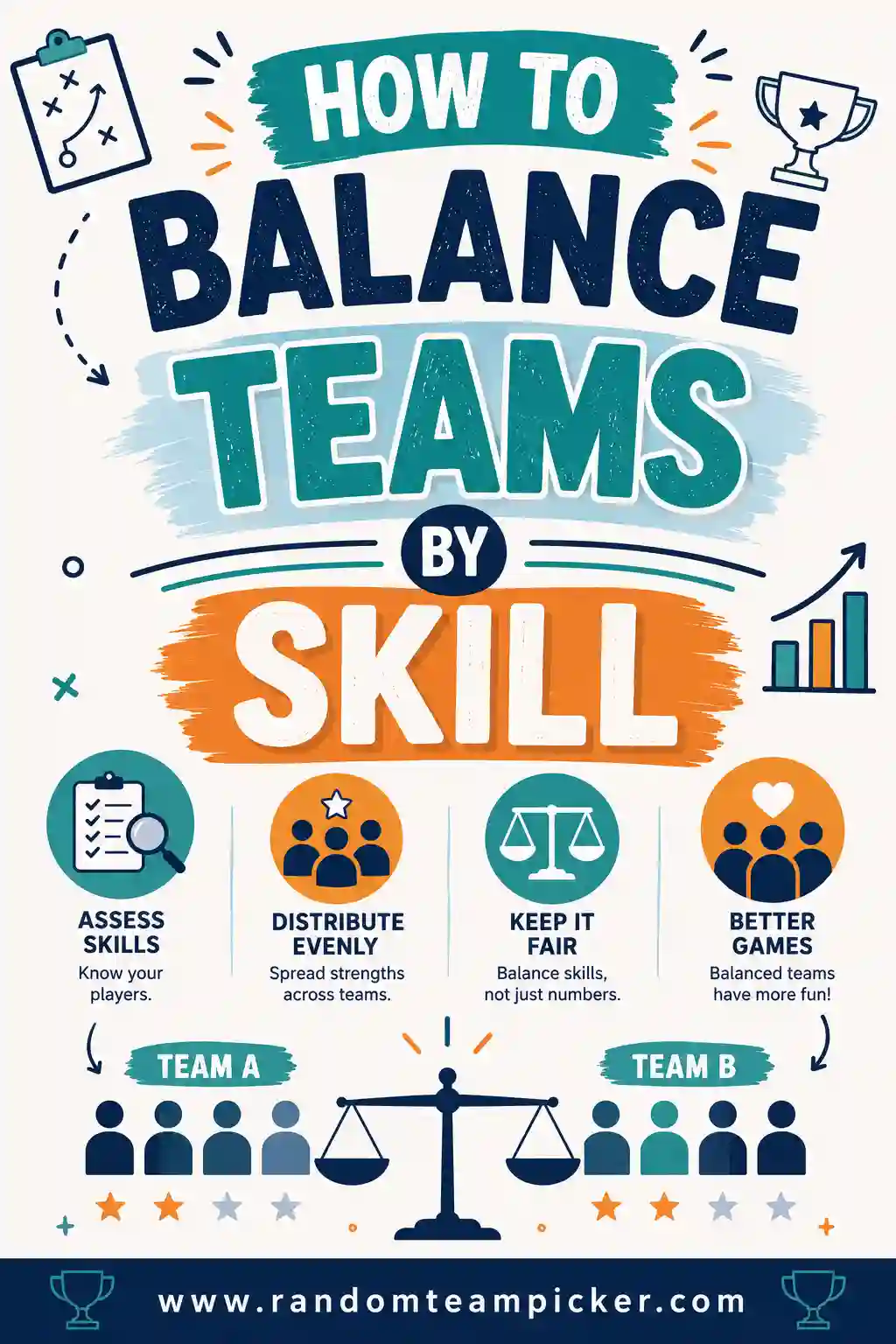
Snake drafts shine when you're trying to balance teams by skill for competitive play. Rank your players, then deal them out snake-style, and both teams end up with a fair mix of strong and developing players.
The tradeoff is time and the need to rank everyone. For a quick pickup game it's overkill, but for a league or tournament it's worth the effort.
Method 4: Quick Manual Methods
Sometimes you just need teams now, with no screen and no ceremony. These do the job.
Counting off
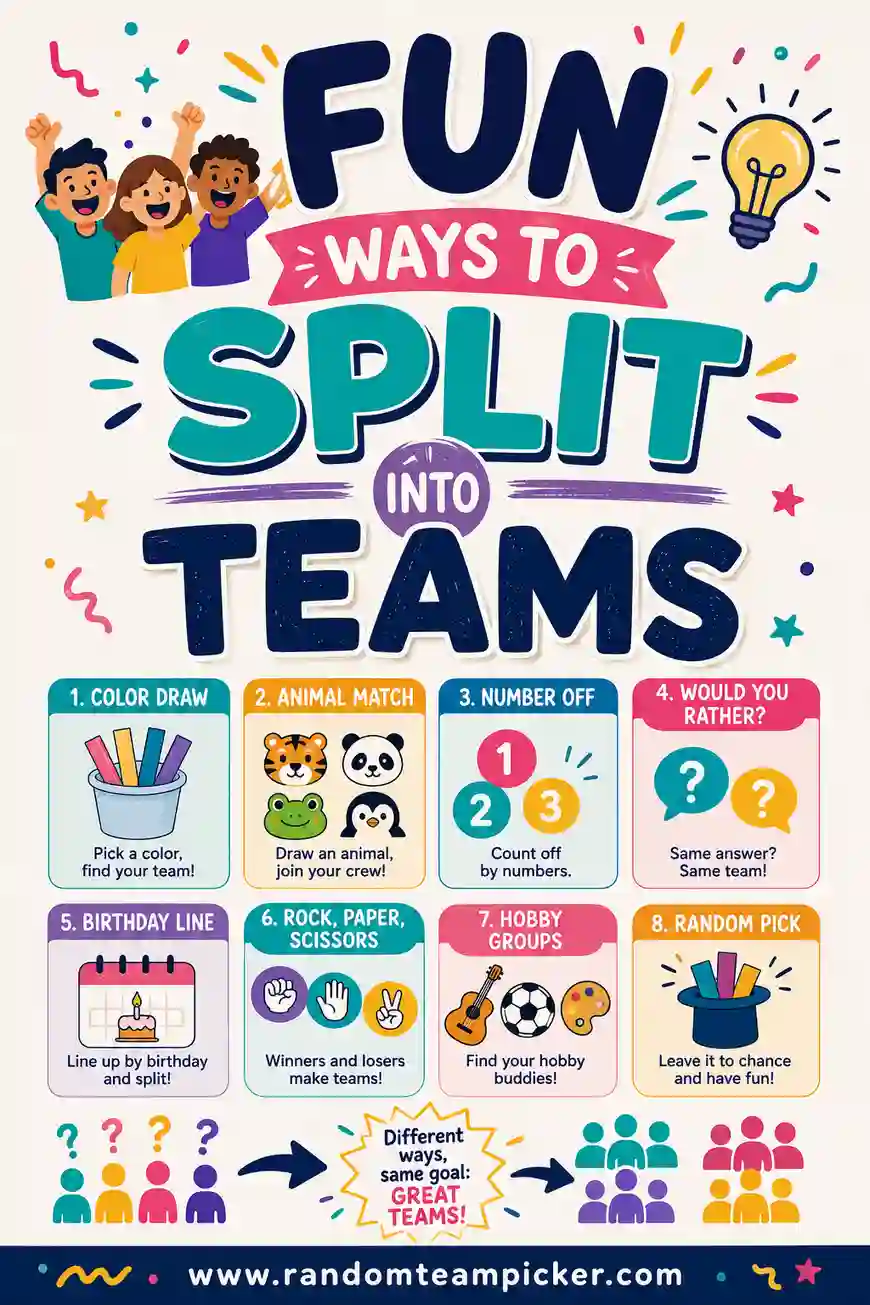
Everyone counts "1, 2, 1, 2" around the circle. All the 1s are one team, all the 2s the other. Fast and fair, though sharp players learn to position themselves to land with a friend.
Draw from a hat
Write names on slips, fold them, and draw them into piles. Fully random and satisfyingly old-school. Great for small groups and family game nights.
Split by a shared trait
Group by birthday month, shirt color, or odd/even house number. It adds a fun twist, but watch out, these can accidentally create lopsided sides.
Line up and chop
Have everyone line up by height or birthday, then split the line down the middle. Adds movement and works well with kids who have energy to burn.
Manual methods are charming, but they're slower and easier to game than a shuffle. When you want speed and airtight fairness together, reach for the generator.
How to Match the Method to Your Group
Still not sure which to use? Match it to who you're working with.
- Classrooms: random every time. It's fair, fast, and mixes up social circles. See how to divide a class into groups for the full playbook.
- Casual sports and pickup games: random or counting off. Keep it light and get playing.
- Competitive leagues: snake draft or ranked balancing, so the games stay close.
- Office and team-building: random, to break up the usual desk cliques.
- Party games: random for fairness, or a silly shared-trait split for laughs.
- Kids' birthday parties: random, always. No child should be picked last at their own party.
When in doubt, go random. It's the safest choice for the widest range of groups.
Picking More Than Two Teams
Most of the discussion so far assumes two teams, but plenty of games need three, four, or more. The good news is that every method scales, some just handle it better than others.
Random generators scale effortlessly. Set the number of teams to whatever you need and the tool divides everyone evenly in a single click. This is by far the smoothest option for multi-team splits, because doing it by hand gets fiddly fast.
Counting off scales, with care. Instead of "1, 2," count "1, 2, 3, 4" for four teams. It works, but the more teams you add, the easier it is for someone to lose track of their number.
Drafts get slow. Captain and snake drafts across four or five teams turn into a lengthy process with lots of captains and picks. Fine for a serious league draft night, overkill for a quick game.
A few things to watch with multiple teams:
- Even sizes get trickier. With 22 players across 4 teams, you'll have two teams of six and two of five. Spread the extras out rather than piling them onto one team.
- More teams, smaller sides. Make sure each team still has enough players to actually play the game. Four teams of two might not be enough for a full-field sport.
- Label clearly. With four teams, "Team 1" through "Team 4" gets confusing. Use colors or names so nobody forgets which side they're on.
Common Team-Picking Mistakes to Avoid
Even with a good method, a few slip-ups can spoil the split. Steer clear of these.
Letting the same people always captain. If two confident players run every draft, the group's social pecking order calcifies. Rotate the responsibility, or skip captains entirely.
Picking teams too slowly. Drag the selection out and you lose the group's energy before the game even begins. Whatever method you use, keep it moving.
Ignoring uneven numbers. A team with an extra player has a real advantage in most games. Sort out the odd number before you start, don't let it slide.
Reshuffling until you like it. If you keep re-running a random split because you wanted a certain mix, you've quietly turned a fair method into a biased one. Commit to the shuffle.
Using the same teams every single time. Predictable teams get stale, and the same side keeps winning. Fresh teams keep everyone engaged and give underdogs a shot.
Tips for Teams That Stay Fun
Picking the teams is half the battle. These habits keep the whole thing enjoyable.
Reshuffle between rounds. Fresh teams keep games from getting stale and give everyone new teammates.
Keep sides even. If numbers don't divide cleanly, rotate the extra player in and out, or let the bigger team play a member down.
Announce teams with energy. A little "and Team Blue is…" fanfare makes even a random split feel exciting.
Have a plan for latecomers. Slot new arrivals onto the smaller team so the balance holds.
Don't over-optimize casual play. For a backyard game, close enough is perfect. Save the careful balancing for when the score really matters.
Frequently Asked Questions
What is the fairest way to pick teams?
A random team generator is the fairest for most groups. It ignores popularity and skill reputation, giving everyone an equal chance at every team. For competitive play where you want even skill, a snake draft based on rankings is fairest.
How do I pick teams without hurting anyone's feelings?
Avoid captain drafts where someone gets picked last. Use a random shuffle instead and show the group it's random. When teams are visibly luck-based, no one takes their placement personally.
What's the quickest way to split into teams?
A random team picker is quickest, paste names and click once. If you have no device, counting off around the circle is the fastest low-tech option.
How do I make teams even when the number of players is odd?
Let the extra player rotate in and out, have the larger team play one member down, or add a floating role like a referee or scorekeeper. A generator will also spread an odd number as evenly as possible on its own.
Should teams be random or balanced by skill?
For casual and mixed groups, random is best, it's fair and fast. For competitive play where close games matter, balance by skill using a snake draft or ranked split.
Can I pick more than two teams at once?
Yes. Most methods scale to three, four, or more teams. With a generator you just set the number of teams and it divides everyone evenly in one go.
Ready to Pick Fair Teams in Seconds?
Now you know the best ways to pick teams, from captains to snake drafts to the quick random shuffle. For most groups, the simplest answer is also the fairest: open the free team picker, paste your names, choose your teams, and let it split everyone evenly. It's free, there's no sign-up, and nobody gets picked last. Give it a try before your next game.