How to Balance Teams by Skill
To balance teams by skill, rank your players from strongest to weakest, then deal them out in a snake pattern (best player to Team 1, next to Team 2, then reverse) so each team gets an even mix of talent. This keeps games close and fun instead of blowouts. If you just want a quick, fair split without ranking anyone, a random team picker spreads players evenly on its own, which is close enough for most casual games.
Want to start splitting right now? Open the free team picker, paste your player list, and shuffle. For skill balancing, order your names strongest-first before you split.
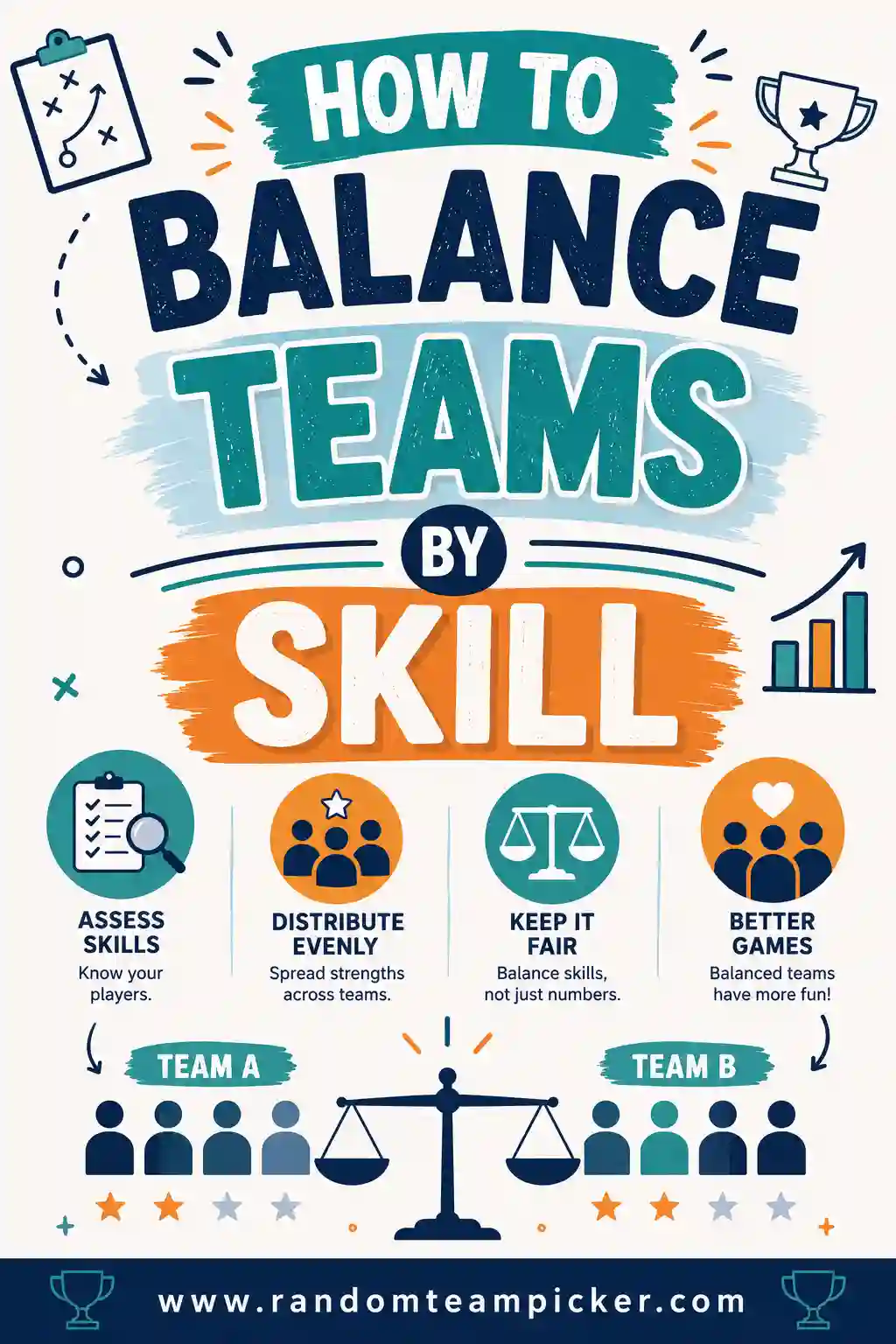
Why Balancing Teams by Skill Matters
Nobody enjoys a blowout. When one team stacks all the strong players, the game's decided in the first five minutes, and the losing side stops trying. Balanced teams keep everyone in it, the score stays close, the effort stays high, and both sides walk away happy.
Skill balancing matters most when the outcome counts: league play, tournaments, competitive scrimmages, or any group that takes its games seriously. It matters less for a backyard kickabout, where a rough split is plenty.
The trick is spending just enough effort to make the game fair, without turning team selection into a math project. This guide keeps it practical.
Step 1: Rank Your Players
You can't balance skill until you have a rough sense of who's strong. Ranking doesn't need to be scientific, a quick tiering is enough.
The simplest approach is to sort everyone into three buckets:
- Strong (A): your best players, the ones who carry a game.
- Average (B): solid contributors who play a steady role.
- Developing (C): newer or less experienced players still finding their feet.
For a bit more precision, rank everyone in a straight line from best to weakest. This gives you an ordered list you can deal out fairly in the next step.
Ways to rank without playing favorites
- Use recent results. Win-loss records, stats, or past performance are more objective than gut feel.
- Ask the group. Have players privately rate themselves or vote. Aggregate scores smooth out individual bias.
- Watch a warm-up. A quick scrimmage tells you plenty about who's on form today.
Keep rankings private if you can. Nobody loves seeing themselves labeled "C," and public tiers can bruise egos.
Step 2: Use the Snake Draft to Split Them
Once players are ranked, the snake draft is the cleanest way to divide them evenly. Here's how it works with two teams:
- Best player goes to Team 1.
- Second-best goes to Team 2.
- Third-best goes to Team 2 again (the order reverses).
- Fourth-best goes to Team 1.
- Keep snaking back and forth: 1, 2, 2, 1, 1, 2, 2, 1…
That back-and-forth is what makes it fair. Neither team gets to grab two top players in a row.
Here's a worked example with eight ranked players (1 = best):
| Pick order | Player rank | Team |
|---|---|---|
| 1 | Rank 1 | Team 1 |
| 2 | Rank 2 | Team 2 |
| 3 | Rank 3 | Team 2 |
| 4 | Rank 4 | Team 1 |
| 5 | Rank 5 | Team 1 |
| 6 | Rank 6 | Team 2 |
| 7 | Rank 7 | Team 2 |
| 8 | Rank 8 | Team 1 |
Team 1 gets ranks 1, 4, 5, 8. Team 2 gets ranks 2, 3, 6, 7. Add those up and the total "skill" on each side is nearly identical. That's a balanced game.
For more than two teams, the same snake pattern works, you just deal across all the teams and reverse direction at the end of each round.
Step 3: Sanity-Check the Balance
After the draft, take a quick look. The math can be even but reality sometimes isn't. Watch for these:
- Position clumping. In sports, all your goalies or all your shooters on one side ruins balance even if the skill totals match. Spread key positions out.
- Chemistry. Two players who click can outperform their individual ratings. Split up known power duos.
- Recent form. Someone rated "average" might be red-hot lately. Trust what you're seeing today over an old ranking.
If a team looks stacked, swap two players of similar rank between sides. One or two tweaks usually fixes it.
Balancing With a Random Team Picker
Here's the good news: for a lot of groups, you don't need to rank anyone. A random team picker already spreads players evenly by chance, and across a full group the strong and weak players tend to distribute fairly on their own.
Random works great when:
- The skill gap between players is small.
- The game is casual and the score doesn't decide anything big.
- You want speed and zero drama over rankings.
For tighter balance, use this hybrid trick:
- Rank your players roughly (A, B, C tiers).
- Shuffle each tier separately, or paste them strongest-first.
- Split so each team gets a similar count from each tier.
That gets you most of the fairness of a full snake draft with a fraction of the effort. And because it's still built on a shuffle, it stays free of the bias that captain picks bring.
Common Balancing Mistakes to Avoid
Even with good intentions, it's easy to slip up. Steer clear of these.
Stacking one team "to make it interesting." It doesn't. It makes it boring for both sides. Keep the sides even.
Over-ranking casual players. If it's a fun pickup game, a detailed ranking system is overkill and can make people self-conscious. Match the effort to the stakes.
Ignoring team size. Balanced skill means nothing if one team has an extra player. Keep the headcounts even first, then balance skill.
Never reshuffling. The same balanced teams every week get predictable. Rebalance now and then so players face new matchups.
Announcing tiers publicly. Labeling someone the weakest player, out loud, is a quick way to kill their confidence. Keep rankings behind the scenes.
Skill Balancing for Different Activities
The right amount of balancing depends on what you're playing.
| Activity | Balancing effort | Method |
|---|---|---|
| Backyard / pickup game | Low | Random shuffle |
| School PE class | Low–medium | Tiered shuffle |
| Rec league | Medium | Snake draft |
| Competitive tournament | High | Ranked snake draft + review |
| Esports / gaming | Medium–high | Rank-based split |
| Trivia night | Medium | Spread the "smart" players out |
Notice the pattern: the more the result matters, the more it's worth ranking carefully. For everything else, a quick shuffle is genuinely fine. If you want a broader look at your options, our guide to the best ways to pick teams compares every method side by side.
Balancing Beyond Raw Skill
Skill ratings are the backbone of team balance, but a truly even game depends on a few other factors too. Ignore these and two "equal" teams can still play out lopsided.
Position and role. In most team sports, roles matter as much as raw ability. Two teams with equal total skill are still unbalanced if one has both goalkeepers and the other has none. Deal out positions as deliberately as you deal out skill.
Stamina and fitness. In games that run long, a team of fit players will pull ahead late even against equally skilled opponents. If endurance varies a lot in your group, factor it in.
Experience with the game. A player might be athletic but new to the specific game's rules and tactics. Experience is its own kind of skill, spread the veterans across teams so no side is all rookies.
Communication. Teams that talk well outplay quiet ones. If a couple of players are natural organizers, don't put them both on the same side.
You don't need a spreadsheet for all of this. Just glance at your drafted teams and ask, "Does each side have a keeper, a mix of fitness, and at least one vocal leader?" A couple of swaps usually evens it out.
Rebalancing Mid-Session
Sometimes you get the teams wrong, or one side clicks and runs away with it. Rebalancing partway through keeps the games worth playing. Here's how to do it without drama.
- Watch the score gap. If one team wins several rounds in a row by a wide margin, that's your cue.
- Swap, don't overhaul. Move one or two players of similar skill between sides rather than redrawing everything. Small tweaks preserve the game's flow.
- Frame it as fairness, not punishment. "Let's mix it up to keep it close" lands better than singling out a player who's "too good."
- Reset between games, not mid-game. Make swaps at a natural break so you're not stopping play awkwardly.
A quick reshuffle with a team picker is handy here too, when a session goes sideways, a fresh random split can reset the balance and the mood at once.
Frequently Asked Questions
How do you balance teams by skill fairly?
Rank players from strongest to weakest, then deal them out in a snake pattern (1, 2, 2, 1…) so each team gets an even spread of talent. Check the result for position clumping and swap similar-ranked players if one side looks stacked.
What is a snake draft?
A snake draft is a way of assigning players where the pick order reverses each round. Team 1 picks first in round one, Team 2 picks first in round two, and so on. This stops any team from grabbing all the top talent early, keeping skill even.
Can a random team picker create balanced teams?
Yes, for most casual groups. A random shuffle spreads strong and weak players evenly by chance. For tighter balance, sort players into tiers first, then make sure each team gets a similar number from each tier.
How do I balance more than two teams?
Use the same snake pattern across all teams. Deal the best players out one per team, then reverse direction at the end of each round. This keeps every team's total skill roughly equal.
Should I tell players their skill ranking?
Usually not. Public rankings can embarrass players and create tension. Keep your tiers private and just announce the final teams. The goal is fair games, not a leaderboard.
How often should I rebalance teams?
Rebalance whenever the games start feeling one-sided, or every few sessions to keep matchups fresh. Regular reshuffling also stops the same players from always winning or always losing together.
Ready to Build Balanced Teams?
Balancing teams by skill comes down to ranking your players and splitting them evenly, whether by a careful snake draft or a quick tiered shuffle. When you're ready, open the free team picker, paste your list (strongest names first for skill balancing), and let it split fair, close-game-ready teams in seconds. It's free, there's no sign-up, and your next match is set to stay competitive. Give it a try.