Give Me a Random NFL Team: How to Pick One Fairly
Give me a random NFL team means drawing one of exactly 32 franchises with an equal 1-in-32 chance each, which is about 3.1% per team. Anything that does not give all 32 the same odds is not a random draw — it is a preference dressed up as one, and that includes picking a team out of your own head.
That distinction matters more than it sounds, because most people who want a random team want it for a reason that depends on fairness: settling a bet with a friend, assigning franchises for a season-long game, or picking a team to follow without letting bandwagon instincts decide. Here is how to do it cleanly, and what goes wrong when you do not.
Why You Cannot Do This In Your Head
Ask anyone to name a random team and the same handful come back. People reach for the franchises they saw in a recent playoff, the ones in their own state, the ones with a quarterback they can name. Ask a room of ten people for a random team and you will get four or five duplicates, drawn from maybe eight of the 32 clubs.
That is not a character flaw, it is how recall works. Availability drives the answer. Teams that have been on national broadcasts recently are simply easier to retrieve, so they get "randomly" chosen far more often than 3.1% of the time.
The practical effect is that a self-picked team is never a fair draw. If two friends are assigning teams for a season-long contest and one of them picks, the result is contaminated no matter how honest that person is. A mechanical method — a shuffle, a spin, a generated number — removes the argument entirely, which is usually the actual reason people want one.
Methods That Give All 32 an Equal Chance
A generator. The fastest option. A random team picker draws from the full league and returns one immediately. This is what most people mean when they search for a random nfl team generator — a single tap, one result, no setup.
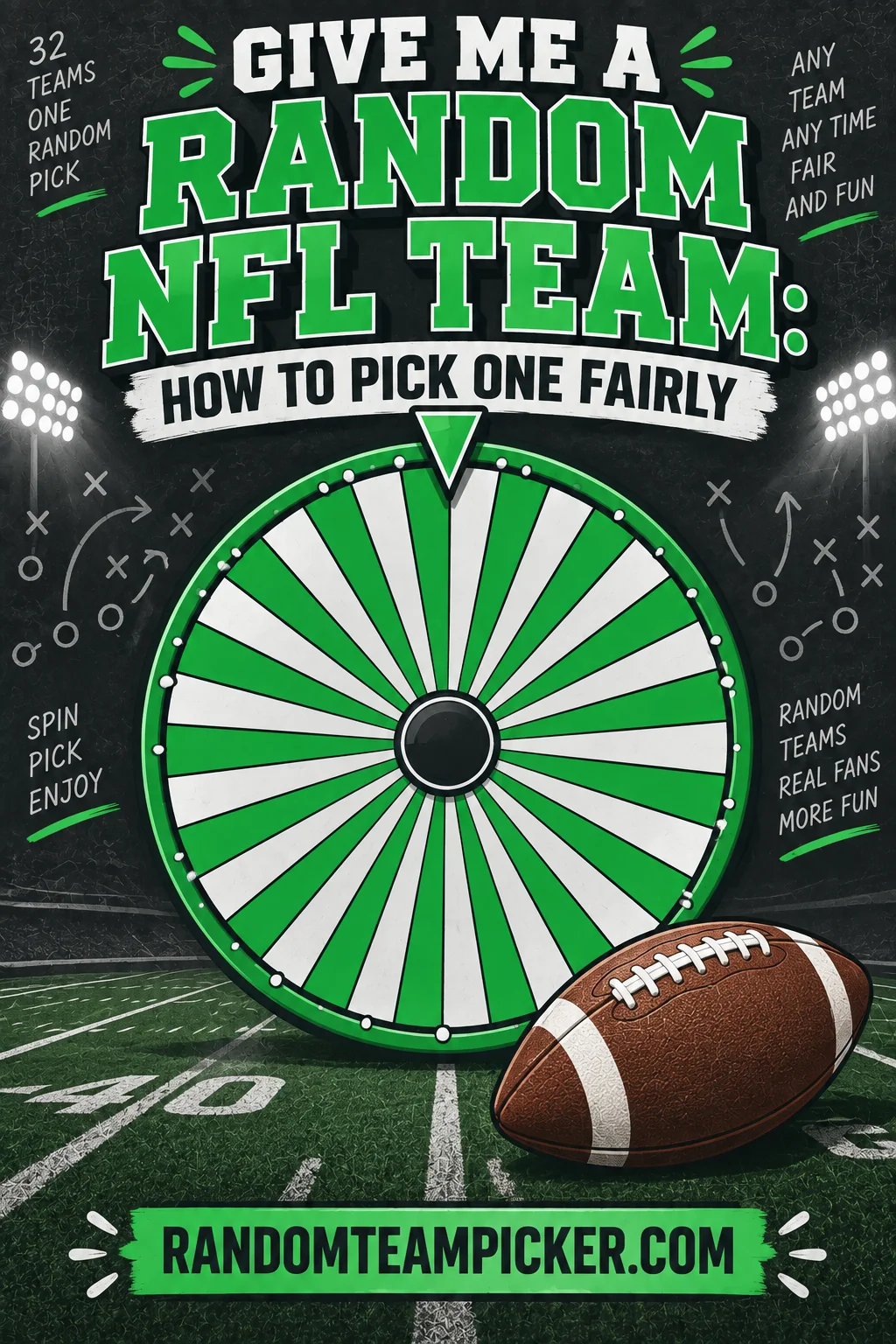
A spinning wheel. A random nfl team wheel divides a circle into 32 equal segments and spins. Functionally identical odds to a generator, but people trust it more because they can watch it happen, which is genuinely useful when a group needs to agree the draw was fair.
Numbered slips. Write all 32 names on identical slips, fold them the same way, and draw blind from a bowl. Slow, but unimpeachable, and it is the only method that works with no devices at all.
Dice. Two ten-sided dice give you 1 through 32 with re-rolls above 32, or roll one die for the conference, one for the division, and one for the team within it. The conference-division-team route is elegant: coin flip, then 1 through 4, then 1 through 4 again. Three quick rolls, perfectly uniform.
A shuffled deck. Assign 32 cards to 32 teams, shuffle properly, cut once, take the top. Overkill for a single draw, ideal when you need to deal out teams to a whole group in one pass.
Drawing for a Group Without Repeats
Single draws are easy. Group draws are where people get it wrong, because they draw one team, put it back, draw again, and hand two people the same franchise.
For a group, you want a draw without replacement. Every team removed from the pool once it is assigned. The cleanest low-tech version is the shuffled-deck method: shuffle all 32, deal one to each player, done in one pass with no duplicates possible.
If you are using a generator, run it once per person and skip any repeat rather than accepting it. Skipping keeps the remaining draws fair, because each subsequent pick is uniform across the teams still available.
There is one wrinkle worth flagging. Draw order does not affect anyone's odds when you remove used teams. The first pick and the last pick are equally fair in the sense that nobody has better odds of any particular team — but the last picker has no choice left at all if you are drawing for exactly 32 people. For groups under about ten, this never comes up. For a full 32-person league draft, run the whole shuffle at once and reveal it, rather than picking sequentially, so nobody sits through a countdown to a foregone conclusion.
The League You Are Drawing From
There are 32 clubs, split into two conferences of sixteen, and each conference is divided into four divisions of four teams.
| Conference | Divisions | Teams per division | Total |
|---|---|---|---|
| AFC | East, North, South, West | 4 | 16 |
| NFC | East, North, South, West | 4 | 16 |
That structure gives you a clean tiered draw if you want one. Flip a coin for the conference, roll a four-sided outcome for the division, roll again for the team. Every one of the 32 comes out at exactly 3.1%, and it feels more ceremonial than a single number, which matters when a group is watching.
The structure also shapes what you get. Divisions decide who a team plays twice a year, which decides who its fans learn to dislike. Getting assigned a team means inheriting three rivalries you did not choose, and that is the part that makes a random assignment feel like a real allegiance a few weeks in.
Why People Want One
Settling something. Two people disagree, neither wants to concede, and a random team breaks the tie without either of them having chosen it. Fairness is the entire point here, so use a method both can watch.
Season-long games. Friends assign each other a franchise and follow it for a year, scoring on wins or on how badly the assignment goes. This needs a draw without repeats and a rule agreed before the draw about what happens if two people want to swap.
Video game franchise modes. Players who always rebuild the same club use a draw to force themselves somewhere unfamiliar. This is the most common reason people search for an nfl random team generator, and it is a good use — the whole appeal is being handed a roster you would never have picked.
Picking a team to actually follow. Someone new to the sport, or someone who moved and has no local allegiance. A draw is a legitimate starting point, though it is worth knowing that most people who do this end up either loving the randomness of it or quietly swapping within a month. Both are fine.
Classroom and group activities. Teachers assigning research topics, or a group splitting into supporters for a friendly competition. Here the fairness has to be visible, so a wheel beats a phone in someone's hand.
Choose a Random NFL Team, or Choose Deliberately?
Not every situation calls for randomness, and it is worth being honest about which one you are in. If you want to choose a random nfl team purely to break a tie, take whatever comes out and do not re-draw. Re-drawing until you like the answer is just picking slowly.
If you are choosing a team to follow for years, randomness is a reasonable starting filter but a poor final answer. A better process is to draw three at random, then choose among those three based on what actually sustains fandom: whether you can watch their games at a sensible hour where you live, whether anyone you know follows them, and whether their style of play is one you enjoy watching. The random draw does the useful work of getting you off the fence and away from the obvious bandwagon options. Your own judgment does the rest.
The one thing to avoid is re-drawing repeatedly while pretending it is still random. If you are going to use judgment, use it openly with a shortlist. That is a legitimate method. A rigged draw is not.
What People Type Into Search
The phrasing scrambles constantly and it all means the same thing. Random team generator nfl, nfl random team generator, random nfl team chooser, nfl random team wheel, and plain random team all describe one function: return one of 32 clubs with equal probability. There is no meaningful difference between a chooser, a picker, a generator and a wheel beyond the animation.
The only real question worth asking of any of them is whether the odds are genuinely uniform and whether it can draw without replacement for a group. Those two features cover essentially every use case on this page.
Making a Draw Feel Fair to Everyone
Fairness has two halves: the math and the perception. A generator handles the math. The perception is on you.
Announce the method before the draw, not after. Agreeing in advance that whatever comes out stands is what stops the arguing later.
Let someone else press the button, or use a wheel everyone can see. A draw run entirely on one person's phone, with the result announced afterward, will be questioned even when it was perfectly clean.
Decide the re-draw rule up front. Either there are no re-draws, or there is exactly one under a named condition, such as a duplicate in a group draw. Deciding this mid-draw is where friendships get tested.
Write the results down as they come out. In a group of eight this sounds unnecessary and by the third week of a season-long game it will not be.
Variations on a Straight Draw
Not every draw should be uniform, and it is worth knowing which variation fits your situation.
Conference-locked draws. Two friends each want a team, and neither wants to be in the same conference as the other. Draw one team, then draw the second from the sixteen clubs in the opposite conference. The odds within each pool stay even, and you get a guaranteed cross-conference matchup to argue about.
Division draws. Assign four friends the four teams of one randomly chosen division. Every one of them plays the other three twice a season, so the whole group has a built-in rivalry from week one. This is the best format for a season-long game among a small group, and almost nobody thinks of it.
Weighted draws. Occasionally you want the odds tilted — a franchise-mode player who wants a rebuilding challenge might exclude recent playoff teams from the pool. That is a legitimate choice, but say so out loud. A weighted draw described as random is the thing that causes arguments.
Draft-order draws. For a group game, randomize the pick order first and then let people choose teams in that order. This is a hybrid: the fairness lives in the order, and the choosing lives with the players. It suits groups where people care which team they get, since a fully random assignment tends to produce one person who is quietly miserable all season.
Redraw-on-rejection. Every player gets exactly one rejection, used immediately or lost. It softens a harsh draw without turning the process into shopping, and it dramatically improves how a season-long game feels by about week four.
Things That Are Not Random
A few methods look random and are not. Picking the team whose city is nearest to where a dart lands on a map heavily favors clusters — several regions have two or three clubs within a short drive, and large stretches of the country have none. Alphabetical position, jersey numbers, and anything tied to last season's standings all carry the same problem: the structure of the underlying data is uneven, so the outcome is skewed.
Letting the youngest person in the room pick is not random either, it is delegation. That may be fine for your purposes, but call it what it is. The whole value of a genuine draw is that nobody can be blamed for the result, and that value disappears the moment a person made the choice.
Frequently Asked Questions
What are the odds of drawing any specific NFL team? One in 32, or roughly 3.1%, assuming the draw is uniform. Any method that does not give all 32 the same chance — including picking from memory — will skew heavily toward recently televised and locally popular clubs.
Is a wheel more random than a generator? No. Both produce a uniform result from the same pool of 32. A wheel is more convincing to a group because the process is visible, which matters for settling disputes, but the odds are identical.
How do you assign teams to a group without duplicates? Draw without replacement. Shuffle all 32 names and deal one per person in a single pass, or run a generator once per player and skip any repeat. Never draw with the full pool each time unless you actually want duplicates allowed.
Should you re-draw if you dislike the team you get? Not if the draw was meant to settle something — re-rolling until you are happy is just choosing. If you are picking a team to follow long term, draw three at random and choose among those three openly. That is honest, and it still avoids the bandwagon problem.