Random Team Generator vs Manual: Which Is Fairer and Faster?
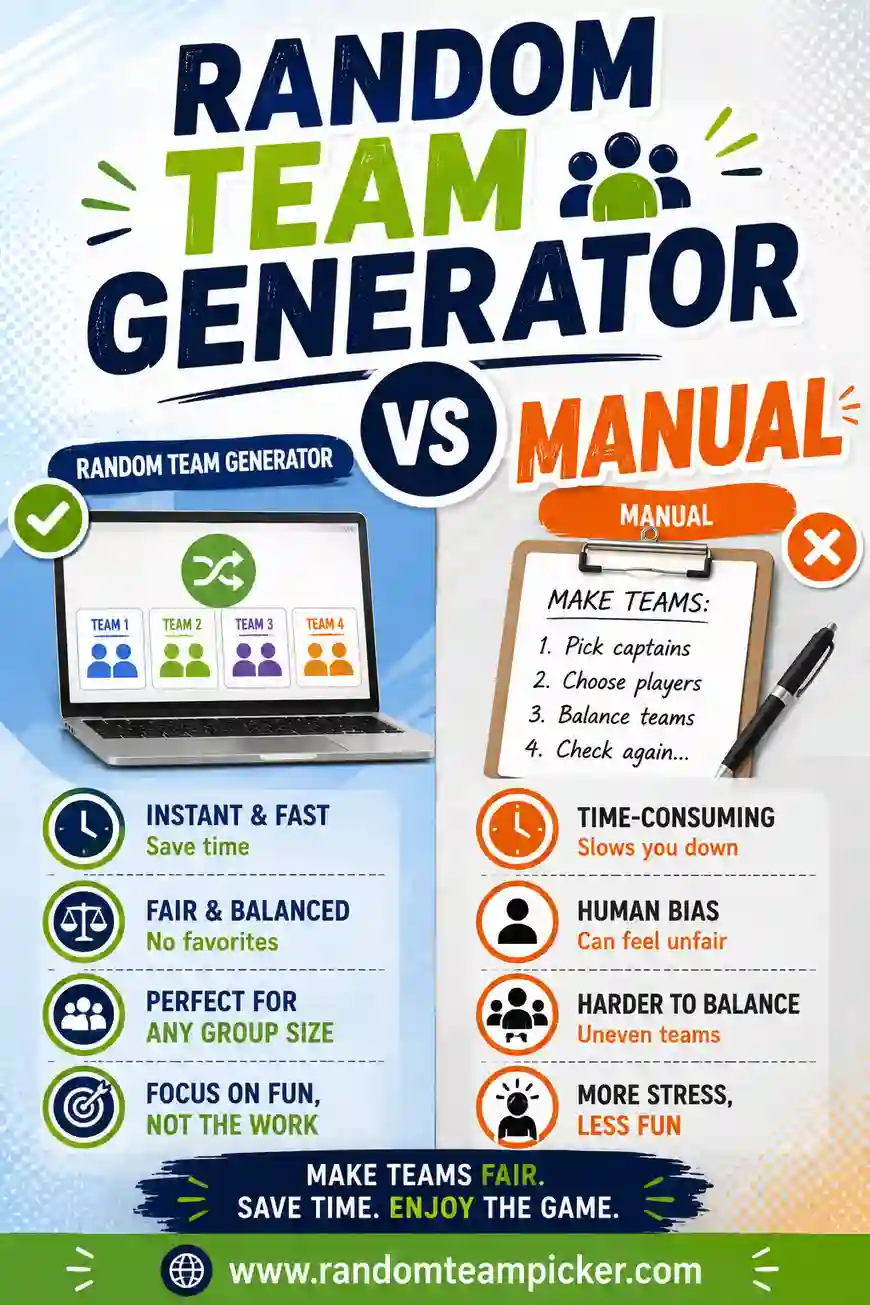
A random team generator beats splitting teams by hand on both speed and fairness. It shuffles your whole list and deals everyone into balanced groups in one click, with no bias about who ends up where. Doing it manually — captains picking players, or you sorting names yourself — is slower and quietly favors friends and favorites. For fair teams fast, use a random team generator.
Want to see the difference yourself? Open the free team picker, paste your names, choose your groups, and compare how quick and neutral it feels versus sorting by hand. No sign-up, no download, done in seconds.
The Short Answer
If you want fair teams without spending much time or making anyone feel bad, a random generator wins. Here's why in one breath: it's faster, it's genuinely unbiased, it produces even group sizes, and nobody can accuse you of playing favorites because a computer made the call.
Manual splitting still has its place — a tiny group, a moment when you want captains to feel in charge, or when there's no device around. But for most situations, from classrooms to pickup games to team-building, a random team generator is the better default.
Let's break down exactly where each method wins and loses.
Speed: It's Not Close
Manual splitting eats time you often don't have.
Sorting a group by hand means writing or reading each name, deciding where it goes, keeping a running count so groups stay even, and double-checking you didn't skip anyone. For a class of 30 or a party of 20, that's several minutes of fiddly work — and you do it all over again if plans change.
A random generator collapses all of that into one action. You paste the list, choose your groups, and it deals everyone out instantly. Change your mind about the number of teams? One click reshuffles the whole thing.
Here's the rough time difference:
| Group size | Manual splitting | Random generator |
|---|---|---|
| 8 people | 1–2 minutes | Under 5 seconds |
| 20 people | 3–5 minutes | Under 5 seconds |
| 30+ people | 5+ minutes | Under 5 seconds |
| Reshuffle | Start over | One click |
Speed alone is a strong argument, but fairness is where the gap really shows.
Fairness: The Hidden Bias in Manual Splitting
You probably don't mean to be biased. Almost nobody does. But when you sort teams by hand, small preferences sneak in.
- You put people who get along on the same side.
- You keep the two kids who chat apart — which everyone notices.
- You unconsciously balance toward the outcome you already expect.
- Captains pick their friends first and the strongest players early.
None of that is malicious. It's just how human judgment works. The trouble is that students, players, and coworkers can feel it, and "you always put them together" is a complaint you don't want.
A random generator removes bias entirely. Every person has the same odds of landing anywhere. The result is neutral, and — this is the key part — it feels neutral to everyone involved. That perception of fairness is worth a lot, especially with kids.
The "picked last" problem
Captains-choosing-players deserves a special mention. It's a tradition in gym class and pickup games, but being chosen last is a small, public sting that some people remember for years. Random splitting spares everyone that moment. Nobody is ranked out loud. For youth and casual settings especially, that kindness matters.
Even Group Sizes Without the Math
When you split by hand, keeping groups even is your job. You have to count, notice when one group is getting big, and shuffle people around. With an odd total, you have to decide where the extra people go.
A team generator handles all of that for you. Ask for four groups and it makes four as-even-as-possible groups automatically. With a number that doesn't divide cleanly, it spreads the extras one per group so you never get one giant team and one tiny one. No counting, no mental math, no lopsided results.
Where Manual Splitting Still Makes Sense
To be fair, hand-picking isn't always wrong. There are a few times it's the right call.
- Very small groups. Splitting four people into two pairs by eye is instant. No tool needed.
- When captains should feel ownership. In some team cultures, letting leaders pick builds buy-in — as long as you manage the "picked last" issue.
- No device handy. Slips of paper in a hat work when there's no phone or internet.
- Deliberate, thoughtful groups. Sometimes you genuinely need to place specific people together for a reason (a mentor with a newcomer, say). That's a judgment call a randomizer can't make.
Even then, a common trick is to start random and make one or two intentional swaps. You get most of the speed and fairness, plus the handful of deliberate placements you actually need.
Head-to-Head Comparison
Here's the full picture side by side.
| Factor | Manual Splitting | Random Team Generator |
|---|---|---|
| Speed | Slow, scales badly | Instant, any size |
| Bias | High (unconscious) | None |
| "Feels fair" | Often questioned | Widely accepted |
| Even sizes | Manual counting | Automatic |
| Reshuffle | Start over | One click |
| Handles odd numbers | You decide | Spreads extras evenly |
| Best for | Tiny groups, no tech | Most everyday splits |
| Cost | Free | Free |
The pattern is hard to miss. For anything beyond a handful of people, the generator wins on every practical measure.
How to Switch to a Random Generator in 4 Steps
If you're used to sorting by hand, moving to a tool is easy.
- Gather your names. Have your list ready — a roster, a sign-up sheet, or just who showed up.
- Paste them in. Drop the names into the team picker, one per line.
- Set your groups. Choose how many teams you want, or set a team size.
- Shuffle. One click gives you balanced, random groups. Reshuffle if you like.
That's the whole switch. Most people never go back to sorting by hand once they see how fast it is.
Common Worries About Random Teams (Answered)
A few concerns come up when people move away from manual picking. Here's the honest take.
"What if random makes an unfair matchup?"
It can occasionally cluster stronger players by chance. The fix is simple: reshuffle once, or make a single swap. Over multiple games, random naturally mixes people, so it evens out.
"Won't people miss picking their own teams?"
Sometimes, a little. But most groups quickly appreciate not having to negotiate, and nobody misses being picked last. The speed and neutrality usually win people over fast.
"Is a computer's random really random?"
Yes — more consistently random than a human, who has patterns and preferences whether they realize it or not. A generator gives everyone equal odds every time.
Real Situations: Which Method Fits
It helps to picture how each method plays out in the moments you actually face.
The Monday project groups
You need six project groups from a class of 30, and you need them before the bell. Sorting by hand means counting heads, remembering who works well together, and fielding "can I be with…" requests. A generator hands you six even groups in one click, and "the computer decided" shuts down the negotiations. Random wins here easily.
The Saturday pickup game
Twelve people show up to play. Captains-picking drags out the start and leaves someone feeling picked last. Paste the twelve names, split into two, and you're playing in seconds with sides nobody can argue about. Random wins.
The four-person carpool
You just need to split four friends into two cars. You'll do it in your head faster than you'd open any tool. Manual wins — this is exactly the tiny-group case where a randomizer is overkill.
The workshop breakouts
Twenty coworkers, and you want them to mix rather than sit with their usual desk-mates. Sorting by hand, you'd unconsciously keep teams together. A generator scatters people across groups so the mixing actually happens. Random wins.
The through-line: the bigger the group and the more fairness matters, the more a random generator pulls ahead. Only the smallest, simplest splits favor doing it by hand.
Which Should You Choose?
For the vast majority of situations — classrooms, pickup sports, parties, workshops, team-building — a random team generator is the better tool. It's faster, fairer, produces even groups, and takes the awkwardness out of dividing people. Reserve manual splitting for tiny groups, moments when captains genuinely add value, or when there's no device around.
If you want to explore your options, our roundup of the best free group randomizers covers the top free tools, and our classroom grouping guide digs into the teaching angle.
FAQ
Is a random team generator fairer than picking teams manually?
Yes. A generator gives everyone equal odds and removes the unconscious bias that creeps into hand-picking, like keeping friends together or ranking players. It also feels fair to the group because a computer made the call, which cuts down on complaints.
Is a random generator faster than splitting by hand?
Much faster. Manual sorting of 20 or 30 people takes several minutes and careful counting. A random team generator does the same split in under five seconds, and reshuffling is one click instead of starting over.
When is manual team splitting better?
Manual works fine for very small groups, when you want captains to feel ownership, when there's no device available, or when you need to place specific people together for a reason a tool can't judge. For most everyday splits, though, random is better.
Do random teams end up balanced?
In size, yes — a good generator makes even groups automatically and spreads odd numbers out one per team. For skill balance, random mixes players fairly over multiple games; if you need strict skill-balancing, that's a separate, more advanced feature.
Can I still make a few deliberate choices with a generator?
Yes. A common approach is to shuffle for a fast, fair base, then make one or two intentional swaps if you need a specific placement. You keep most of the speed and neutrality while handling the exceptions by hand.
Is a random team generator free?
Our team picker is completely free with no sign-up. You can split any size group into balanced random teams as many times as you like at no cost. There's nothing to download or install.
The Bottom Line
Splitting teams by hand is slow and quietly biased. A random team generator is fast, neutral, and produces even groups with one click — and everyone accepts the result because it's genuinely fair. For classrooms, sports, parties, and meetings, it's the better default. Open the free team picker, paste your list, and see how much easier fair teams can be. It's free, there's no sign-up, and every split is truly random. For more, compare the best free group randomizers or read up on team pickers vs name picker wheels.