Holiday Team Name Generator: Christmas, Halloween & Thanksgiving Team Names
Holiday Team Name Generator
Pick a season and a style, generate a batch, then split your players into teams and print the roster.
A holiday team name works the same way any team name works: an unexpected modifier in front of a concrete noun. Frosted Nutcrackers reads as a team. Team Christmas does not, because anybody could claim it and it puts no picture in anybody's head. The season only changes the word bank.
The generator above applies that formula to five seasons and three styles, and it will also split your players into even teams and print the roster. Everything below is what to do with the names once you have them.
Why Holiday Names Are Easier Than Ordinary Ones
Christmas, Halloween and Thanksgiving all come with a ready-made vocabulary that everyone in the room already shares. Nobody needs the reference explained. A quiz team called Unbuttoned Turkeys lands instantly in late November in a way that the same joke would not in March.
Halloween is the strongest of the five, because its nouns are already vivid: ghouls, ravens, gravediggers, banshees, poltergeists. Half the work of a good team name is picking a noun with a picture attached, and Halloween hands you two dozen of them.
Christmas is the funniest, because it is the only season where the objects are inherently silly. Sprouts. Fruitcakes. Baubles. Putting a menacing modifier in front of a mildly ridiculous noun is where most of the laughs come from, which is why Feral Sprouts works better than Feral Wolves.
New Year is the sharpest, because the whole season is about intentions people know they will not keep. Gym Memberships Pending gets a laugh from a room of adults every time, and it needs no setup at all.
The Three Styles and When to Use Them
Classic
A modifier and a noun that do not belong together. This is the default because it produces the widest range and the highest hit rate, and because it sounds like a team rather than a joke. Use it for anything competitive, anything sporting, or any group where somebody will be shouting the name across a hall.
Alliterative
Both words share a first letter. Frosted Fruitcakes. Wicked Werewolves. These are noticeably easier to chant and noticeably easier to remember, which matters if the name has to survive being announced once at the start of an evening. The trade-off is a smaller pool, since only some combinations line up.
Use it for children, for large events with many teams, and for anything with a scoreboard, because an alliterative name is the one people can still recall at the end.
Wordplay
The curated puns for each season. These are the names that get read out and get a laugh, and they are what most people are actually looking for when they search for a holiday team name. They do not follow the formula, because a good pun does not need to.
One caution: a pun is funny once. For a single quiz night that is exactly right. For a league that runs all season, a classic name wears better.
Picking One Without Losing Twenty Minutes
Team-name discussions get worse the longer they run. A group starts with the funniest option and slowly converges on whichever name nobody objects to, which is almost never the good one.
The method that works: generate a batch, read them aloud, and take the first one that makes somebody laugh. Then stop. Reading aloud matters, because a name that looks good written down can land flat when spoken, and it is spoken every time it is used.
If a group genuinely cannot decide, generate six and vote once, with no second round. A vote takes ninety seconds. A discussion takes twenty minutes and leaves somebody annoyed.
For a quiz night, do not choose in advance. Generate at the table while the first round is being handed out. The best team names have always been decided in about four seconds while the quiz master is waiting.
Christmas and Office Party Team Names
The December office quiz is the single most common use of this, and it has one constraint the others do not: the name will be read out by somebody from management, printed on a scoreboard, and possibly photographed.
Names that clear that bar and still get a laugh: Unbuttoned Turkeys, Last-Minute Shoppers, Feral Sprouts, Naughty List Regulars, Tinseled Chimneys, Overfed Reindeer. Each one is a joke about the season rather than about a person, which is the only reliable test.
For a family Christmas, the constraint reverses and you can be much sillier. Gingerbread Grinches and Roasting Chestnuts both work, and a family will happily take a name that means nothing to anybody outside the room.
Christmas is also the season where the wordplay style earns its keep. Fleece Navidad and Sleigh My Name get the biggest reaction of any names in this generator, and December is the one month of the year they make sense.
One thing to decide early: whether teams keep the same name across the evening's games. Keeping it makes the scoreboard readable and lets a rivalry build. Changing it between games is more fun but nobody can remember who is winning.
Halloween Team Names
Halloween has the best raw material of any season, because its nouns already carry a picture. You do not have to work to make Gravediggers or Poltergeists interesting.
Strong classic pairings: Bewitched Gravediggers, Shrieking Scarecrows, Withered Bats, Restless Mummies, Feral Black Cats, Moonlit Banshees. Put any of those on a scoreboard and they read as a team immediately.
For a Halloween quiz specifically, the wordplay list is what most people are looking for. Squad Ghouls, Creepin It Real, Fangs for the Memories and Trick or Trivia all turn up at real quiz nights, and they turn up because they work.
With children, dial the menace down. Skeletal and Unholy are a bit much for a class of seven-year-olds. Stick to the sillier nouns, pumpkins, owls, lanterns and black cats, and use the alliterative style, which children pick up faster and repeat more.
Thanksgiving, Winter and New Year
Thanksgiving names are almost all about food and about eating too much of it, which is a joke every single person at the table is in on. Stuffed Pilgrims, Unbuttoned Drumsticks, Napping Casseroles, Gravy-Soaked Wishbones. The wordplay list runs to Pie Hard and Yam What I Yam, both of which are older than anybody using them and still get a laugh.
Winter is the one to use when the event is in January or February and Christmas has passed. Frostbitten Toboggans and Shivering Radiators are seasonal without being tied to a holiday, which makes them the right choice for a school term, a sports league or anything running past the new year.
New Year is built entirely on the gap between intention and behavior, which makes it the sharpest of the five with a room of adults. Gym Memberships Pending, Last Year's Model and Well-Intentioned Do-Overs all land instantly and need no explanation at all.
Team Names for Children
Children's teams follow different rules from adult ones, and getting it wrong is the difference between a name a class chants all afternoon and a name the teacher has to keep repeating.
Shorter is better. Two words, and ideally two short ones. A seven-year-old will not use a name they cannot say quickly while running.
Alliteration wins. It is genuinely easier to remember and much easier to chant. Wicked Werewolves beats Bewitched Werewolves for a class every time, even though the second is the better joke.
Let them pick from a shortlist. Generate six, put them on the board, and let each team choose in order. A name a team chose is a name they defend. A name assigned to them is a name they ignore.
Avoid anything frightening. The Halloween word bank includes some genuinely dark words. For younger children stick to the pumpkins and owls end of the list, and consider using the winter theme instead, which is entirely safe.
The roster is worth printing for a class even when you would not bother for adults. Pinning a sheet to the wall settles every argument about who is on which team, permanently, in a way that saying it out loud does not.
Names That Cause Problems
Anything aimed at a person. A name that is a joke about a specific colleague, teammate or classmate is funny to everybody except one person, and that person remembers it far longer than anyone else does.
Anything that needs explaining. If the name only works once you have told a story, it is an in-joke rather than a team name. It will be misread on the scoreboard and mispronounced by whoever is reading out the results.
Adjective-only names. Team Awesome, The Unstoppables, The Legends. They claim something rather than picture something, and every event has three of them.
Anything you would not want read out. At a work event this is the only test that matters, because at some point somebody senior will read the scoreboard aloud. A mild joke about the work itself is the safe zone and it is usually funnier than the alternative anyway.
Very long names. Anything over about four words gets shortened by whoever is keeping score, and the shortened version is rarely the funny part.
Using the Roster
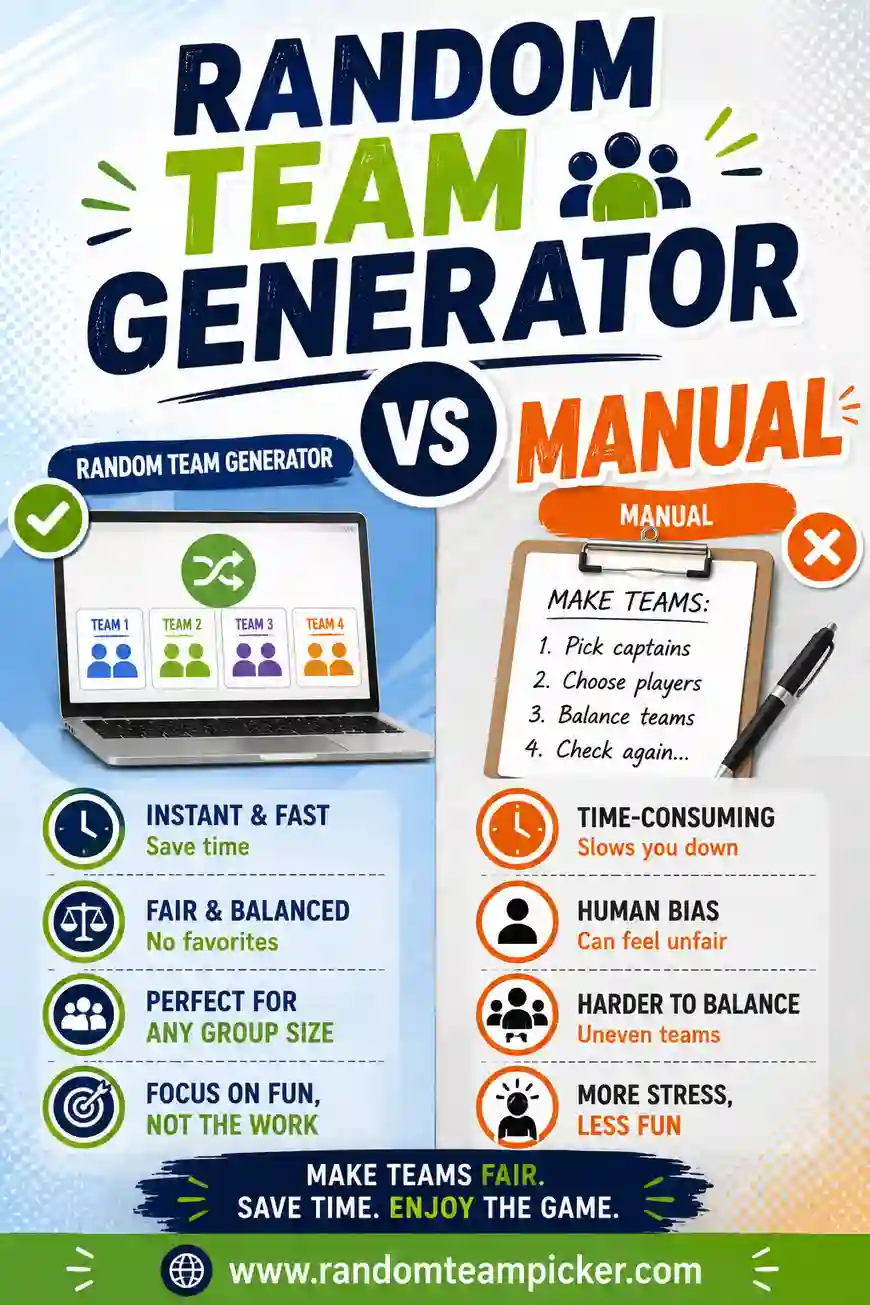
The second half of the tool splits your players into even teams and gives each team one of the generated names. Paste the names in one per line, pick how many teams you want, and it shuffles and deals them out.
It deals round robin rather than in blocks, which matters more than it sounds. Blocks tend to follow the order people were typed in, and people get typed in by table, by family or by friendship group, which produces exactly the uneven teams you were trying to avoid. Dealing one at a time breaks up whatever order the list arrived in.
An odd number of players leaves one team a person short, which is normal and fine for a quiz. For anything physical, give the short team the choice of who goes twice rather than assigning it, because a team that picked its own extra player does not complain about it.
Print the roster and put it on a wall. Reading team assignments off a phone means saying every name twice and answering the same question four times. A sheet on a wall answers it once.
Nothing you type is saved or sent anywhere. It stays in this browser tab, so closing the page loses the roster. Print it if you want to keep it.
How Many Teams to Make
For a quiz, four to six players a team is the sweet spot. Fewer than three and the team has gaps in its general knowledge that nothing can cover. More than six and the quiet people stop contributing, because there is always somebody faster to answer.
For party games, smaller is better. Three or four keeps everybody involved and keeps the waiting short. Minute-length games in particular fall apart with big teams, because most of the room is watching rather than playing.
For anything with a physical element, keep team sizes equal even if it means somebody sits out a round. An extra body is a real advantage in a relay and it will be noticed.
With a very large group, more teams beats bigger teams. Ten teams of four runs better than four teams of ten, as long as you have the space, because everybody is doing something at once.
Reusing the Same Names Next Year
Teams get attached to names. If your office quiz runs every December, the team that was Frosted Nutcrackers last year will want to be Frosted Nutcrackers again, and that continuity is worth more than a fresh name.
Write them down at the end of the night. A photograph of the printed roster on somebody's phone is enough, and it saves the whole conversation next year.
If a team wants to keep its name but the season has changed, keep the noun and change the modifier. Frosted Nutcrackers becomes Cursed Nutcrackers at Halloween and Stuffed Nutcrackers at Thanksgiving. The team stays recognizable and the joke refreshes itself.