How Many People Per Team Is Best? (A Simple Guide)
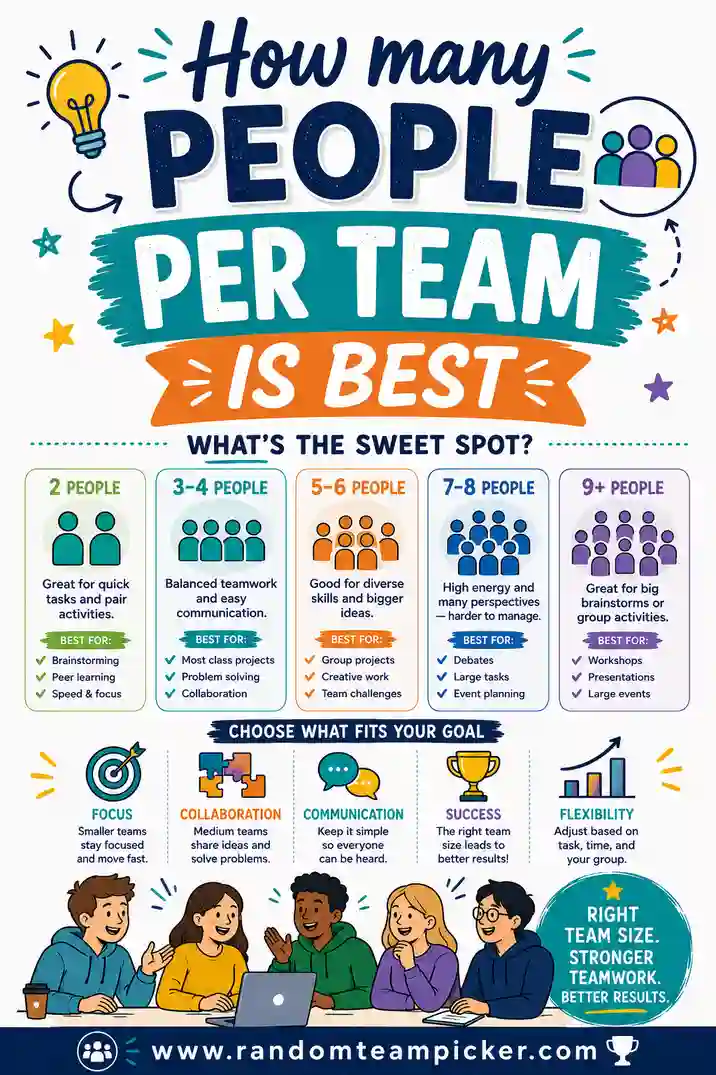
For most activities, three to five people per team is best. That range is big enough to share the work and spark ideas, but small enough that everyone stays involved and nobody hides. The exact number depends on your activity: quick games do well with two or three, while big projects can handle four or five. The fastest way to hit your target is a free random team picker: set your team size and it splits your whole list evenly.
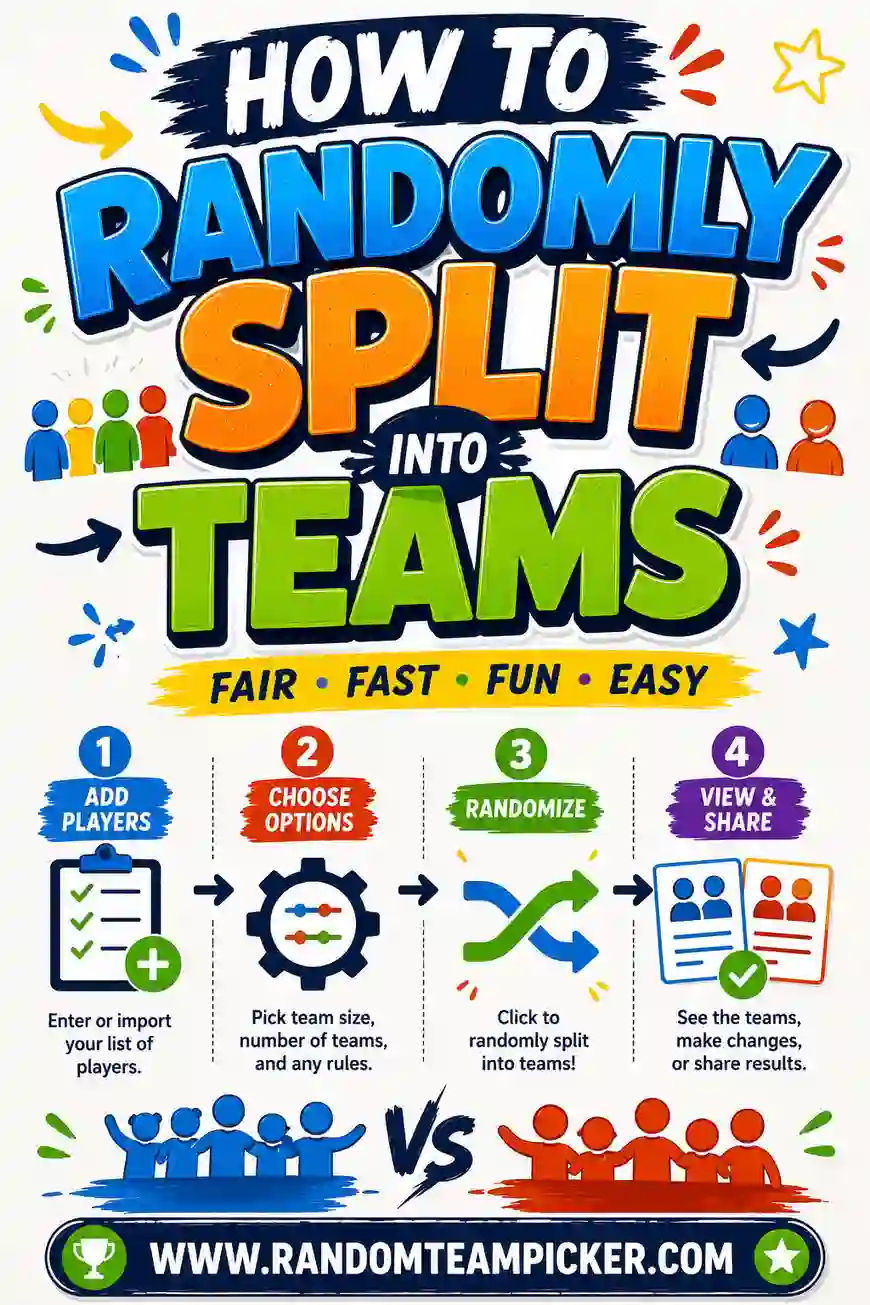
Want the even split right now? Open the free team picker, paste your names, choose how many per team, and it does the math for you. No sign-up, no leftover-person headaches, no manual counting.
The Short Answer: Three to Five
If you only remember one thing, remember this range. Three to five people per team is the reliable sweet spot for classrooms, offices, and most games. Here's why it works so well:
- Everyone has a role. Small enough that no one can coast unnoticed.
- Enough hands for the job. Big enough to split the workload without crushing anyone.
- Fast decisions. Small teams agree quickly; big teams argue.
- Real communication. Everyone gets heard, which rarely happens in a group of eight.
Four is often the single best number for a graded project. Two pairs can split work, and there's still a tiebreaker if the group has to vote on something.
Why Bigger Teams Aren't Better
It's tempting to think more people means more done. Usually the opposite is true. As a team grows, a few problems creep in.
Social loafing
The bigger the team, the easier it is for someone to quietly do nothing and let others carry the load. Researchers have a name for this: social loafing. In a team of three, there's nowhere to hide. In a team of eight, at least one person will disappear.
Coordination drag
Every extra person adds communication lines. Three people have three connections to manage; six people have fifteen. Past five or so, teams spend more time coordinating than doing.
Fewer chances to speak
In a big group, the loudest voices dominate and quieter people check out. Smaller teams give everyone room to contribute, which is usually the whole point of teamwork.
The takeaway: unless the task genuinely needs many hands, keep teams small.
Ideal Team Size by Activity
Different activities have different sweet spots. Here's a quick reference.
| Activity | Ideal team size | Why |
|---|---|---|
| Class group project | 3–4 | Shared workload, everyone has a job |
| Quick in-class task | 2–3 | Fast, hands-on, no coasting |
| Office project | 4–6 | Room for varied skills |
| Brainstorming | 4–5 | Enough ideas without chaos |
| Trivia / quiz game | 4–6 | More knowledge, more fun |
| Relay / active games | 4–8 | Keeps everyone moving |
| Debate | 2–3 per side | Clear roles, sharp arguments |
| Escape room | 4–6 | Enough eyes on the puzzles |
Use this as a starting point, then adjust for your group and your goal.
How Many Teams Should You Make?
Sometimes you know your headcount and just need to decide how to split it. Here's a simple way to think about it: divide your total by your target team size.
- 20 people, teams of 4 → 5 teams
- 30 people, teams of 5 → 6 teams
- 12 people, teams of 3 → 4 teams
- 25 people, teams of 4 → 6 teams (with one team of 5 or a spare)
The team picker does this division for you and spreads any leftover people so the teams stay as even as possible. You can set either the number of teams or the size per team, whichever you're anchoring on.
When your number doesn't divide evenly
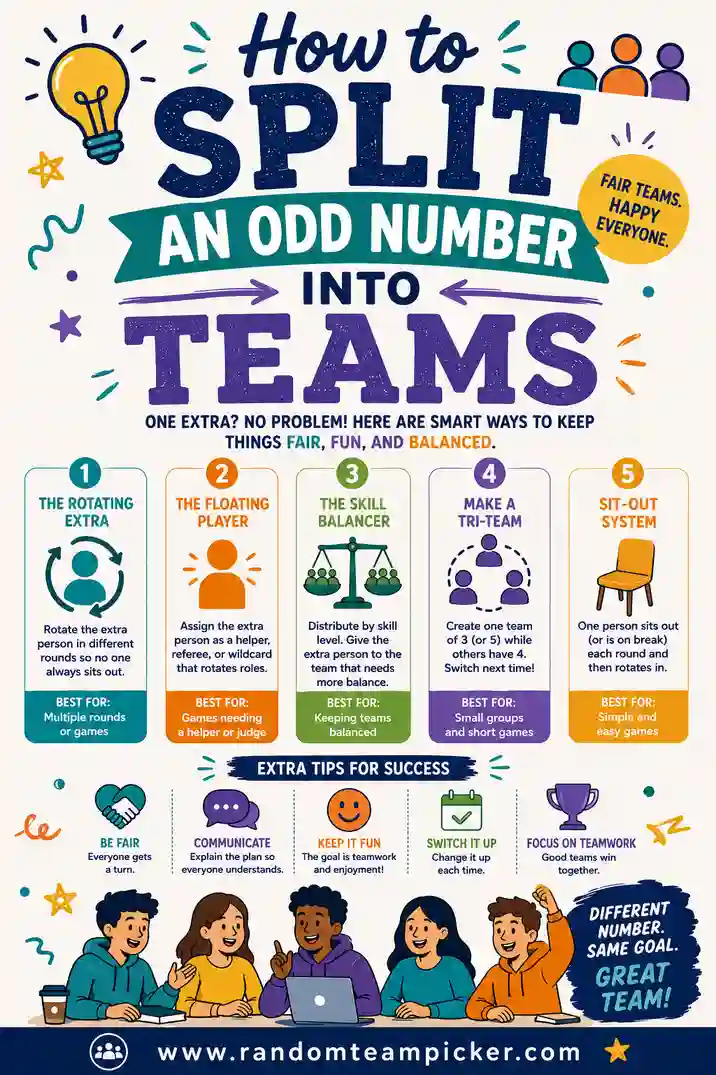
Most real groups don't split cleanly, and that's fine. The standard fix is to let one or two teams be a person larger or smaller than the rest. It barely affects fairness. If you want every case spelled out, our guide on how to split an odd number into teams walks through the options.
Special Cases: When to Break the Rule
The three-to-five range covers most situations, but a few call for something different.
Pairs (teams of 2)
Best for peer work, quick discussions, and debates where you want maximum accountability. Nobody can hide in a pair. The downside is you lose the mix of perspectives a bigger team brings.
Large teams (6+)
Sometimes you genuinely need more hands, like a big event build or a large sports side. When you go big, assign clear sub-roles or split into sub-groups so the team doesn't drift into social loafing. Structure is what keeps a large team productive.
Solo work with a team check-in
For some projects, people work alone but report to a small team. This gives individual accountability plus the support of a group. It's a nice middle path for research-heavy work.
Balancing Size With Skill
Size isn't the only thing that matters. Two teams of four can still be lopsided if all the strong players land on one. To keep teams fair on both counts:
- Set your size first. Decide three, four, or five per team based on the activity.
- Shuffle randomly. A random split is the fairest starting point and instantly balances by chance.
- Make small swaps if needed. For high-stakes work, glance at the teams and trade one or two people to even out skills.
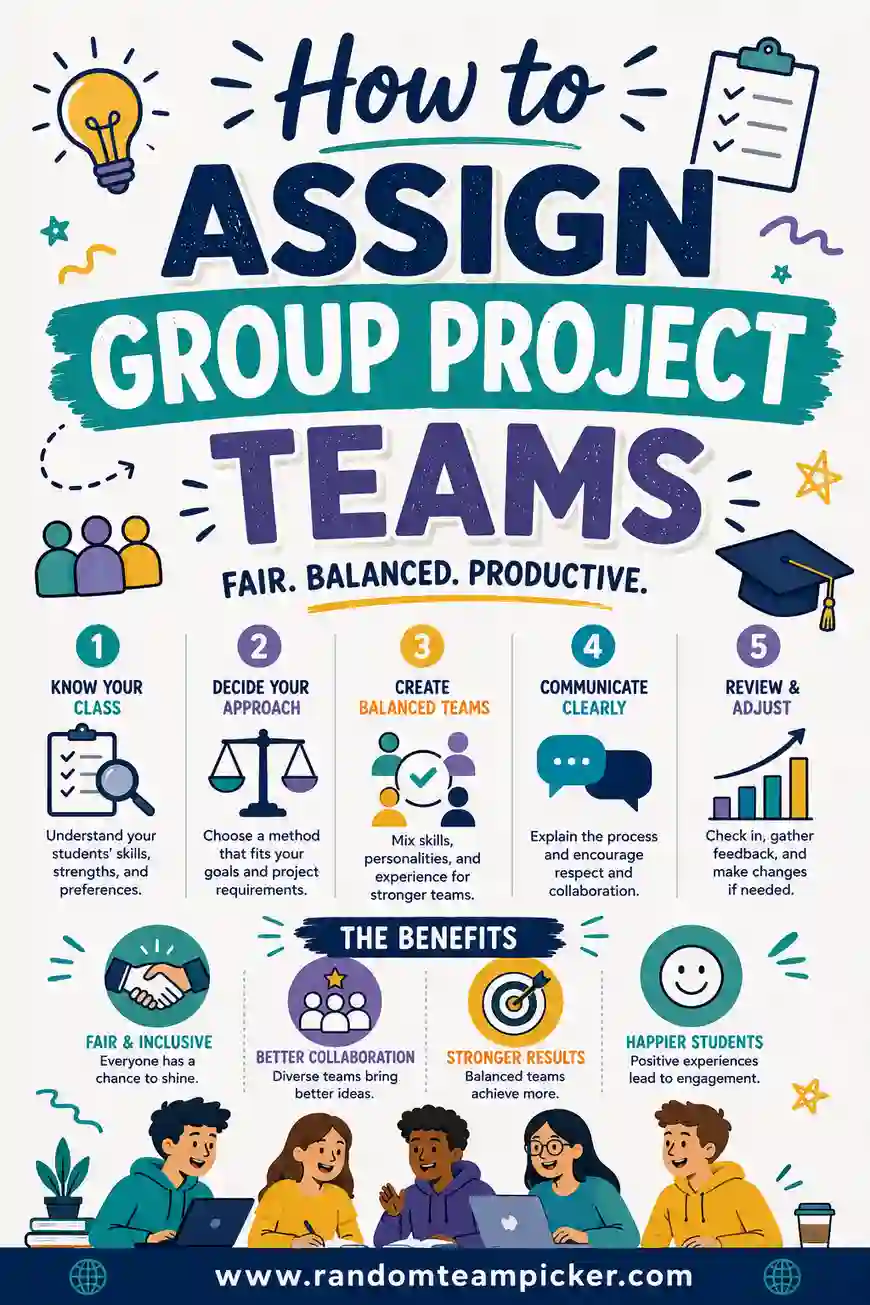
Random assignment handles most of the balancing for you. For anything graded or competitive, that quick swap is the finishing touch. Our guide on how to assign group project teams covers the skill-balancing approach in more detail.
Quick Rules of Thumb
When you're short on time, lean on these:
- Default to four. It's the best all-around team size for projects.
- Go smaller for speed. Two or three for quick tasks and games.
- Go bigger only when the task demands it. And add roles when you do.
- Never exceed six without sub-groups. Past six, teams need internal structure.
- When in doubt, make more small teams than fewer big ones. Small teams almost always outperform.
Keep these in your back pocket and you'll rarely go wrong.
How Team Size Changes the Experience
The number of people on a team doesn't just affect output; it changes how the whole activity feels. Understanding that helps you pick a size on purpose rather than by accident.
Teams of two
A pair is the most intimate team. There's nowhere to hide and no room for a bystander, so accountability is at its peak. Pairs move fast because there's only one other person to agree with. The trade-off is fragility: if the two clash or one is absent, the team stalls. Use pairs when you want maximum focus and personal responsibility.
Teams of three
Three is where real "team" dynamics begin. You get multiple viewpoints and a natural tiebreaker for decisions, but the group is still small enough that everyone stays fully involved. Many teachers consider three the minimum for a group to feel like a group rather than a partnership. It's a fantastic default for shorter projects.
Teams of four
Four is the workhorse size. Two people can pair off on one part of the task while the other two handle another, and you still have an even number for splitting duties. It's large enough to survive one member coasting, yet small enough that coasting is noticeable. If you had to pick one size for everything, four would be it.
Teams of five and up
Five adds a bit more horsepower for research-heavy or creative work, but it's near the ceiling. Once you pass five, the group needs roles and a clear leader or it starts to drift. Beyond six, always split into sub-groups. A "team" of eight is really two teams of four wearing the same jersey.
Reading Your Group Before You Split
Numbers are a starting point, but the people in front of you matter too. Adjust your team size based on a few quick reads:
- Quiet group? Go smaller. In a room of shy people, a team of five leaves the quiet ones silent, while a team of two or three forces gentle participation.
- Chatty, high-energy group? You can go a little bigger; they'll keep each other engaged.
- Mixed experience levels? Smaller teams stop a couple of experts from steamrolling everyone else.
- Tight on time? Smaller teams decide faster. If the clock is short, shrink the groups.
The best organizers treat the "ideal size" as a guideline and then flex it to the room. A random team picker makes that easy: change the size, reshuffle, and you instantly see how the split looks before you commit.
Frequently Asked Questions
How many people per team is best for a group project?
Three to four is best for most group projects. That's enough to share the workload while keeping everyone accountable. Four is often ideal because two pairs can split the work and there's a natural tiebreaker for group decisions.
Is a team of 5 too big?
No, five is fine for many activities, especially office projects, brainstorming, and trivia. It's near the top of the ideal range. Past six, though, you should add clear roles or split into sub-groups to prevent people from coasting.
What's the smallest a team should be?
Two. Pairs work great for peer tasks, debates, and quick discussions because accountability is high. The trade-off is fewer perspectives, so use pairs when focus matters more than variety.
How do I decide how many teams to make?
Divide your total headcount by your target team size. Thirty people in teams of five makes six teams. A team picker does this for you and evenly spreads any leftover people so the groups stay balanced.
Why are smaller teams usually better?
Smaller teams reduce social loafing (people hiding in the crowd), cut coordination overhead, and give everyone a chance to speak. Unless a task truly needs many hands, a smaller team gets more done per person.
Does team size affect fairness?
It can. Uneven sizes give some teams an advantage, so keep them within one person of each other. Size also interacts with skill, so shuffle randomly and make a swap or two if one team ends up stacked.
Ready to Split Your Group Into Even Teams?
Now that you know the ideal size, let the tool handle the math. Open the free random team picker, paste your list, set your team size or number of teams, and get perfectly balanced groups in seconds. It's free, there's no sign-up, and it spreads any leftover people automatically so every team stays even.
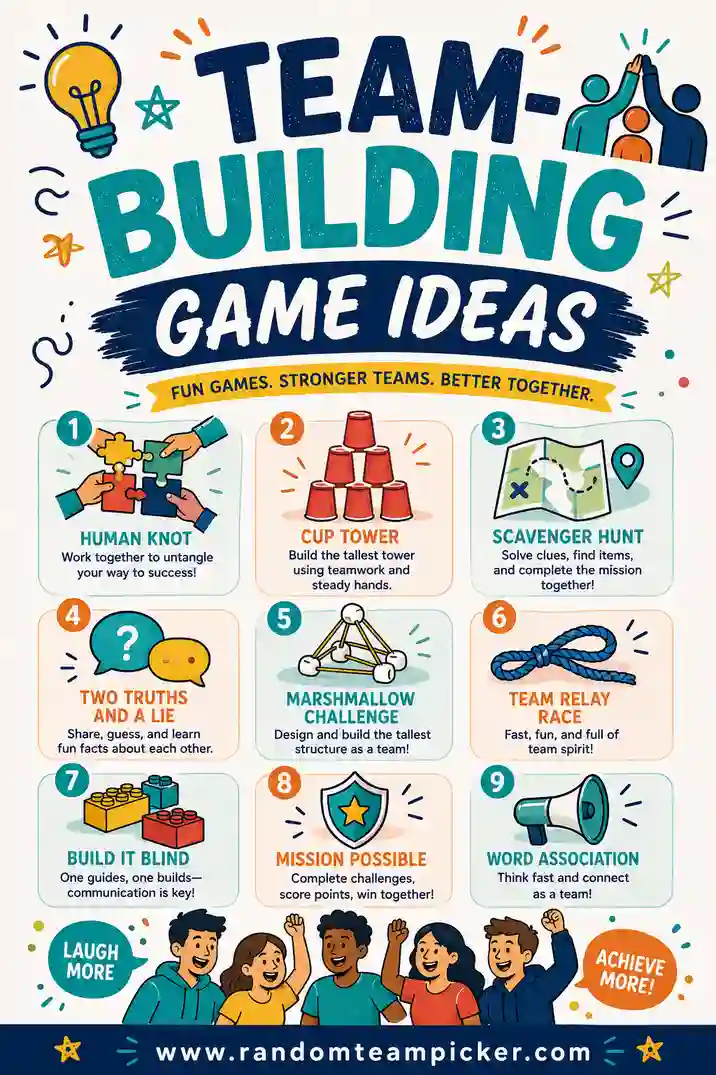
Sorting out the rest of your setup? See how to assign group project teams, how to split an odd number into teams, and some team-building game ideas to play once your teams are set.