How to Split an Odd Number Into Teams (Fairly)
To split an odd number of people into teams fairly, make most teams the same size and let one team be a single person larger or smaller. That one-person difference barely affects fairness, and it beats forcing an awkward split or leaving someone out. The fastest way to do it is a free random team picker: paste your names, pick your teams, and it spreads the leftover people automatically so the groups stay as even as possible.
Want it sorted in seconds? Open the free team picker, drop in your list, and it handles the odd math for you. No sign-up, no counting on your fingers, no one stuck without a group.
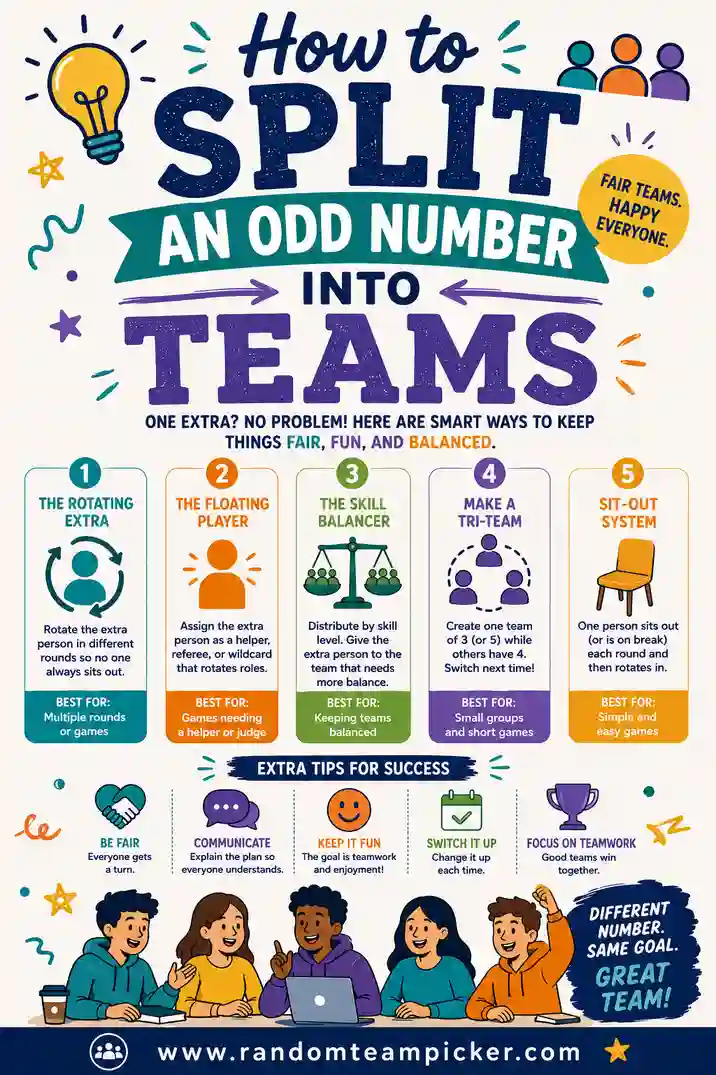
The Simple Rule for Odd Numbers
Here's the whole thing in one sentence: divide as evenly as you can, and put the extra people on separate teams rather than piling them onto one.
Say you have 15 people and want 4 teams. Fifteen doesn't divide by four, so you get teams of 4, 4, 4, and 3. That's the fair answer. The leftover doesn't clump; it just means one team is a hair smaller.
The mistake people make is trying to force a perfectly equal split when the numbers won't allow it. They shouldn't. A one-person gap between teams is normal, expected, and totally fair. Chasing perfect equality just wastes time.
How to Handle the Leftover Person
When your group doesn't divide cleanly, you've got a few good options. Pick the one that fits your activity.
Option 1: Make one team bigger (or smaller)
The simplest fix. If 11 people split into 2 teams, you get 6 and 5. Done. This works for almost everything and is what a team picker does by default.
Option 2: Give the odd person a special role
Turn the leftover into an asset. The extra person can be the referee, scorekeeper, judge, or caller. This is great for games where you need a neutral official anyway. Suddenly the "odd one out" is the most important person in the room.
Option 3: Rotate a floater
For ongoing activities, let one person rotate between teams or sit out one round and swap in the next. Common in pickup sports when you've got an odd number of players. Everyone gets roughly equal play time over the session.
Option 4: The odd person picks
Let the extra player choose which team to join, or use them as a swing player who helps whichever side is losing. Keeps things light and fair.
Which Option Fits Your Situation?
Not sure which to use? This quick guide matches the fix to the setting.
| Situation | Best fix | Why |
|---|---|---|
| Class group project | Uneven team sizes | Simplest; one team of 3 or 5 is fine |
| Pickup sports | Rotating floater | Everyone gets fair play time |
| Board / card game | Odd person as dealer or judge | Needs a neutral role anyway |
| Trivia night | Uneven team sizes | One extra brain barely tips the scale |
| Relay race | Odd person runs twice | Keeps the race even |
| Debate | Odd person as moderator | Perfect neutral role |
When in doubt, uneven team sizes (Option 1) is the safe default. It's fair, fast, and works nearly everywhere.
Working Through Real Examples
Numbers click better with examples. Here's how common odd counts break down.
- 7 people, 2 teams → 4 and 3. Or 3 and 3 with one referee.
- 9 people, 2 teams → 5 and 4.
- 11 people, 3 teams → 4, 4, 3.
- 13 people, 4 teams → 4, 3, 3, 3.
- 15 people, 2 teams → 8 and 7.
- 21 people, 5 teams → 5, 4, 4, 4, 4.
- 25 people, 4 teams → 7, 6, 6, 6.
Notice the pattern: spread the remainder one person at a time across different teams. Never dump all the extras onto one group; that's the only way to make it genuinely unfair.
The quick mental math
Divide your total by the number of teams. The whole-number part is your base team size. The remainder tells you how many teams get one extra person. For 23 people in 5 teams: 23 ÷ 5 = 4 remainder 3, so three teams have 5 and two teams have 4. A team picker does this instantly, but it's handy to know the logic.
Keeping It Fair When Teams Are Uneven
An uneven split is fine, but a little care keeps it feeling fair, especially for competitive activities.
Put the smaller team's strongest players together. If one team has fewer people, a random shuffle usually balances the skill anyway, but you can nudge it. A team of three strong players can absolutely hold its own against four average ones.
Rotate who's short over multiple rounds. Playing several rounds? Make sure the same team isn't always the smaller one. Reshuffle between rounds so the disadvantage (if any) moves around.
Use the odd role fairly. If someone's sitting out as a ref or scorekeeper, rotate that role so no one misses all the fun. Nobody should be the permanent benchwarmer.
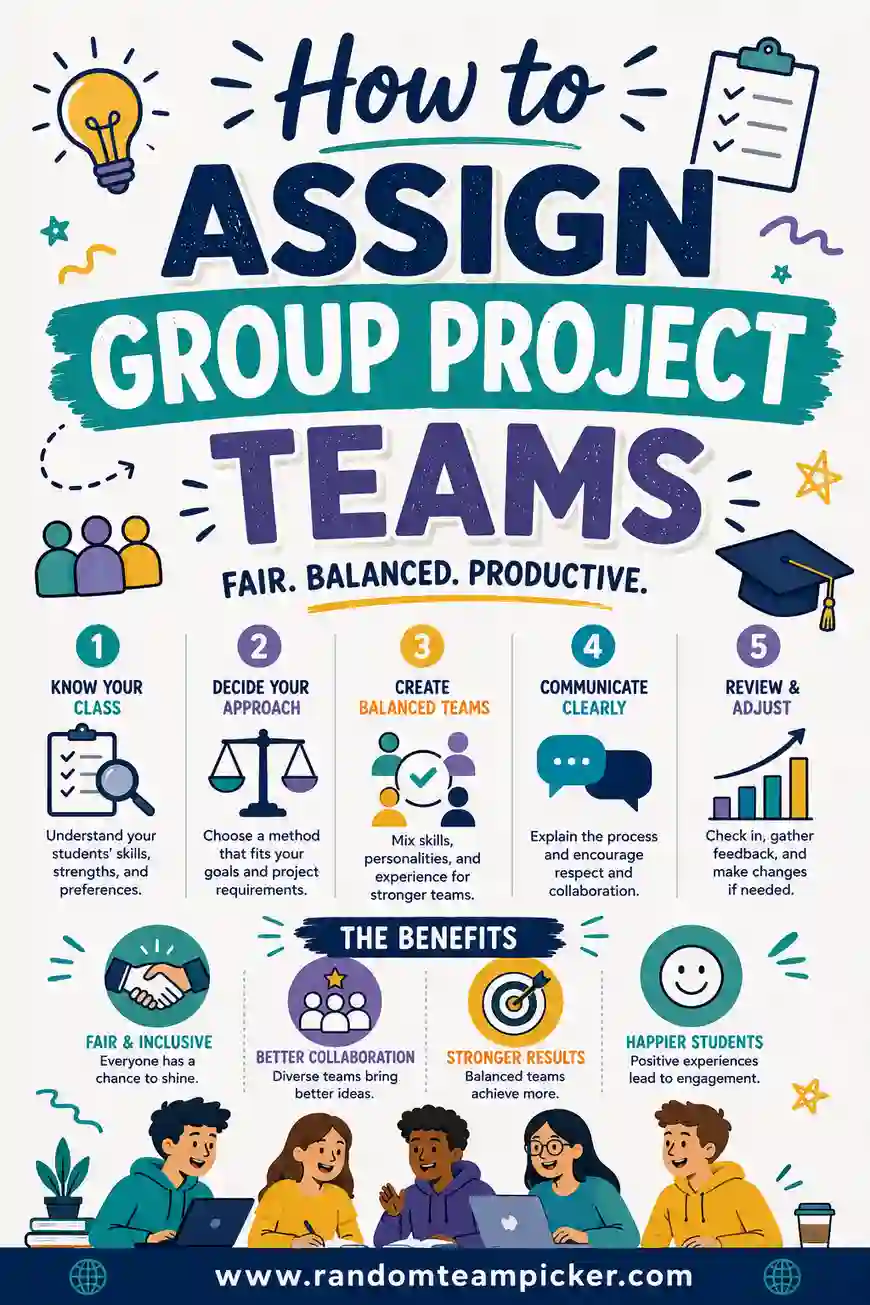
For a deeper look at balancing size and skill together, see our guide on how to assign group project teams.
Odd Numbers and Ideal Team Size
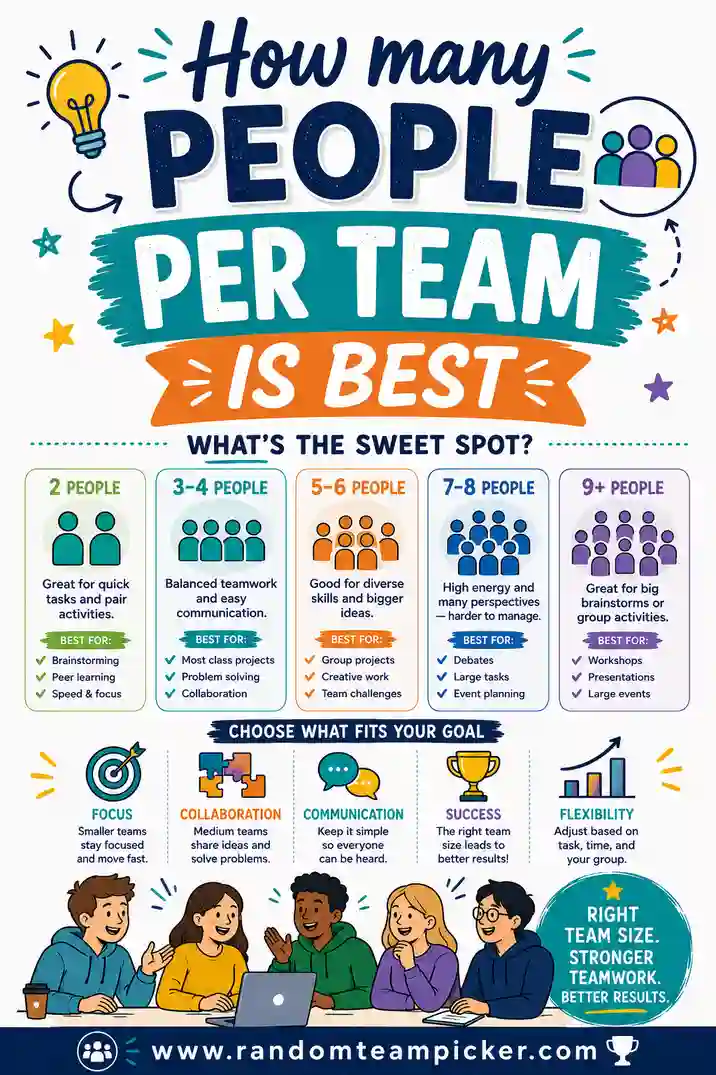
Sometimes the fix for an odd number is just to change your team size. If 15 people won't split into teams of 4 cleanly (you get 4, 4, 4, 3), maybe teams of 3 or 5 fit better (five teams of 3, or three teams of 5). Both divide 15 evenly.
So before you wrestle with leftovers, ask: is there a team size that divides my group cleanly? Often there is. Our guide on how many people per team is best helps you find a size that both suits your activity and splits neatly.
When no size divides evenly, though, don't force it. Fall back to the simple rule: mostly-even teams with a one-person difference. That's always fair enough.
Let the Tool Do the Math
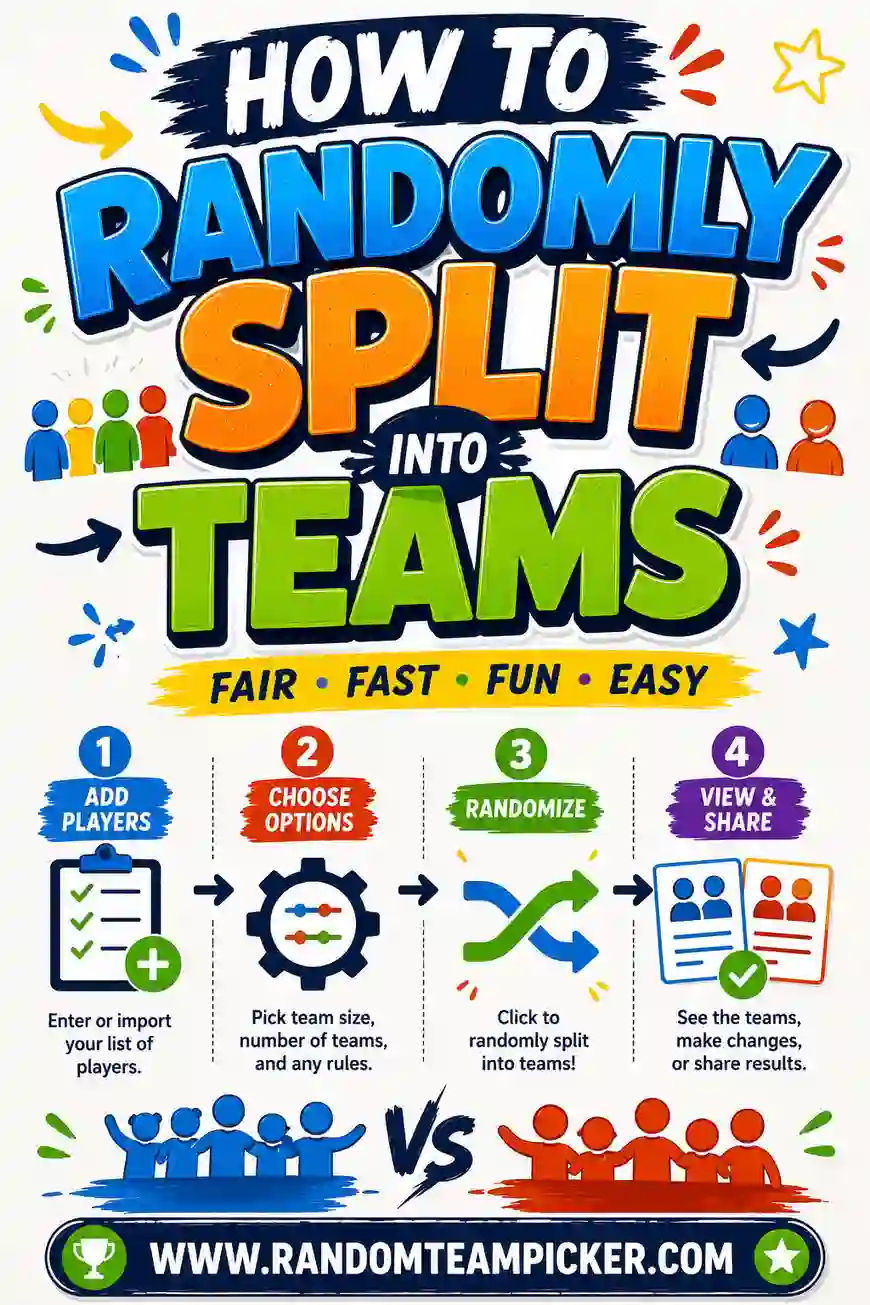
You can absolutely do all this by hand, but for anything bigger than a dozen people it's faster to let software handle it. A random team picker takes your full list, splits it into however many teams you want, and automatically spreads any leftover people so no single team is overloaded.
That means:
- No manual division or counting
- No accidentally stacking the extras onto one team
- A fresh, unbiased shuffle every time
- The option to set either number of teams or people per team
For an odd group, this is the difference between a two-minute puzzle and a two-second click. It also removes any suspicion that you "arranged" the uneven team on purpose, since the split is clearly random.
Odd Numbers in Common Real-World Settings
The "right" fix shifts a little depending on where you are. Here's how the odd-number problem tends to play out in the settings people ask about most.
In the classroom
Odd numbers are the norm, not the exception, and students rarely care about a one-person difference. Make one group of three or five and move on. If it's a graded project, just make sure the smaller group isn't also the weakest, a quick glance and one swap fixes that. Rotating groups across the term means the same students aren't always in the odd-sized team.
On the field or court
Sports are where the leftover person matters most, because play time is the currency. A rotating substitute is the classic answer: one player rests each round and swaps in the next, so everyone gets roughly equal minutes. If the game needs an official, the odd person refereeing solves two problems at once.
At game nights and parties
Keep it relaxed. The extra person can deal cards, keep score, or judge close calls, and honestly, that role is often the most fun. Nobody at a party is counting to make sure the teams are exactly equal, so lean on whatever keeps the energy up.
At work
For office activities, uneven teams are completely fine, one extra brain rarely tips a brainstorm or a quiz. For actual project work, an odd person can float between teams as a shared resource, or take a coordinating role across groups. Fairness here is less about equal size and more about equal workload.
A Quick Reframe: Odd Isn't a Problem
It's worth saying plainly: an odd number is not something to fix so much as something to accept. Teams almost never divide perfectly, and every experienced coach, teacher, and event host has made peace with a group that's one bigger or one smaller. The players certainly have. The only real mistake is dumping all the extras onto a single team or leaving someone standing without a group. Avoid those two things and you're fine.
So relax about the leftover. Spread it evenly, give someone a fun role if it fits, and get on with the activity. A one-person gap is invisible in practice.
Frequently Asked Questions
How do you split an odd number of people into teams?
Divide as evenly as you can and let one team be a single person larger or smaller. For example, 11 people into 2 teams becomes 6 and 5. Spread any extra people across different teams rather than piling them onto one, and the split stays fair.
What do you do with the extra person when teams don't divide evenly?
You have good options: make one team bigger, give the extra person a special role like referee or scorekeeper, rotate them as a floater between teams, or let them pick a side. For most activities, simply making one team bigger is the easiest fair fix.
Is it fair if one team has more players?
Yes, a one-person difference is completely fair for nearly all activities. If it's competitive, a random shuffle usually balances the skill anyway, and you can rotate who's short across multiple rounds so no team is always the smaller one.
How do I split an odd number into teams for sports?
Use a rotating floater or make the odd person a referee or scorekeeper. In pickup games, one player sits out each round and swaps in the next, so everyone gets roughly equal play time. For relays, the odd person can run an extra leg.
Can a team picker handle odd numbers automatically?
Yes. A random team picker divides your list into the teams you choose and automatically spreads leftover people so no single team is overloaded. It does the odd-number math for you and shuffles randomly every time.
What's the best team size to avoid odd-number problems?
Pick a team size that divides your total cleanly. If 15 people won't split into fours evenly, try threes (five teams) or fives (three teams). When no size divides evenly, just use mostly-even teams with a one-person gap.
Ready to Split Your Odd-Numbered Group?
Stop wrestling with the math. Open the free random team picker, paste your list, and it'll split any number, odd or even, into balanced teams in seconds. It's free, there's no sign-up, and it spreads leftover people automatically so every team stays as even as possible.
Want to get the rest right too? Check out how many people per team is best, how to assign group project teams, and how to pick captains fairly.