How to Make Fair Teams (Balanced & Unbiased)
To make fair teams, use a free team generator to randomly shuffle everyone into even, unbiased groups, then, if the game is competitive, nudge the split to balance skill levels evenly across sides. Fairness comes from two things: no favoritism in how people are assigned, and a roughly even spread of ability so no one team runs away with it. The fastest way to get both is a random shuffle followed by a quick balance check. Here's how to do it right.
Want to start now? Open the free team generator, paste your names, and get a fair, random split in one click. No sign-up, no bias.
What Makes a Team "Fair"
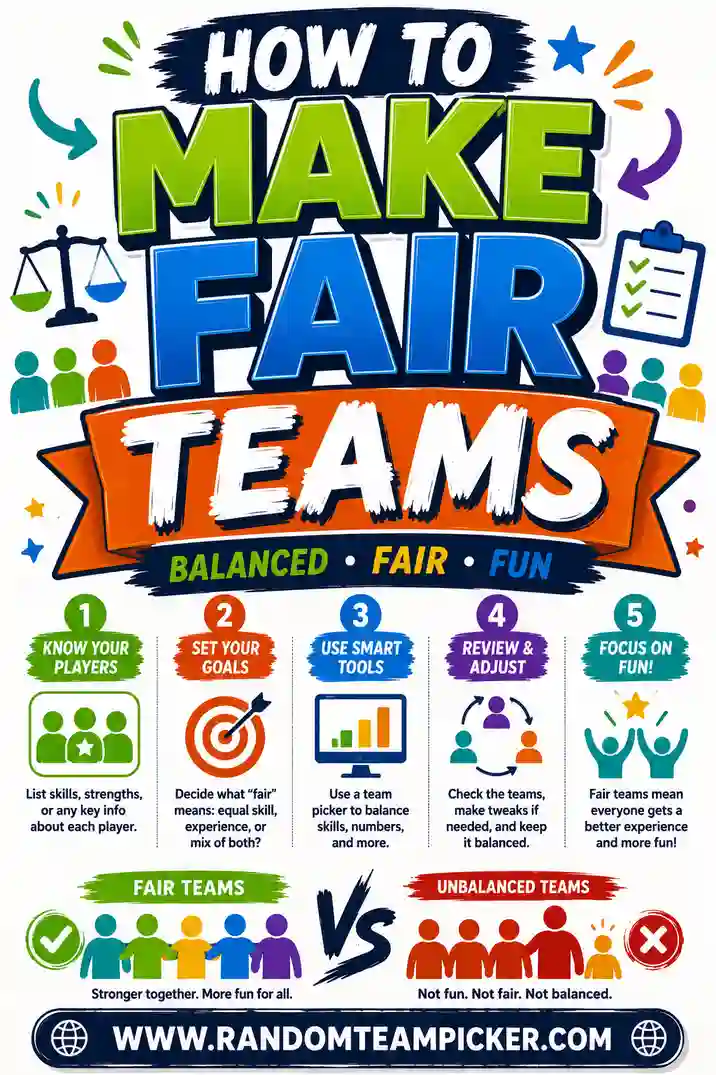
Fair means two things at once, and it helps to separate them.
- Unbiased assignment. No one stacked the teams on purpose. Friends aren't clustered, the popular kids aren't grouped, and nobody was picked last. A random shuffle handles this instantly.
- Even balance. The teams are roughly matched in strength, so the game is a real contest rather than a foregone conclusion. This is where a little skill-balancing comes in for competitive play.
For casual fun, unbiased assignment is usually enough, random is fair by definition. For serious games or leagues, you want both: random as the base, then a balance pass so the sides are evenly matched.
The Two-Step Method for Fair Teams
Here's the reliable recipe that works almost anywhere.
- Start with a random shuffle. Paste your names into the team generator, pick your number of teams, and shuffle. This gives you an unbiased, even-sized split with zero favoritism.
- Do a quick balance check. Glance at the teams. If all the strong players landed on one side, either reshuffle for a new draw or swap a pair of players between teams to even out the skill gap. Keep the rest random.
That two-step approach gives you the best of both worlds: the fairness of randomness plus the balance of a light touch-up. For casual games, you can stop after step one.
Why start random instead of hand-picking?
If you build teams entirely by hand, bias sneaks in even when you mean well. You remember who's good, who's your friend, who complained last time. Starting from a random base strips all of that out. Then any balancing you do is a small, visible adjustment, not a top-to-bottom stack.
How to Balance Teams by Skill
When the game is competitive, here are the fairest ways to even out ability.
- Reshuffle until it's close. The simplest fix. If one draw looks lopsided, click again. A few tries usually lands a balanced split.
- Swap a pair. After shuffling, trade one player from each team to fix an obvious imbalance while keeping everyone else random.
- Snake draft the top tier. Rank your handful of strongest players, then place them evenly (Team 1, Team 2, Team 2, Team 1…). Randomize everyone else. This spreads the standouts without hand-building the whole roster.
- Rate and pool. For leagues, sort players into rough tiers (strong, average, newer) and shuffle within each tier, then deal one from each tier to each team. This gives every side a similar mix.
Keep balancing light and visible
The more you tinker, the more it looks rigged. Aim for a couple of swaps at most, and do them in the open. A visible, small adjustment reads as fair; a mysterious hand-built roster reads as biased, even when it isn't.
Fair-Team Setup by Group Size
Team size affects fairness too, if teams are wildly different sizes, no amount of balancing feels even. Use this chart as a guide.
| People | Fair setup | Notes |
|---|---|---|
| 4–8 | 2 even teams | Swap one pair if skill is uneven |
| 9–16 | 2–4 teams | Snake-draft top 2–4 players |
| 17–30 | 4–5 teams | Tier-and-shuffle for balance |
| 31–60 | 6–8 teams | Assign captains, spread strong players |
| 60+ | 2–4 big teams | Balance by pools, use subs for odd numbers |
Whatever the size, keep team counts as even as possible. One team of 6 against a team of 4 feels unfair before the game even starts.
Handling Odd Numbers Fairly
An uneven headcount is the most common fairness snag. The extra person has to go somewhere, so make it feel deliberate, not lucky.
- Rotate the extra player. In multi-round games, the odd player switches teams each round so no side keeps the advantage.
- Use a floating substitute. The extra person subs in and out across both teams, evening playtime.
- Give a non-playing role. Referee, scorekeeper, or timer is a great fit for anyone who'd rather not play a physical game.
- Add a handicap. Let the smaller team have an extra turn or a small head start to balance the numbers.
Announce your odd-number rule before you shuffle. Deciding it up front keeps it fair; deciding it mid-game looks like you're helping a side.
Fair Teams in Different Settings
The method flexes to wherever you are.
Classrooms
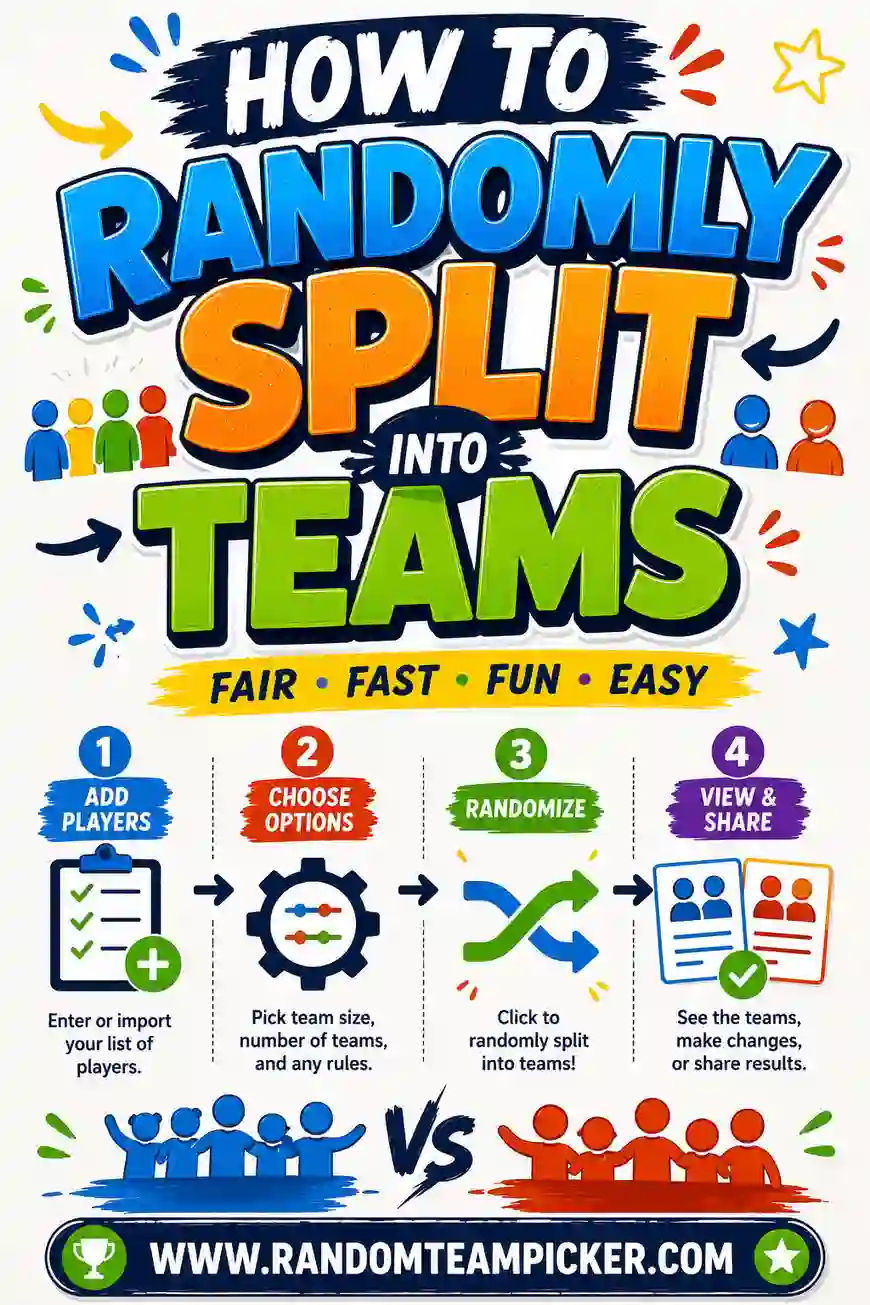
For group projects, random assignment stops the popularity contest and mixes ability so strong and struggling students share groups. Post the teams so it's clearly not teacher favoritism. Our guide on how to randomly split into teams covers the classroom flow.
Sports and pickup games
Random plus one balance swap is usually all you need. For leagues where results matter, use the tier-and-shuffle approach so every team gets a similar spread of skill.
Work and team-building
Fairness here often means mixing departments and seniority evenly. Ignore job titles, shuffle everyone, and you get diverse, balanced groups that meet the team-building goal.
Parties and family games
Keep it light. Random is plenty fair for charades or trivia, and over-balancing kills the casual mood. If one team dominates, just reshuffle next round.
Common Fairness Mistakes to Avoid
These are the traps that make "fair" teams feel unfair.
- Letting captains pick players. The classic unfairness engine, best players first, someone always last. Skip it for a random shuffle.
- Balancing in secret. If you quietly stack skill, be honest and call it "balanced," not "random."
- Uneven team sizes. Fix the numbers before you worry about skill. Lopsided sizes undo any balancing.
- Never reshuffling. Keeping the same teams all day demoralizes the losing side. Fresh teams each round is fairer and more fun.
- Over-tuning casual games. For fun play, endless balancing makes it feel controlled. Let random be random.
Getting Everyone to Agree the Teams Are Fair
Here's a truth that surprises people: teams can be perfectly fair and still feel unfair if the group didn't see how they were made. Perception is half the battle. A split that happens behind a screen invites suspicion, even when it was completely random.
So make fairness visible:
- Shuffle in front of the group. Let people watch the names scramble on screen, or draw cards in the open. Seeing the randomness happen shuts down the "you rigged it" complaint before it starts.
- Explain your method out loud. "Teams are random, and if it looks stacked I'll reshuffle once." A one-sentence rule sets expectations and makes any adjustment feel above-board.
- Announce odd-number rules first. Decide where the extra player goes before you draw, so it never looks like a mid-game favor.
- Own any balancing. If you swap two players to even out skill, say so and say why. A visible, explained swap reads as fair; a silent one reads as meddling.
When people trust the process, they accept the outcome, even the team that loses. That trust is worth more than a perfectly optimized split.
Fair Teams for Repeat Play
Fairness isn't just about one game, it's about how you handle a whole session or season. The same two teams playing all afternoon almost always drifts into unfair territory, because one side gets discouraged and the other gets cocky.
For casual play, the simplest fair habit is to reshuffle between games. A fresh random split each round means every loss is temporary and every player gets new teammates. It keeps energy up and spreads the wins around.
For leagues and ongoing competitions, fairness looks different. There you want stable teams so records mean something, but you balance them carefully at the start using tiers or a snake draft. Then you keep the teams fixed and let skill and effort decide the standings. The fairness lives in the balanced setup, not in constant reshuffling.
Match your approach to the setting: reshuffle often for fun, balance carefully once for competition. Both are fair, they just get there differently.
Random vs. Balanced Teams: A Quick Comparison
| Random teams | Balanced teams | |
|---|---|---|
| Setup time | Instant | A few extra minutes |
| Fairness type | Unbiased | Evenly matched |
| Best for | Casual fun, kids, parties | Leagues, competitions |
| Risk | Occasional lopsided draw | Can look hand-picked |
| How to get it | Shuffle | Shuffle, then balance |
Most of the time, a random shuffle is all the fairness you need. Reach for careful balancing only when a blowout would genuinely spoil the game.
Frequently Asked Questions
How do I make teams that are actually fair?
Start with a random shuffle in a free team generator so there's no favoritism, then, for competitive games, swap a pair or reshuffle to balance skill evenly. Random assignment plus a light balance check gives you fair, even teams.
How do I balance teams by skill level?
Rank your few strongest players and place them evenly across teams (a snake draft), then randomize everyone else. For leagues, sort players into rough tiers and deal one from each tier to each team so every side gets a similar mix.
Is random the same as fair?
For casual play, basically yes, random means unbiased, which is fair. For competitive games, you may also want the teams evenly matched in skill, so add a quick balance pass on top of the random shuffle.
How do I make fair teams with an odd number of people?
One team gets an extra player, so make it deliberate: rotate the odd player between rounds, use them as a floating substitute, or give the smaller team a small handicap. Decide the rule before you shuffle.
Should I let team captains pick players?
Usually not. Captains picking players is the most common source of unfairness, the best players go first and someone always feels chosen last. A random shuffle is faster and kinder.
Is the fair team generator free?
Yes, it's completely free with no sign-up. It runs in your browser on any device, so you can build fair, balanced teams from a phone, tablet, or computer.
Ready to Make Fair Teams?
You've got the recipe: shuffle randomly for an unbiased base, then balance lightly if the game is competitive. Open the free team generator and you'll have fair, even teams in seconds. It's free and there's no sign-up. For more, see our guides on how to randomly split into teams, a team generator for two-team splits, and a team generator for large groups. Fair teams, happy players, better games.