Team Generator for Two-Team Splits: Fast & Fair
A team generator for two-team splits is a free tool that takes your list of people and instantly divides them into two fair, random, evenly sized sides. You paste the names, click shuffle, and get Team 1 and Team 2 ready to go, no captains picking players, no arguments about who got stacked. It's the quickest way to set up any head-to-head game: dodgeball, trivia, capture the flag, red team vs. blue team, you name it.
Ready to split? Open the free team generator, paste your names, and get two balanced teams in one click. No sign-up, no math, no drama.
👥 Random Team Picker: split your list into teams
The sample names are from this page. Replace them with yours, one per line or separated by commas.
Why Two Teams Is the Classic Split
Head-to-head is the most natural way to compete. One side against the other, a clear winner, easy to keep score. That's why so many games (from backyard soccer to office trivia) come down to two teams.
But two teams only works if both sides feel fair. The old captain-picks-players method almost guarantees unfairness: the athletic kids go first, the same person always gets chosen last, and the game is decided before it starts. A random two-team generator fixes that in one click:
- Both sides start even. The tool deals names back and forth so team sizes match.
- Nobody feels picked last. There's no ranking, just a random deal.
- The split is trusted. When everyone sees the shuffle, they accept the result.
How to Split Into Two Teams in Seconds
You don't need any setup. Here's the whole thing.
- Enter your names. Type or paste everyone's name, one per line. First names work fine.
- Set it to two teams. Choose 2 as your number of teams.
- Shuffle. The generator scrambles the list and deals people alternately into Team 1 and Team 2, so both come out even.
- Play. Announce the sides and start the game.
Want a different mix? Shuffle again. Every click gives you a fresh, fair two-way split, which is great if the first draw felt lopsided in skill.
Games and Events Perfect for Two Teams
Two-team splits fit a huge range of activities. A few of the most common:
Backyard and gym sports
Soccer, basketball, dodgeball, kickball, capture the flag, all built for two sides. Split the group, hand out pinnies or colored bands, and go.
Trivia and quiz nights
Two big teams keep a quiz lively and loud. Random sides prevent the "all the smart people on one team" problem that ruins a fair game.
Party games
Charades, Pictionary, tug of war, relay races, minute-to-win-it challenges. Nearly every party game gets more fun as a two-team battle.
Classroom review games
Teachers love a red team vs. blue team review before a test. A random split keeps it fair and gets quiet kids involved without singling anyone out.
Running a bigger event that needs more than two sides? Our guide to a team generator for large groups covers multi-team setups.
Two-Team Size Guide
Wondering how many players per side works best? This chart maps group sizes to team setups and good game types.
| Total people | Per team | Feels like | Great for |
|---|---|---|---|
| 4–6 | 2–3 | Quick and casual | Card games, mini challenges |
| 8–12 | 4–6 | Balanced and active | Dodgeball, trivia, charades |
| 14–20 | 7–10 | Full-sized game | Soccer, capture the flag |
| 22–40 | 11–20 | Big and lively | Field games, quiz battles |
| 40+ | 20+ | Two mega-teams | Color war, large events |
For active sports, 5 to 8 per side keeps everyone moving. For quiz and party games, bigger teams are fine since the whole side plays together.
Balancing Two Teams by Skill
Pure random usually spreads talent well, but sometimes you want tighter balance, like when one team happens to get all the fast runners. Here's how to handle it.
- Reshuffle for a better mix. The fastest fix. If one draw looks stacked, click again for a new random split.
- Swap a pair after shuffling. Trade one player from each side to even out obvious skill gaps, while keeping the rest random.
- Snake-draft the top players first. For serious games, hand-place your few strongest players evenly, then let the generator randomize everyone else.
- Set a team captain each. Captains keep their side organized and can call subs, useful for longer games.
When "purely random" is the point
For casual fun, resist the urge to over-balance. The whole appeal of a random split is that nobody rigged it. A slightly uneven game where everyone laughs beats a perfectly balanced game where people suspect tampering. Save the careful balancing for when the stakes actually matter.
Handling Odd Numbers
Two teams and an odd headcount? No problem. The generator puts the extra person on one side, so you'll have, say, 5 vs. 6. A few ways to handle the odd player fairly:
- Rotate the extra. In multi-round games, the odd player switches sides each round.
- Make them a referee or scorekeeper. Great if someone would rather not play a physical game.
- Add a "ghost" player. For some games, the short team gets an extra turn to make up the gap.
Whatever you choose, decide before the game so it feels fair, not like a mid-game advantage.
Random vs. Captains Picking Players
It's worth spelling out why the generator wins for two-team splits.
| Random generator | Captains picking | |
|---|---|---|
| Speed | Instant | Slow, one pick at a time |
| Fairness | No bias | Best players go first |
| Feelings | Nobody picked last | Someone always is |
| Trust | High (visible shuffle) | Low (looks rigged) |
| Best for | Casual and fair play | Rarely worth it |
The only real case for captains is when you specifically want a strategic draft. For everything else, especially with kids, a random split is faster and kinder.
Share Your Two Teams
Once you've shuffled, getting the result to everyone is quick. Read out Team 1 and Team 2, or turn the screen around so people can find their name. For a longer event, screenshot the split on your phone so there's a record. The generator runs in your browser on any device, so you can set up sides from the sideline, the classroom, or the living room couch.
Fun Ways to Name and Mark Your Two Teams
A random split gives you Team 1 and Team 2, but those names are forgettable. Giving each side an identity turns a plain list into a real rivalry, and it takes two seconds.
- Colors. Red vs. blue is the classic for a reason. Hand out pinnies, bandanas, or colored wristbands and the teams are instantly visible.
- Silly names. Let each side pick something goofy, "The Waffles" vs. "The Pancakes." Kids especially buy in harder when they named their own team.
- Animals or mascots. Sharks vs. Eagles, Lions vs. Bears. Easy to shout and easy to cheer.
- This vs. that. Cats vs. Dogs, Summer vs. Winter, Sweet vs. Savory. Low-stakes debates make great team lines.
Marking teams matters as much as naming them, especially for active games. In a fast-moving game of capture the flag, players need to tell friend from foe at a glance, so anything visible, a colored band, a hat, even shirts inside-out, keeps the game clean.
Running a Best-of-Three With Two Teams
Two-team events are more fun as a short series than a single game. A best-of-three keeps everyone engaged and gives the losing side a shot at a comeback. Here's a clean way to run one.
- Draw the teams once and keep them. Shuffle at the start, name the sides, and stick with them across all three games so a rivalry can build.
- Play three different games. A physical game, a thinking game, and a wildcard. Mixing formats means one team's strength won't decide everything.
- Track wins on a scoreboard. First to two games wins the series. A visible tally keeps both sides invested.
- Reshuffle for the next series. When you start a new best-of-three later, draw fresh teams so the same side doesn't dominate all day.
This structure works for backyard parties, gym class, camp, and office game nights alike. The generator handles the fair draw; the series format handles the fun.
Quick Two-Team Games You Can Start Right Now
Once you've split into two sides, you'll want a game to play. Here are crowd-pleasers that need almost no equipment and work for nearly any age.
- Charades. One team acts, the other guesses, then swap. Keep score by how fast each side solves the clue. Zero supplies needed.
- Dodgeball or its softer cousins. With soft balls or even balled-up socks indoors, two teams and a center line is all it takes.
- Trivia showdown. Read a question, first team to answer correctly scores. Great for classrooms and parties alike.
- Relay races. Line up both teams, run a simple relay, first team through wins. Add silly rules (hop, walk backward) for laughs.
- Tug of war. The ultimate two-team classic. All you need is a rope and even sides, which the generator guarantees.
- Pictionary. One team draws, both race to guess. Fast, loud, and endlessly replayable.
The beauty of a two-team split is how many games it unlocks. Once the sides are fair, you can jump between activities all afternoon without re-sorting, just keep the same teams or reshuffle for variety.
A Worked Example: 17 People at a Family Picnic
Here is how a two-team split plays out with a real, messy group: 17 relatives at a picnic, ages 6 to 70, who want to play kickball and then a round of charades.
- Write the list. Someone types all 17 names into a phone. Two cousins arrive late, so leave a note to add them later.
- Shuffle into two teams. Paste the names into the free team generator with the count set to two. You get one side of 9 and one side of 8.
- Check the obvious mismatch. Say three of the four teenagers land on the same side. Swap one teenager for one adult of a similar age range on the other side. One swap, done.
- Handle the odd player. The team of 9 sends one person to be the kickball umpire for the first few innings, then rotates someone else in.
- Add the latecomers. When the two cousins arrive, put one on each side. The teams stay balanced without a full reshuffle.
- Keep teams for charades. After kickball, keep the same two sides for charades so the rivalry carries over, or reshuffle if one team won kickball by a mile.
The whole setup takes a couple of minutes, and no grandparent or little kid has to stand in a line waiting to be picked.
Siblings, Best Friends and Other Pairs
Two-team splits bring up a question that bigger splits rarely do: should certain people be on the same side or on opposite sides? Siblings, best friends, couples, and coworkers who share a desk all tend to raise it. There is no single right answer, but there is a simple way to handle each case.
When you want pairs split up
Some pairs are better on opposite teams. Two siblings who argue, two best friends who chat instead of playing, or two very skilled players who would make one side unbeatable. Shuffle as normal, then look for those pairs. If any landed together, swap one of them with someone of similar skill on the other side. It keeps almost all of the randomness while solving the real problem.
When you want pairs kept together
Sometimes keeping two people together is kinder. A young child may feel safer with an older sibling, or a new student may need a familiar face. In that case, treat the pair as one entry on your list for the shuffle, such as "Maya and Leo," then split them back into two names when you announce teams. Just keep the team sizes in mind, since that entry counts as two players.
Be open about it
Whatever you decide, say it out loud before the shuffle: "Siblings will be on different teams" or "Little kids stay with a grown-up." When the rule comes first, nobody reads a swap as favoritism.
Combining Two Groups That Already Know Each Other
A common two-team situation is two existing groups coming together: two classes for a review game, two families at a reunion, two departments at a work picnic, or two youth groups on a shared trip. The easy move is to let each group be its own team. It is usually the wrong one.
When the teams match the groups people walked in with, the game turns into "us versus them," and nobody meets anyone new. A random split mixes everyone, so each team has people from both groups. That builds new connections and makes the competition about the game, not about which class or family is better.
- Put everyone on one list. Combine both rosters before you shuffle so the tool treats them as one group.
- Check the mix after shuffling. If one side ended up mostly from one group, reshuffle once.
- Use neutral team names. Pick colors or silly names, not "Room 12" or "the Johnsons," so the new teams feel like their own thing.
When Two Teams Are Bigger Than the Game
Two-team splits are easy until the sides are larger than the game allows. Twenty-four people and a volleyball court that fits six per side, for example. You still want two teams, you just need a plan for who plays when.
Rotate on a set signal
Choose a clear moment to sub: every point, every inning, every five minutes, or every time a team scores. A set signal stops arguments about who has been sitting out longest.
Keep a simple sub order
After the shuffle, each team numbers its players in the order they appear on the list. Players 1 through 6 start, and the next numbers rotate in. Because the list order is random, so is the sub order, which saves each team from arguing about who starts.
Give the bench a job
Players waiting to sub can keep score, chase loose balls, or cheer as loudly as possible. Staying involved keeps them part of the team instead of spectators.
If even rotating feels like too much waiting, that is a sign the group would be happier as more than two teams. Our guide to the team generator for large groups covers those setups.
Frequently Asked Questions
How do I randomly split a group into two teams?
Paste your list of names into a free team generator, set it to two teams, and hit shuffle. The tool deals everyone alternately into Team 1 and Team 2, so both sides come out even and random in seconds.
How do I make two teams fair by skill?
Random shuffling usually spreads talent evenly on its own. If one draw looks stacked, reshuffle or swap a player from each side. For serious games, place your few strongest players evenly first, then randomize the rest.
What if I have an odd number of people?
The generator puts the extra person on one team, so you'll have something like 5 vs. 6. Handle it fairly by rotating the odd player between rounds, or by giving them a referee or scorekeeper role.
Is a random split better than letting captains pick?
For most games, yes. Random is faster, avoids the "picked last" sting, and feels fairer to everyone. Captains picking players only makes sense when you want a deliberate strategic draft.
Is the two-team generator free?
Yes, it's completely free with no sign-up. It runs in your browser on a phone, tablet, or computer, so you can split into two teams anywhere.
Can I reshuffle for a new split?
Yes. Every click produces a fresh, fair two-team split. Reshuffle as many times as you like until you get a mix everyone's happy with.
How do you split siblings into different teams?
Shuffle your list into two teams as usual, then check where the siblings landed. If any pair ended up together, swap one of them with a player of similar age or skill on the other side. Announce the rule before the shuffle, such as siblings play on different teams, so the swap feels like part of the plan rather than favoritism.
What is a fair way to decide which team goes first?
Keep it simple and visible. Flip a coin, play a quick round of rock paper scissors between one player from each side, or let the team that was listed second in the shuffle go first. In a series of games, alternate who starts each round so neither side keeps the early advantage.
How do you split into two teams when more people show up than can play?
Split everyone into two teams anyway, then set up a rotation. Each team numbers its players in list order, the first group starts, and the rest sub in on a set signal like every point or every five minutes. Players waiting on the bench can keep score or cheer so they stay part of the team.
Ready to Split Into Two Teams?
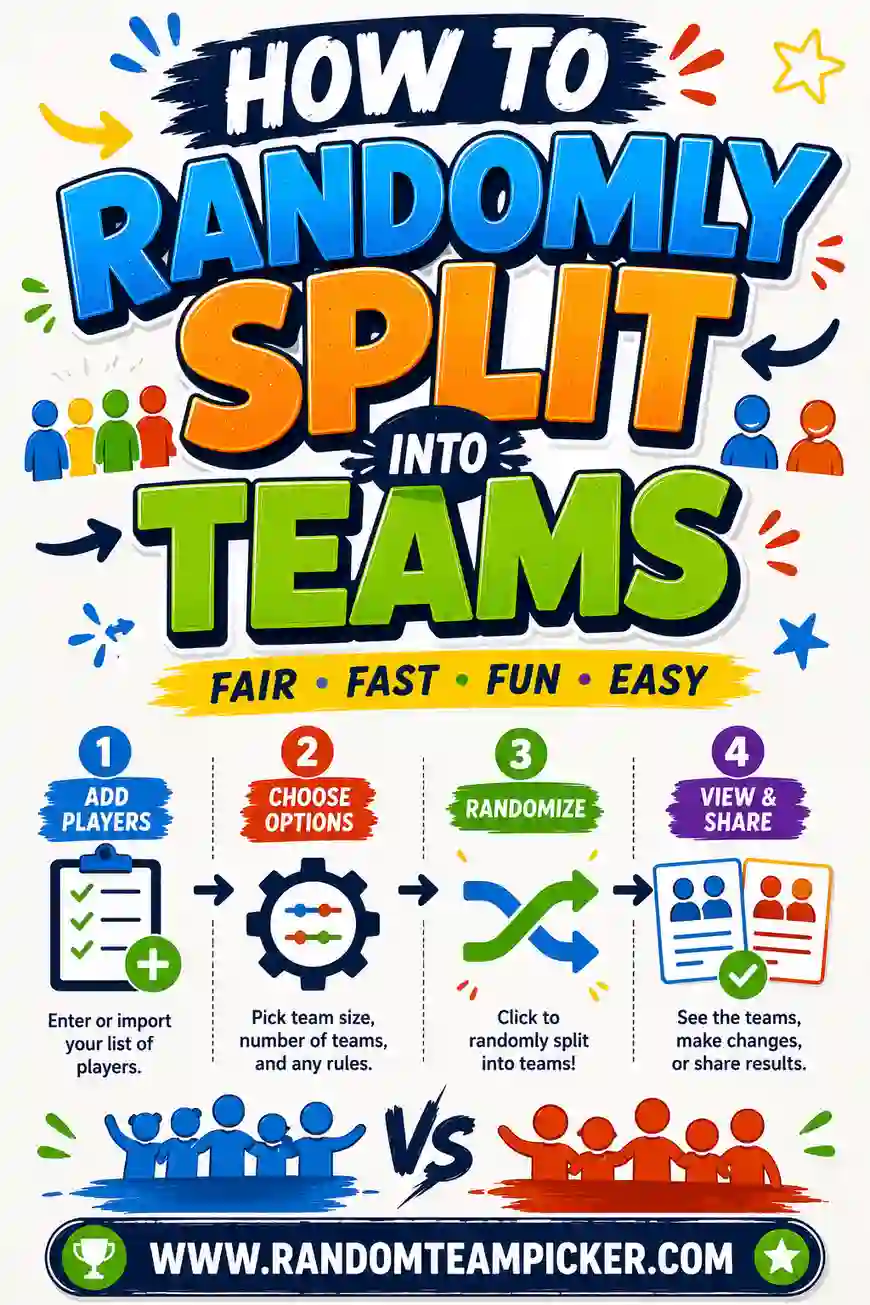
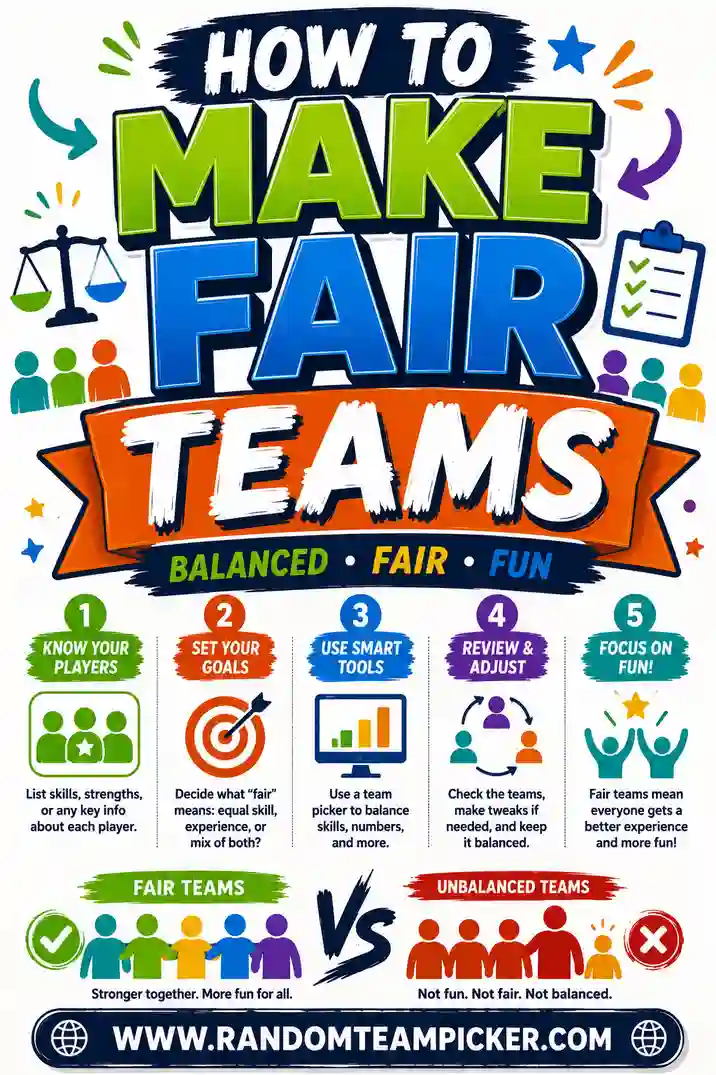
Enter your names, open the free team generator, set it to two teams, and you'll have fair, even sides ready in one click. It's free, there's no sign-up, and every shuffle gives you a fresh split. For other setups, see our guides on a team generator for large groups, how to randomly split into teams, and how to make fair teams. Two teams, zero drama, let the game begin.