How to Randomize Without Repeats (Fair Teams, Every Time)
To randomize without repeats, you shuffle your full list once and then deal names out in order, so each person lands in exactly one spot and nobody gets picked twice. The trick is to draw from a list that shrinks as you go, instead of picking at random from the whole pool over and over. The fastest way to do it is a free random team picker that shuffles your names and splits them into groups with zero duplicates, in one click.
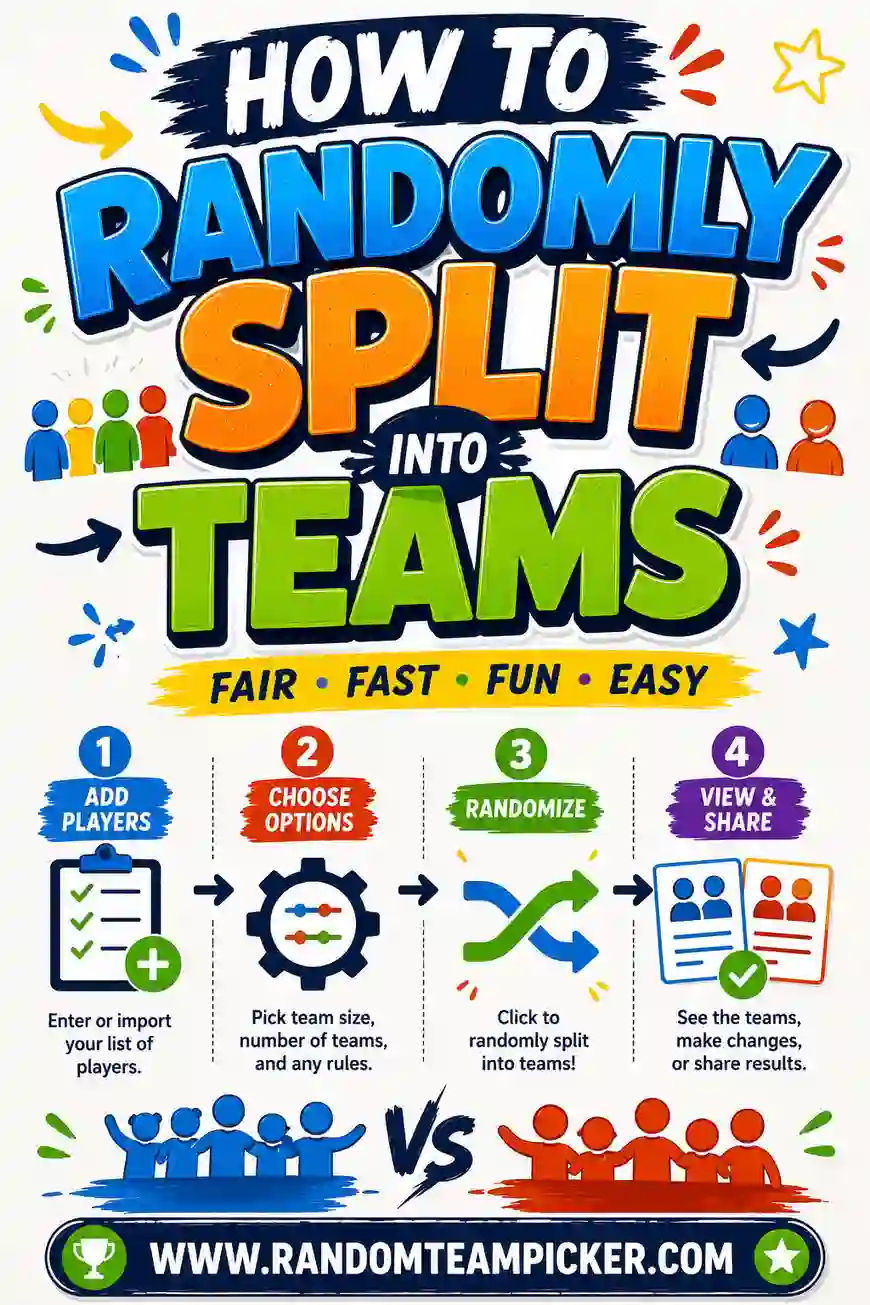
Want to skip the manual work? Open the team picker, paste your names, choose how many teams you want, and it hands back clean, repeat-free groups instantly. No sign-up, no spreadsheet formulas, no counting on your fingers.
What "Randomize Without Repeats" Actually Means
There are two very different kinds of "random." Knowing which one you want saves a lot of headaches.
Random with repeats is like rolling a die. Every roll is independent, so you can roll a 4 five times in a row. If you use this method to build teams, the same person can get picked again and again while someone else never gets picked at all. That's fine for a dice game. It's terrible for fair teams.
Random without repeats is like shuffling a deck of cards and dealing them out. Every card comes up exactly once. When you shuffle a list of names this way, everyone lands in a group, nobody is left out, and nobody is doubled up. This is what you almost always want for teams, groups, chores, gift exchanges, and turn order.
If you've ever "randomized" a list and noticed the same name kept coming up, you were using the with-repeats method by accident. The fix is to switch to a shuffle-and-deal approach.
The Core Method: Shuffle Once, Then Deal
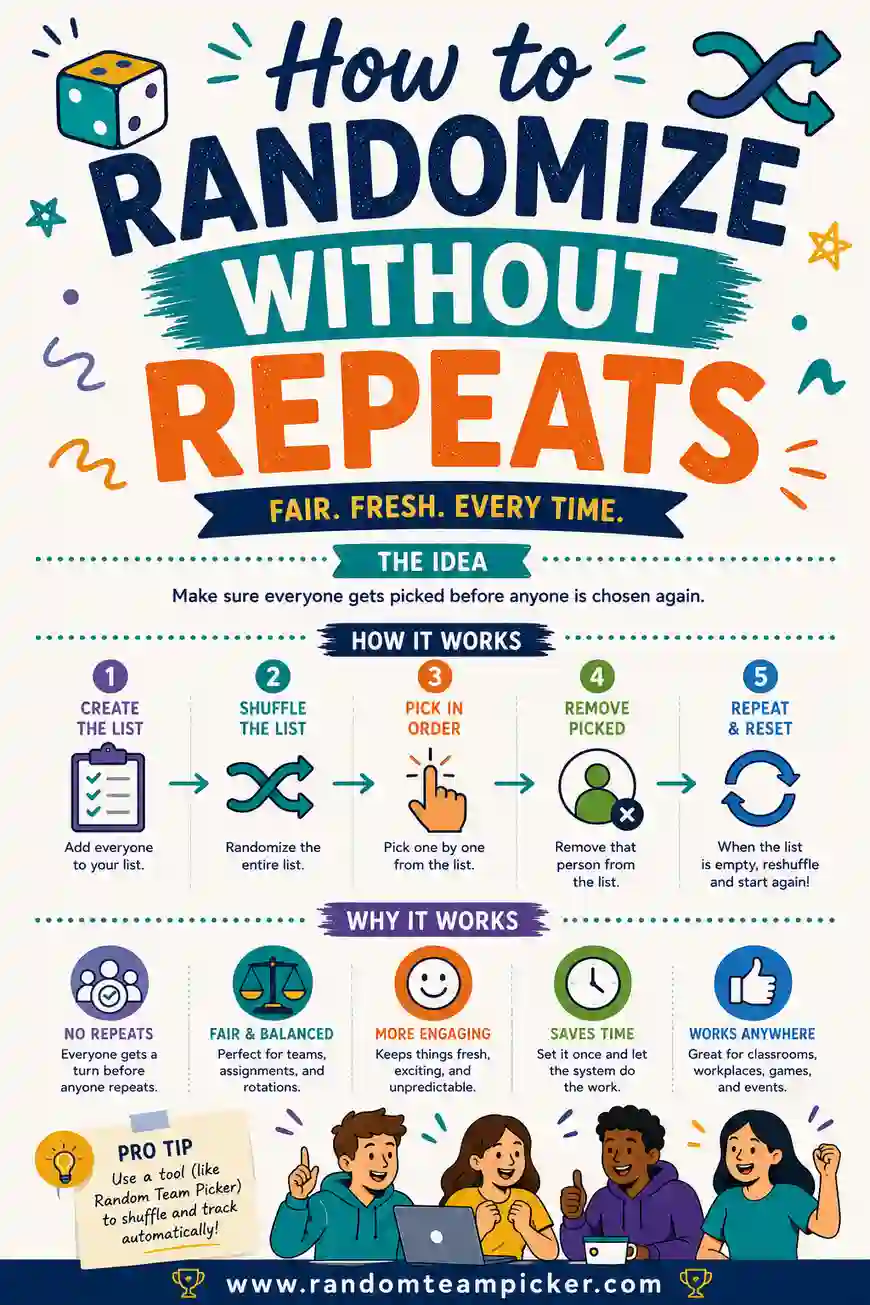
Here's the whole idea in three steps. This is exactly how a good team picker works under the hood.
- Put every name in one list. No duplicates in your source list to start with.
- Shuffle the entire list one time. Scramble the order so it's unpredictable.
- Deal in order. Walk down the shuffled list and drop names into groups one by one. Because you never revisit a name, no one repeats.
That's it. The magic is in step two. Once the list is shuffled, dealing is just counting.
Why "pick a random name, then repeat" fails
A lot of people try to randomize by grabbing a random name from the pool, then grabbing another random name, and so on. The problem is that unless you remove each name after you pick it, you'll grab some names twice and skip others. If you do remove each name as you go, congratulations, you've just reinvented shuffle-and-deal, only slower and easier to mess up. Shuffling the whole list first is cleaner and far less error-prone.
How to Randomize Without Repeats by Hand
No computer? You can still do it with paper.
- Slips in a hat. Write each name on a slip, fold them, drop them in a bowl, and pull them out one at a time. Assign the first slip to Team 1, the second to Team 2, and so on, then loop back. Each slip only exists once, so there are no repeats by design.
- Number and sort. Write your names in a column. Next to each, jot a random number (roll dice or use a phone). Sort the names by those numbers. Now deal down the sorted list into your groups.
- Deck of cards. Assign each person a card, shuffle, and reveal. The order the cards come up is your randomized, repeat-free order.
These work great for a handful of people. Once you're past 15 or 20 names, doing it by hand gets slow and mistake-prone, which is where a tool earns its keep.
The Fastest Way: Use a Free Team Picker
For anything bigger than a small group, a free random team picker is the easiest path. You paste your list, pick your settings, and it does the shuffle-and-deal for you.
What a good picker handles automatically:
- Guaranteed no repeats. Every name is used exactly once.
- Even splits. It balances group sizes, and handles leftovers when the numbers don't divide cleanly.
- Re-shuffle in one click. Don't love the first result? Shuffle again for a fresh, still-fair split.
- Any list size. Six names or six hundred, same speed.
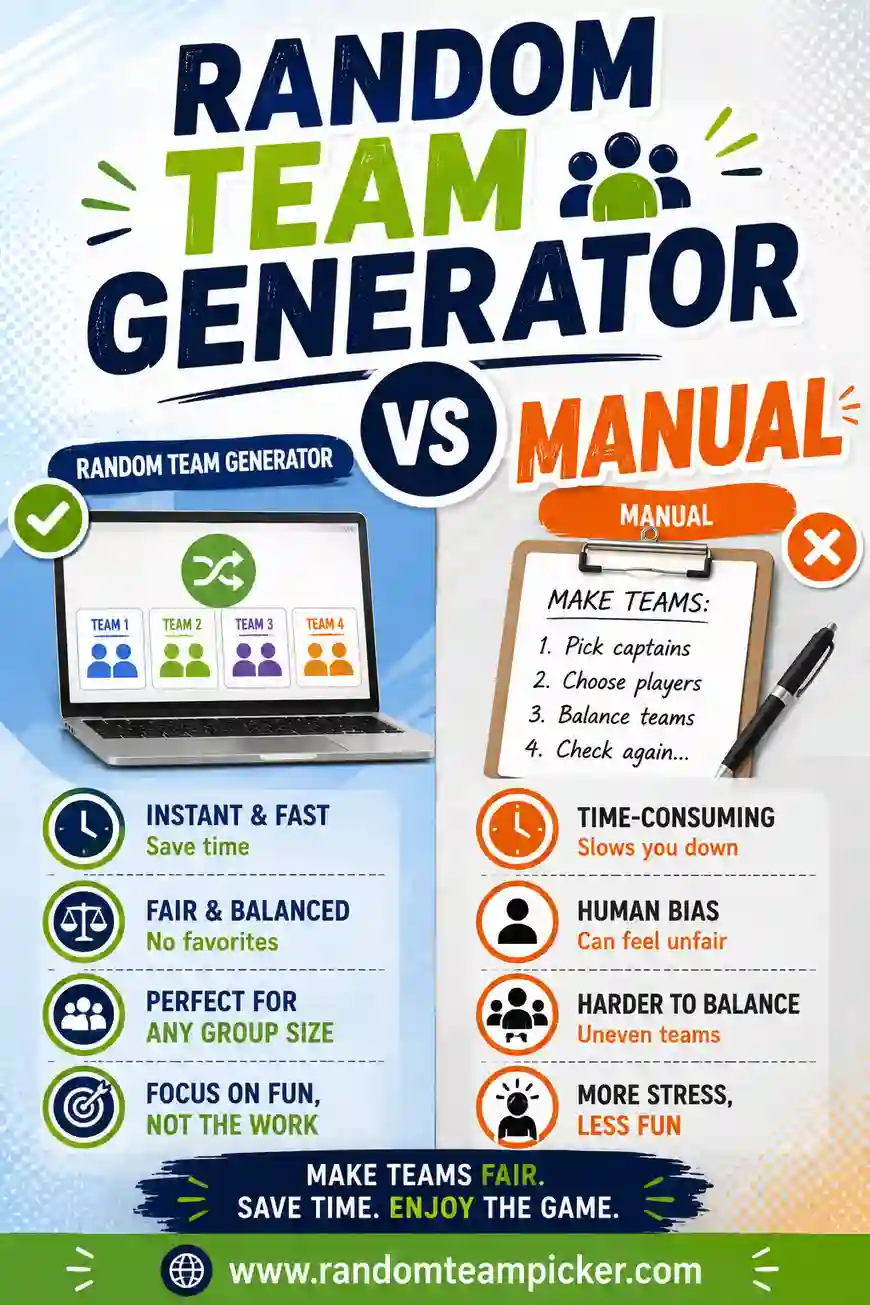
It also removes the human temptation to nudge the result. When you draw by hand, it's weirdly easy to "accidentally" put two friends together. A tool doesn't play favorites, which keeps things honest. If you're curious how the two stack up, see our breakdown of a random team generator vs. doing it manually.
Handling Common Snags
Real lists are messy. Here's how to keep them repeat-free anyway.
Duplicate names in your list
If you have two people named "Alex," the tool can't tell them apart, and neither can your players. Add a last initial or a tag: "Alex R" and "Alex T." Now they're distinct entries and each gets its own spot.
Numbers that don't divide evenly
Say you have 22 people and want 4 teams. That's 5, 5, 6, 6. A good picker spreads the extras out so no single team is stuck being much bigger. If you're doing it by hand, deal one name to each team in rotation, and the leftover names naturally land on the first teams you dealt to. For a deeper look, read our guide on splitting an odd number into teams.
You want a different result
Repeat-free doesn't mean you're locked into the first outcome. Just shuffle again. Each shuffle is a fresh, independent, still-repeat-free arrangement of the same names.
Randomize Without Repeats vs. With Repeats
Here's a side-by-side so you can pick the right method for your task.
| Situation | Method you want | Why |
|---|---|---|
| Splitting people into teams | Without repeats | Everyone plays once, nobody's doubled |
| Assigning chores or roles | Without repeats | One job per person, all jobs covered |
| Secret gift exchange order | Without repeats | Each person gives and gets once |
| Rolling for damage in a game | With repeats | Each roll should be independent |
| Picking a daily "winner" from a raffle you refill | With repeats | Same person can win on different days |
| Random turn order for one round | Without repeats | Each player goes exactly once |
If your task is about sharing something out fairly among people, you want without repeats almost every time.
A Quick Worked Example
Say you're a coach with 9 players and you want 3 teams.
- List them: Ava, Ben, Cara, Dan, Eli, Faye, Gus, Hana, Ivy.
- Shuffle the list. Suppose it becomes: Faye, Ivy, Ben, Hana, Cara, Gus, Ava, Dan, Eli.
- Deal in a rotation: Team 1 gets Faye, Team 2 gets Ivy, Team 3 gets Ben, then back to Team 1 for Hana, and so on.
Final teams:
- Team 1: Faye, Hana, Ava
- Team 2: Ivy, Cara, Dan
- Team 3: Ben, Gus, Eli
Nine names in, nine names out, each used once, teams evenly sized. That's a clean randomize-without-repeats result, and the team picker does exactly this in a single click.
Tips for a Result Everyone Trusts
A fair method only feels fair if people believe it. A few small moves help.
- Shuffle in front of the group. Let people watch the button get pressed. Transparency kills "you rigged it" complaints.
- Read the source list out loud first. Confirm everyone's on it and spelled right before you shuffle.
- Don't re-shuffle until you get the "right" answer. Pick a rule up front, like "we take the first shuffle" or "best of one." Re-rolling until your favorites are together defeats the point.
- Keep a screenshot. Handy if anyone forgets which team they're on.
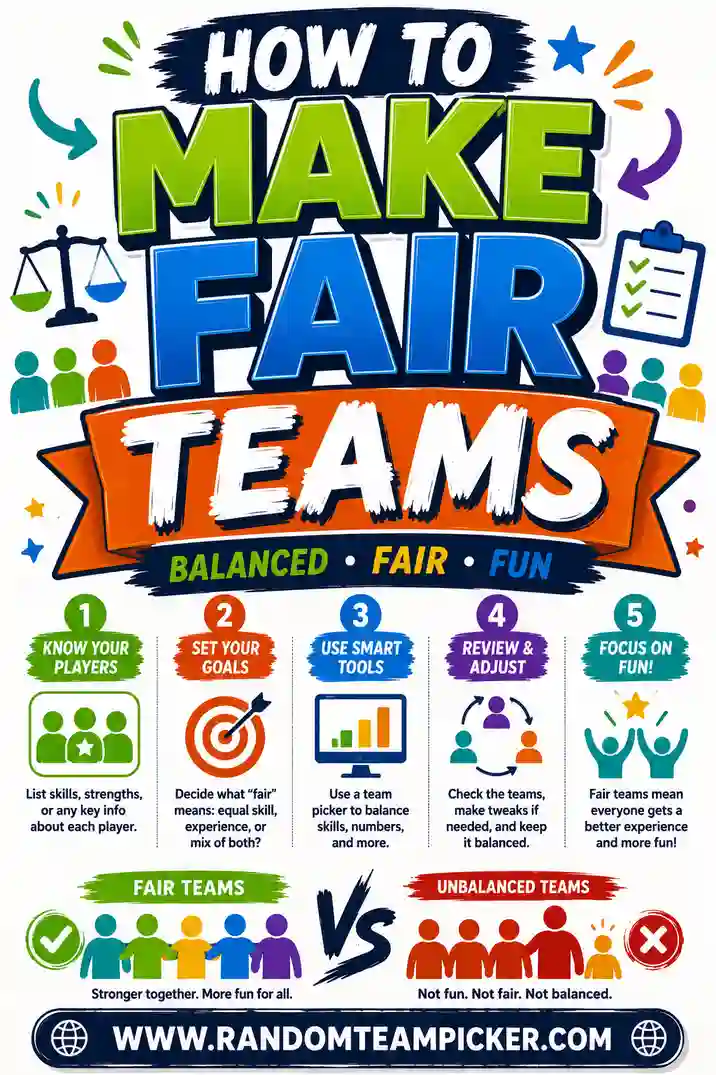
Want to go deeper on fairness and avoiding hidden bias? Our guides on making fair teams and random groups without bias cover it in detail.
Where Repeat-Free Randomizing Comes in Handy
Once you get the shuffle-and-deal idea, you'll spot uses for it everywhere. Here are the everyday jobs it solves.
- Classroom groups. Split a roster into project teams so every student works with someone new, and no one's left standing alone at the end.
- Sports and PE. Deal players into even sides without the slow, awkward captain-picks-last routine that leaves the same kid chosen last.
- Chore rotations. Assign one task per person for the week, every job covered, nobody doubled up.
- Secret gift exchanges. Randomize who gives to whom so each person gives once and receives once.
- Turn order. Set a fair, one-round order for a board game or a presentation so everyone goes exactly once.
- Raffle-style draws where each ticket wins once. Pull winners without any name coming up twice.
In every one of these, the goal is the same: share something out fairly among people, with each person landing in exactly one spot. That's the sweet spot for randomize-without-repeats, and it's precisely what the team picker is built to do.
A note on "reshuffle fatigue"
If you re-shuffle a dozen times hunting for a "perfect" result, you're no longer relying on chance, you're cherry-picking. That quietly reintroduces the bias you were trying to avoid. Pick a rule, take the shuffle, and move on. The whole point of a repeat-free random split is that you trust the first fair result instead of massaging it.
Frequently Asked Questions
What does it mean to randomize without repeats?
It means every item in your list is used exactly once, with none skipped and none doubled. You get this by shuffling the whole list a single time and then dealing items out in order, the same way you'd shuffle and deal a deck of cards.
Why does the same name keep coming up when I randomize?
You're using a method that picks randomly from the full pool each time without removing what it already picked, so names can repeat. Switch to shuffle-and-deal, or use a team picker that removes each name as it assigns it, and repeats disappear.
How do I randomize a list without repeats for free?
Paste your list into a free random team picker, choose how many groups you want, and it shuffles and splits with no duplicates. It's free, needs no sign-up, and works for any list size.
How do I handle two people with the same name?
Give them distinct entries, like "Sam K" and "Sam P." A randomizer treats identical text as one item, so adding a last initial or a tag keeps both people in the draw as separate, repeat-free entries.
Can I get a different result without creating repeats?
Yes. Just shuffle again. Each new shuffle is a fresh, independent arrangement of the same names, and it stays repeat-free every time. Nothing about re-shuffling causes duplicates.
Is shuffle-and-deal really random?
Yes, as long as the shuffle is a proper random shuffle. A good team generator uses a solid shuffle so every possible arrangement is equally likely, then deals in order, which keeps the result both random and free of repeats.
Ready to Randomize Without Repeats?
Stop counting names on your fingers. Open the free team picker, paste your list, and get clean, repeat-free groups in seconds, every name used exactly once, no duplicates, no left-out players. It's free, there's no sign-up, and you can re-shuffle as many times as you like. Give it a try and let the tool handle the shuffling for you.