Easter Egg Hunt Teams: How to Split Kids Fairly by Age
The fairest way to split kids for an Easter egg hunt is by age first, then at random inside each age group. Put toddlers, preschoolers and big kids in separate groups, give each group its own area or its own color of eggs, and let a random team picker sort brothers, sisters and cousins into teams so nobody argues about who's with whom. Easter 2027 is Sunday, March 28, so most family and church hunts land on that weekend or the Saturday before.
Try it with the sample kids below, then paste in your own crowd.
🎲 Pick a random team
Choose a group, then spin. One for each player gives everyone in the names list below a different team.
👥 Random Team Picker: split your list into teams
The sample names are from this page. Replace them with yours, one per line or separated by commas.
How to split kids for an egg hunt by age
A 9-year-old will clear a whole yard before a 3-year-old finds one egg. That's why age groups matter more than anything else. Here's a simple setup that works for most family and church hunts:
| Age group | Hunt area | Egg hiding level | Helpful rule |
|---|---|---|---|
| Ages 0 to 3 | Small, fenced or roped-off patch of lawn | Eggs in plain sight on the grass | One grown-up helper per child |
| Ages 4 to 6 | Front yard or one corner of the park | Low and partly hidden: by tree trunks, in flower pots | Start a minute before the big kids |
| Ages 7 to 10 | Backyard or a bigger area | Trickier spots: in shrubs, on fence rails, under benches | Egg limit per child |
| Ages 11 and up | The whole space, or a clue hunt | Hard spots, plus a golden egg | Teams solve riddles to find eggs |
Have only a few kids? Two groups is fine: "little hunters" (under 6) and "big hunters" (6 and up).
Egg hunt teams: when to use teams instead of every kid for themselves
A classic free-for-all works for small groups. Teams are better when:
- You have a big crowd, like a church, school or neighborhood hunt with 20 or more kids.
- Siblings always compete. Putting them on the same team (or on purpose on different ones) heads off tears.
- Ages are mixed. A team with one big kid and two little ones turns the older child into a helper.
- You want a game, not just a grab. Teams can race to find all the eggs of their color or solve clues together.
Fun egg hunt team ideas
Color teams
Each team hunts only for its own color of eggs: pink, blue, yellow and green. Kids can't scoop up everything, so the eggs spread out evenly. When a kid spots another team's egg, they leave it and can point their friends to it, which is a sweet way to keep it kind.
Mixed-age buddy teams
Pair one older kid with one or two younger ones. The big kid's job is to help, not to grab. It works especially well with cousins at a family Easter.
Clue hunt teams for older kids
Tweens and teens often think egg hunts are "for little kids." Give them a team clue hunt: each egg holds a riddle that leads to the next one, and the last clue leads to a basket the team shares.
Golden egg bonus
Hide one special egg per age group. Whoever finds it picks a small prize for their whole team, so everyone feels like a winner.
How many eggs per child?
A common rule of thumb is about 10 to 15 eggs per child, with more for the little ones' area so they find plenty fast. Then set a limit: once a child finds their number, they help a younger kid instead. That keeps one speedy hunter from taking home half the yard.
A quick worked example: 24 kids at a church hunt, split into three age groups of 8. At 12 eggs each, you need about 96 eggs per group, or roughly 290 eggs total. Round up to 300 so nobody comes up short.
Easter egg hunt safety and kindness tips
- Check fillings for allergies. If you're filling eggs with candy, ask families about allergies ahead of time. Stickers, small toys and coins are easy swaps, and some hunts mark allergy-friendly eggs with a special color.
- Skip tiny toys for the youngest group. Small parts are a choking risk for kids under 3.
- Walk the area first. Look for holes, ant hills and anything sharp before you hide eggs.
- Count your hidden eggs. Write down the number so you know when they've all been found, and no plastic eggs get left behind for the lawn mower.
- Have a plan B for rain. Late March can be wet. A gym, a fellowship hall or a living room works for an indoor hunt.
Easter egg hunt teams for a church or school
Big hunts run smoothest when the groups are set before families arrive. Ask for ages at sign-up, sort kids into age groups, then use the picker to mix each group into teams. Give each team a helper wearing a matching color, and stagger start times by a minute or two so the youngest go first. Our team generator for large groups has more tips for sorting a crowd fast.
What most people get wrong
Starting every age group at once in the same yard. The big kids win in seconds, and the little ones end up in tears with an empty basket. Separate areas or staggered starts fix it. The other common mistake is uneven teams. If you hand-pick, siblings and best friends end up together, and some teams have all the fast kids. A random split, inside each age group, is fairer and nobody can blame the grown-up who picked.
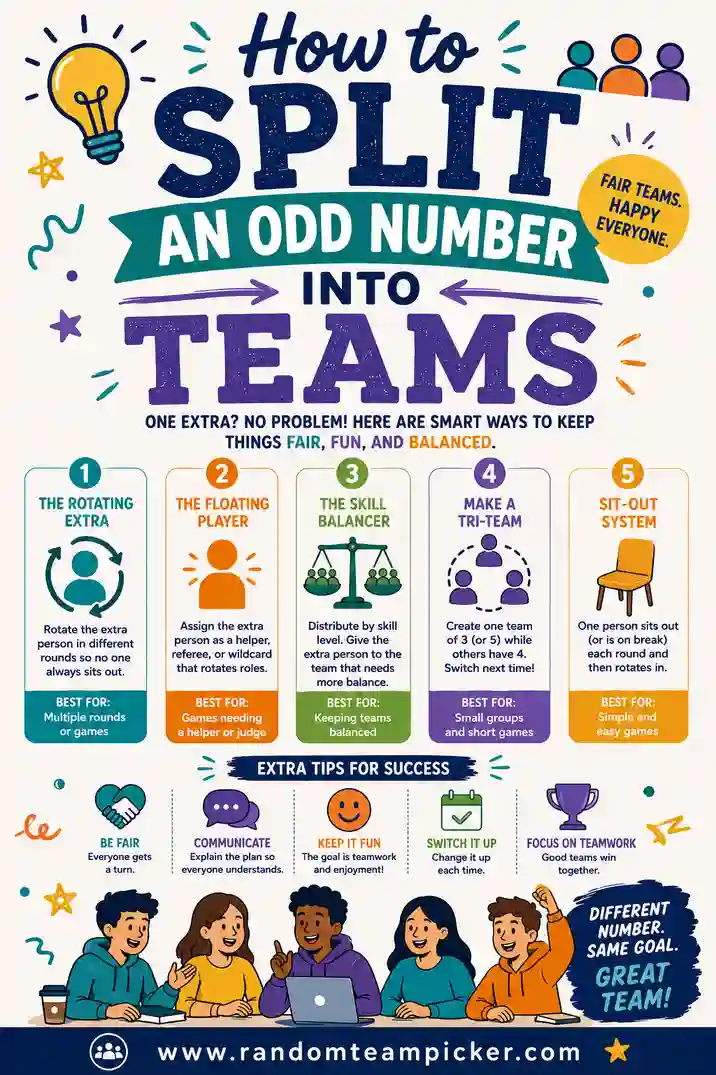
Splitting kids for other games this spring? See our team generator for kids' games and the tips on splitting an odd number into teams. For a fun twist, give your hunt teams names from our random team names list. When you're ready, the free random team picker splits your real crowd in one click.
FAQ
How do you split kids for an egg hunt?
Group them by age first, such as 0 to 3, 4 to 6, 7 to 10 and 11 and up, and give each group its own area or a staggered start. Then split each age group into teams at random.
What age groups should an Easter egg hunt have?
A common setup is ages 0 to 3, 4 to 6, 7 to 10 and 11 and up. With only a few kids, two groups work: under 6 and 6 and up.
How many eggs do you need per child?
A common rule of thumb is about 10 to 15 eggs per child, with extra for the youngest group. Set a limit so fast hunters stop and help younger kids.
When is Easter 2027?
Easter 2027 is Sunday, March 28. Many family and church hunts happen that weekend or on Saturday, March 27.
How do you keep an egg hunt fair for little kids?
Give toddlers their own small area with eggs in plain sight, start them first, and pair them with a grown-up or an older buddy.