Who Goes First: Coin Flip, Dice, Rock Paper Scissors, Straws and a Random Turn Order
The fastest fair way to decide who goes first is to let chance do it, and to agree on the method before anyone touches the game. For two players, flip a coin. For three to six, have everyone roll a die and let the high roll start. For a bigger group, or when you want the whole order settled at once, shuffle every name into a numbered turn order: 1st, 2nd, 3rd and so on. Nobody can argue with a result they agreed to a minute ago.
The small tool on this page does all of it: flip a coin, roll a die, throw rock paper scissors, draw a high card, or shuffle up to 12 players into a full turn order. Below it you'll find the rules for each method, a quick rock paper scissors bracket, how to draw straws with no screen at all, and the house rules families use to keep game night friendly.
Key facts
- Coin flip suits 2 players; a die suits up to 6; high card suits up to 13.
- A full random turn order works for any group, up to 12 in the box below.
- Rock beats scissors, scissors beats paper, paper beats rock.
- Opposite faces of a standard die add up to 7.
- Agree on the method and the tie rule before anyone picks.
🎲 Flip, roll or draw
Choose a group, then spin. One for each player gives everyone in the names list below a different one.
👥 Random Team Picker: split your list into teams
The sample names are from this page. Replace them with yours, one per line or separated by commas.
In the box headed "Flip, roll or draw," tap a chip: Coin flip, Roll a die, Rock paper scissors, High card (Ace down to 2), or Mixed bag for all of them. Press Spin to draw one result. To settle the whole table, type the players' names in the Names box and press One for each player: every name gets a different result from that chip, so with Roll a die nobody can tie. For a complete order, use the splitter instead. Its teams are labeled 1st, 2nd, 3rd and onward, so set Teams to the number of players (up to 12) and press Split into teams. The name in 1st starts. Press Shuffle again for a new order, or Copy teams to paste it into a group chat.
Quick reference: which method fits your table
| Method | Players | Who starts |
|---|---|---|
| Coin flip | 2 | Whoever wins the call |
| Roll a die | 2 to 6 | Highest roll, unless agreed otherwise |
| Rock paper scissors | 2, or a bracket | Winner of the throw |
| High card | 2 to 13 | Highest card, Ace high |
| Drawing straws | Any, in person | Short straw, or long if agreed |
| Random turn order | Any, up to 12 here | The name in the 1st box |
Shuffle the whole turn order in one go
Picking only the first player still leaves a question: who goes second? When play passes to the left, that answers itself. But for a gift swap, a talent show or class presentations, it helps to settle the whole line at once.
Say six friends are playing: Ava, Ben, Cora, Dylan, Emma and Finn. Type the six names, set Teams to 6 and press Split into teams. If Emma lands in 1st, Cora in 2nd and Ben in 3rd, that's the order for the night. Nobody can say they were skipped. I like to rotate it between games: whoever was 1st moves to the bottom, so the starting spot travels around the table.
For more than 12 people, open the full Random Team Picker and set people per team to 1. Everyone becomes their own team in a random order, whatever the size of the list. The random order generator guide covers long lists in more detail.
Coin flip: the classic for two players
A coin flip works because both sides have the same chance. One player calls heads or tails, and if the call is right, that player chooses whether to go first. Decide in advance what heads and tails mean, so nobody re-reads the result to suit themselves, and let the player who didn't call read it aloud. A coin also settles small choices around a game: who deals, which side of the board, who picks the colors.
For a longer contest, try a best-of series. In a best of three, the first side to win two flips takes it; best of five needs three wins, and best of seven needs four. One thing to know about the Spin button: it works like pulling from a hat and won't repeat a result until both sides have come up. That's ideal for handing out turns, but for a best-of series I'd flip a real coin, since each real flip is independent of the last. For more than two choices, a coin can't help, so reach for a die.
Rolling a die to see who starts
Many board games already say "highest roll goes first," and it's a fair rule for up to six players. A standard die has six faces numbered 1 to 6, each with the same chance, and opposite faces always add up to 7: 1 sits opposite 6, 2 opposite 5, and 3 opposite 4.
The trouble with real dice is ties. The usual rule is that only the tied players roll again. With the tool you can skip ties: put up to six names in the Names box, tap Roll a die and press One for each player. Each player gets a different number, so the highest is clear at once. With two dice, totals run from 2 to 12, and 7 is the most common because it can be made in the most ways. A die is also a quick way to pick from a short list: number six game ideas and roll. If you're stuck on what to play, the random activity generator has a whole chip of classic games.
Rock paper scissors: rules, a bracket and friendly tips
The rules
Rock is a closed fist, paper is a flat hand, and scissors is two fingers in a V. Rock beats scissors, scissors beat paper, and paper beats rock. If both players show the same shape, it's a tie and you go again. Say "rock, paper, scissors, shoot" together and show your hand on "shoot," so nobody changes at the last second. On screen, tap the Rock paper scissors chip and press Spin once for each player, then compare. Don't use One for each player here: it gives everyone a different shape, and in the real game two players can both throw rock.
Running a bracket for a group
For a party or a class line, type all the names and set Teams to half the number of players. Eight players make four pairs, and each pair plays best of three. Type the winners back in, split again, and repeat until one champion is left. An odd player gets a bye. Four players need 2 rounds, 8 need 3, and 16 need 4. The random pair generator is made for pairs, and the tournament team generator guide covers bigger events.
Honest tips for getting better
Against someone who throws truly at random, no strategy wins more than its share. But people aren't random. Some repeat a throw after a win, some switch after a loss, and many have a favorite shape when they're nervous. Spotting these habits over several rounds is a fun puzzle for patient kids. The best tip is to mix it up yourself, play at a quick pace, and treat a loss as part of the fun. For young players, practice the hand shapes first and play best of three, so one loss isn't a big deal.
High card: let the deck decide
A standard deck has 52 cards in four suits, Hearts and Diamonds in red, Clubs and Spades in black, each running Ace, 2 through 10, Jack, Queen and King. Everyone draws one card and the highest starts, which works for up to 13 people. Agree first whether the Ace is high or low. In the tool, the High card chip runs from Ace down to 2, and One for each player gives every name a different rank, so there are no ties.
With a real deck, two players can draw the same rank, so agree on a suit order in advance. A common one is Spades, Hearts, Diamonds, Clubs, highest to lowest. Have one person shuffle and another cut, then draw from the top. The same draw starts games like War, Go Fish or Crazy Eights.
How to draw straws with no screen at all
Drawing straws is the offline method for campsites, power cuts and long car trips. You need one straw per player; toothpicks, strips of paper or dry spaghetti all work. Make one shorter than the rest. The holder grips them in a fist with the tops level, so they all look the same length. Each player pulls one without peeking or swapping, and everyone reveals at the same moment.
Agree first what the short straw means: it can start, or the long straw can. Ideally the holder isn't playing, and nobody feels the ends before choosing. For a full order, cut every straw to a different length and line up from longest to shortest. "Drawing the short straw" means getting the unlucky pick, so with kids I like to make it something fun, such as choosing the music.
House rules that keep game night friendly
Plenty of families mix a random pick with their own traditions. Rotation is the most popular: whoever went last in this game goes first in the next. Some let the youngest or the birthday person start, and others let the last winner choose who begins.
Check the game's own instructions first, because many published games say who starts, and the game was designed around that. For team games, split the players into teams first, then decide which team starts. The Random Team Picker can balance teams by skill and keep siblings apart, and our guide to picking captains fairly pairs well with any of these methods.
Ties, late arrivals and sore losers
Most arguments come from three moments: a tie, someone joining late, and someone who dislikes the result. For ties, only the tied players roll or draw again. A late arrival joins the end of the current order rather than forcing a reshuffle. And a re-flip is only for a tie or a coin that rolled under the couch, never for an answer someone doesn't like.
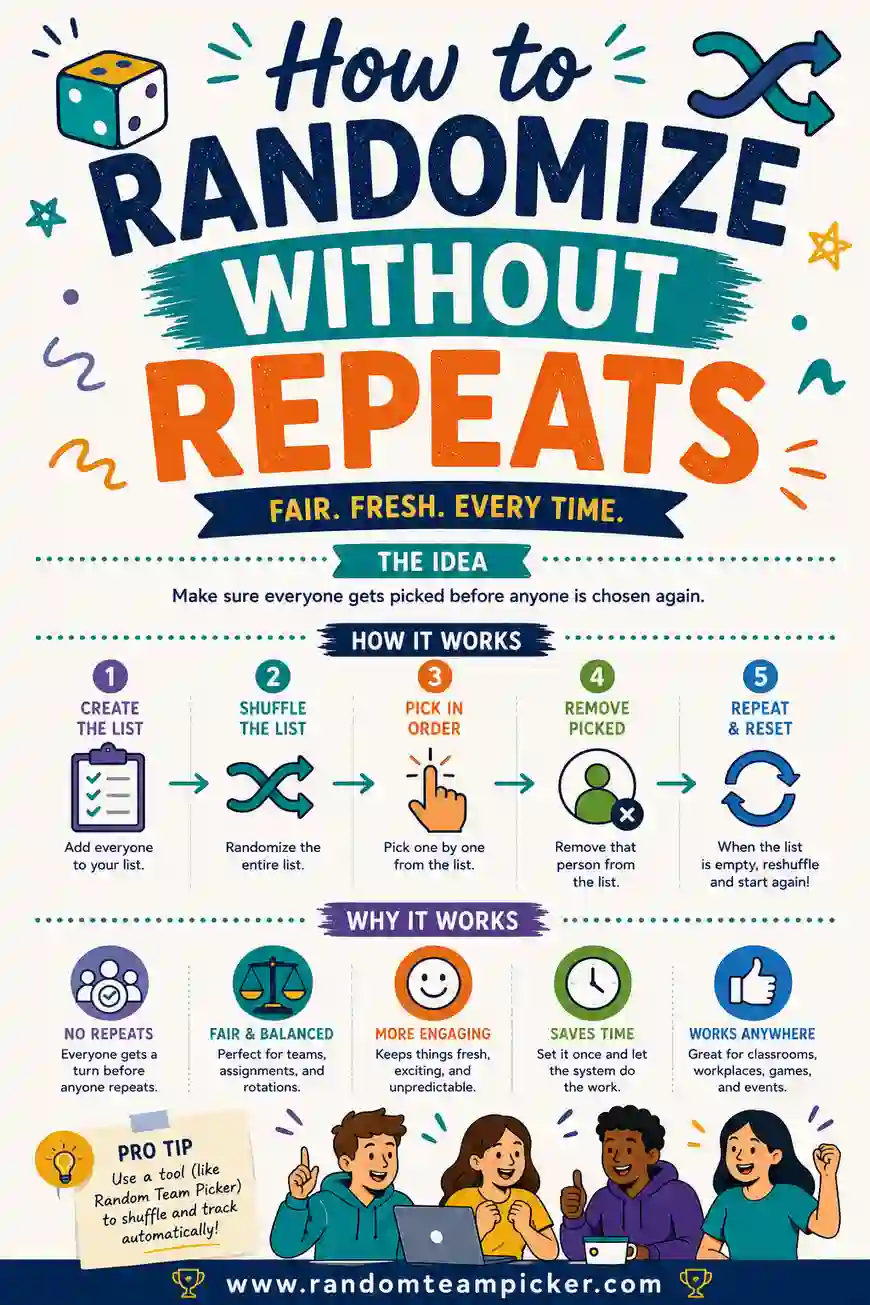
If the same child keeps losing the flip, switch to a rotating order for the rest of the night. Our guide on how to randomize without repeats shows how to make sure nobody goes first twice before everyone has had a go.
Picking a starter for classes, parties and gift swaps
Teachers can use the numbered order for presentations, line leaders or who answers first in a review game. Show the shuffle on the board so students see it's random. For daily helpers, pair it with a classroom jobs list, and if you only need one name, the name picker is set up for that.
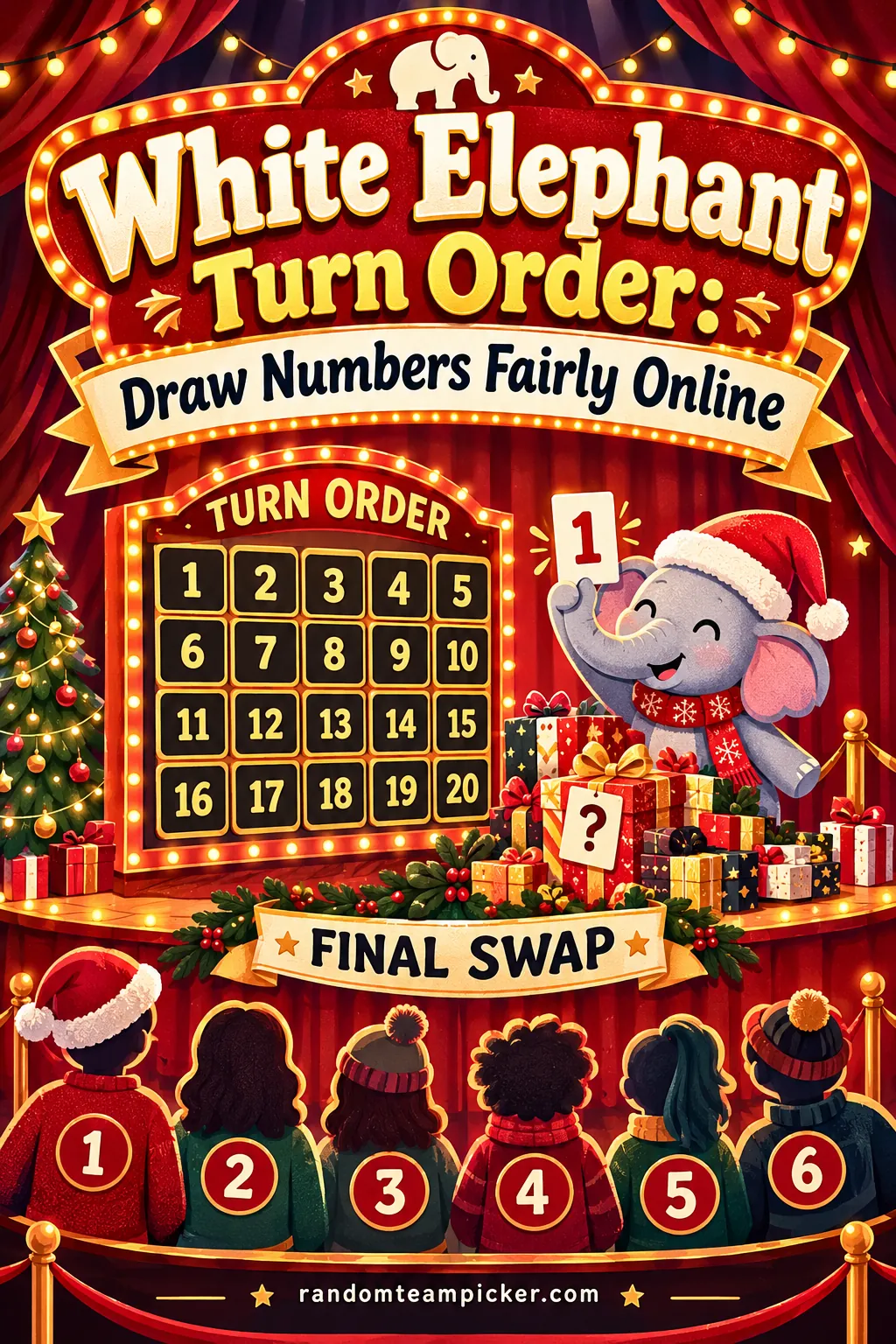
At a party, a mini rock paper scissors bracket is a fun opener while guests arrive. For a gift swap, a numbered order decides who picks first, and our white elephant turn order guide walks through it. For mixed-age kids' games, see the team generator for kids' games, and for more ideas on choosing sides, read the best ways to pick teams.
Quick answers about deciding who goes first
What is the fairest way to decide who goes first?
Any method where everyone has the same chance and the rules are agreed before the pick. A coin flip works for two, a die for up to six, and a shuffled turn order for any group. Agreeing in advance matters as much as the method, because nobody can complain about rules they just accepted.
How do I get a random turn order for my whole group?
Type every player's name into the Names box, set Teams to the number of players (up to 12), and press Split into teams. The boxes are labeled 1st, 2nd, 3rd and so on, so the result is your turn order. For more players, open the full picker and set people per team to 1.
Can two players tie when using the tool?
Not if you use One for each player. It gives every name a different result from the chosen chip, so with Roll a die each player gets a different number, and with High card each gets a different rank. With real dice or cards, only the tied players draw again.
Is it fair to keep flipping until I win?
No. A flip only works as a decider if everyone accepts the first result. Agree on best of one, best of three or another series before you start, and stick to it. A re-flip is for a tie or a coin that rolls away, never for an answer someone doesn't like.
Is there a way to always win rock paper scissors?
No. Against a player who throws truly at random, every shape has the same chance to win, tie or lose. People do have habits, like repeating a winning throw or switching after a loss, and noticing them can help a little in family games. Mixing up your own throws is the best defense.
How do you draw straws fairly?
Use one straw per player, cut one shorter, and hold them with the tops level so they look the same. Ideally the holder isn't playing. Agree first on what the short straw means, let nobody feel the ends, and have everyone reveal at once. Toothpicks or paper strips work if you have no straws.
Is the Ace high or low when drawing for first?
Whichever you agree on before drawing. In the tool's High card chip the Ace is the top card, followed by King, Queen, Jack and 10 down to 2. With a real deck, also agree on a suit order for ties, such as Spades, Hearts, Diamonds, then Clubs.
What if the game's rules already say who starts?
Follow the rulebook, since the game was designed around that rule. Save the coin, die or turn order for games that don't say, or for deciding which team or seat starts when the rules leave it open. Many families also simply rotate the first player from one game to the next.