Random Batting Order and Lineup Generator for Youth Baseball and Softball
To make a random batting order, paste the names of the players at today's game, set the number of teams to the number of players, and press Split into teams. Each player lands on a card labeled Batting 1st, Batting 2nd and so on. That's your lineup. Copy it to your scorebook or phone, and shuffle again for the next game.
For the field, use the "Pick a random position" box. Tap Infield, Outfield or Battery, or use all positions, and press One for each player: every name gets a different spot for the inning. It's built for youth and rec baseball, tee-ball and softball, where everyone bats, everyone plays, and nobody should always hit last or sit in right field all season.
Key facts
- Set teams equal to the number of players for a full random batting order (up to 12 here).
- Many rec leagues use a continuous batting order: everyone on the roster bats.
- A baseball defense has 9 positions: battery (2), infield (4) and outfield (3).
- Rotate positions by inning so every child plays infield and outfield.
- Catchers need full protective gear every time, even in practice.
⚾ Pick a random position
Choose a group, then spin. One for each player gives everyone in the names list below a different one.
👥 Random Team Picker: split your list into teams
The sample names are from this page. Replace them with yours, one per line or separated by commas.
Here's how to use the tool above. In the Names box, replace the sample 12-player roster with your players, one per line. Use the − / + control to set Teams to the number of players (10 players, 10 teams), then press Split into teams; each team is a single player, labeled Batting 1st through the last spot. Press Shuffle again for a new order, and Copy teams to paste it into a group chat. Above the splitter, the "Pick a random position" box has Infield, Outfield and Battery chips; press One for each player to give every name a different field position for the inning, or Spin to draw one position at a time. With more than 12 players, press "Open in the full team picker" and set People per team to 1 for a random order of any size.
Quick reference: batting order and positions by level
| Level | Batting order | Positions |
|---|---|---|
| Tee-ball | Random; whole roster bats | Rotate every inning |
| Coach or machine pitch | Random or rotating | Rotate every inning or two |
| Kid pitch, rec league | Rotating | Rotate; battery only for trained players |
| Competitive travel or older teams | Often set by the coach | Mostly set positions |
What a continuous batting order is
In a standard nine-player game, only the nine fielders bat. Many youth and recreational leagues instead use a continuous batting order: everyone on the roster bats in turn, whether or not they're in the field that inning. With 12 kids, all 12 bat, and the order just keeps cycling through the game. That's why a random order makes so much sense at this level. The lineup isn't really strategy; it's fairness. Every child gets roughly the same number of at-bats, and the question is simply who goes first.
Leagues set their own rules on batting the whole roster, free substitution, inning limits and how many runs a team can score per inning, so check your league's rules before opening day. With a nine-player lineup, shuffle the starters and bat subs as they come in.
Making the order fair across a season
A single random order is fair for one game. Over a season, though, pure luck can put the same child at the bottom three times in a row, and kids notice. The fix is to start random and then rotate. Use the generator for game one. For game two, the leadoff hitter moves to the end of the order and everyone else moves up one spot. Keep rotating each game. In a 12-player roster, every child leads off once in 12 games and bats in every part of the order along the way.
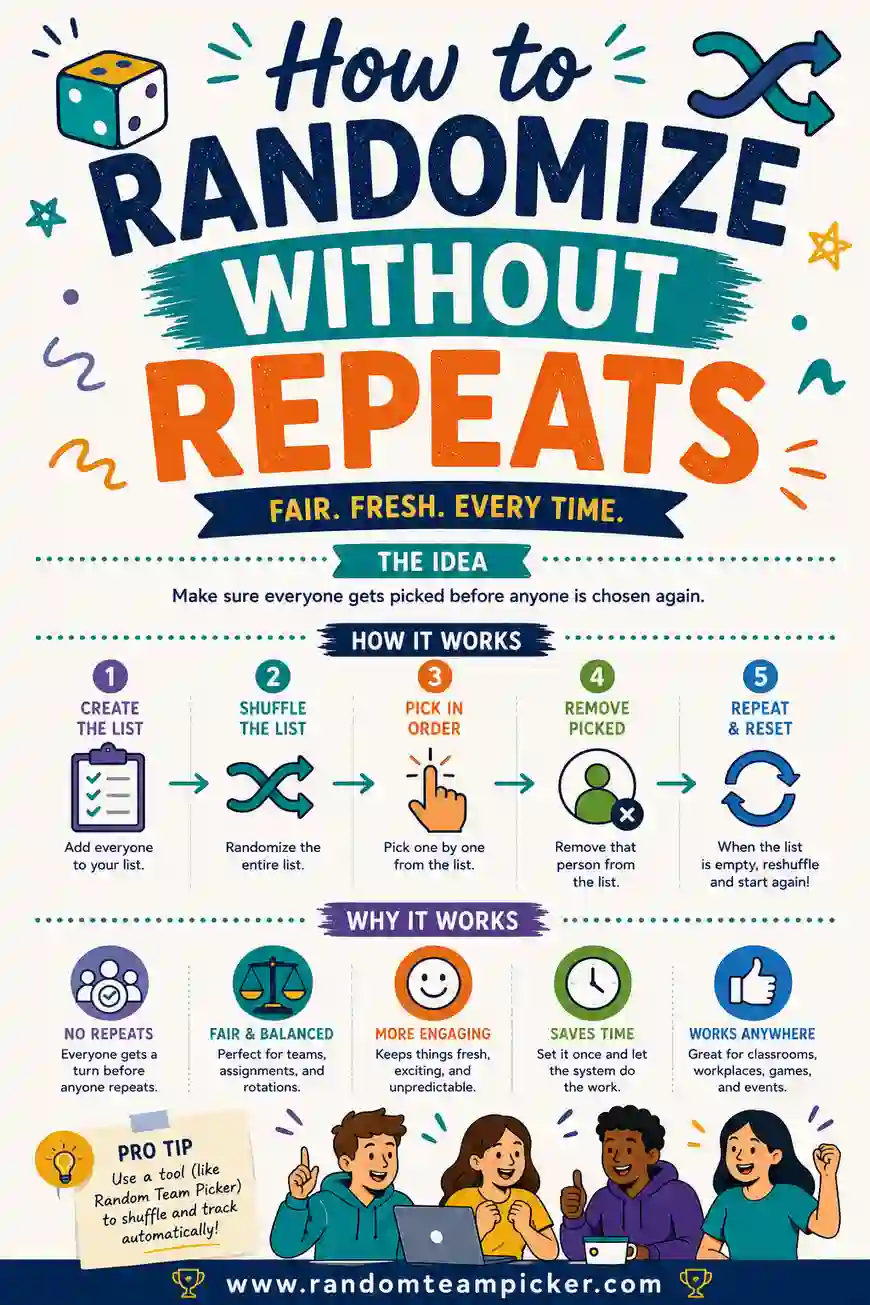
If you prefer a fresh shuffle every game, keep a simple tally of who led off and who batted last. If the same name keeps landing at the end, rotate that player up. Our guide on how to randomize without repeats explains why rotating usually feels fairer than reshuffling. Late arrivals go to the bottom of the order, and players who leave early simply drop out; nobody else moves.
Example: 12 players over four games
Say the generator gives Aria, Brody, Cami, Danny, Eva, Finn, Gwen, Hector, Izzy, Jonah, Kira and Liam for game one. In game two, Brody leads off and Aria bats 12th. In game three, Cami leads off and Brody bats 12th. By game four, Danny leads off and the last spot belongs to Cami. Write all four on one index card.
Giving every player a field position
A baseball or softball defense has nine positions. The battery is the pitcher and catcher. The infield is first base, second base, third base and shortstop. The outfield is left, center and right field. To set an inning, put the players who are in the field in the Names box and press One for each player with all positions selected. With 10 players and nine spots, set one name aside for the bench first and rotate who sits.
The chips help when you want to control the mix. Want every child to play the infield at least once today? Put four players who haven't had an infield turn in the Names box, tap Infield, and press One for each player. Do the same with Outfield for the next three. Use the Battery chip only for players you've trained at pitcher and catcher, which matters more and more as kids start pitching to each other.
Rotating positions inning by inning
A written rotation keeps playing time even and saves arguments in the dugout. Here's a simple four-inning plan for 10 players, where P1 to P10 are your players in any order. Each inning, one player sits, and no one sits twice until everyone has sat once.
| Player | Inning 1 | Inning 2 | Inning 3 | Inning 4 |
|---|---|---|---|---|
| P1 | Pitcher | 1st base | Left field | Bench |
| P2 | Catcher | 2nd base | Center field | Pitcher |
| P3 | 1st base | Shortstop | Bench | Left field |
| P4 | 2nd base | Bench | Pitcher | Right field |
| P5 | Shortstop | Left field | Catcher | 3rd base |
| P6 | 3rd base | Right field | 1st base | Center field |
| P7 | Left field | Pitcher | 2nd base | Shortstop |
| P8 | Center field | Catcher | Shortstop | 1st base |
| P9 | Right field | 3rd base | Right field | 2nd base |
| P10 | Bench | Center field | 3rd base | Catcher |
Notice that every player gets at least one infield inning and one outfield inning, and the battery changes each inning. In a real game, only move a child to pitcher or catcher if they've practiced it. Swap that spot with someone who has, and keep the rest of the plan. If your games are six innings, keep going in the same pattern.
Coach pitch, kid pitch and safety
In tee-ball and coach-pitch or machine-pitch divisions, an adult or a machine delivers the ball, and a player stands near the pitcher's spot as a fielder. That position sees a lot of hard-hit balls, so some leagues ask that player to wear a helmet, and many coaches have them stand a step to the side of the adult pitcher. Teach young fielders the ready position and to keep their glove up.
Once kids pitch to each other, things change. Pitching takes practice, and arm health matters. Many leagues, including Little League, set pitch-count limits and required rest days by age, so learn your league's rules and keep a pitch count every game. Only put a child on the mound if they've practiced pitching and want to. The same goes for catcher: it takes practice to block pitches and receive the ball safely.
Whoever catches, in a game or in the bullpen, must wear full catcher's gear: a catcher's helmet with face mask, a chest protector and shin guards, plus the throat guard and protective cup your league requires. Check that the gear fits the child; a helmet that slips over the eyes isn't protecting anyone. All batters and base runners wear batting helmets. Keep players who aren't batting behind the fence, and only the on-deck hitter swings, in a safe spot.
Keeping playing time fair and kind
Fair playing time is about more than minutes. Give every child at least one infield inning and one outfield inning per game if they want it. Track bench turns on a clipboard so each player sits about the same number of innings across the season. Ask players which positions they'd like to try, and let them practice a new spot at practice before trying it in a game.
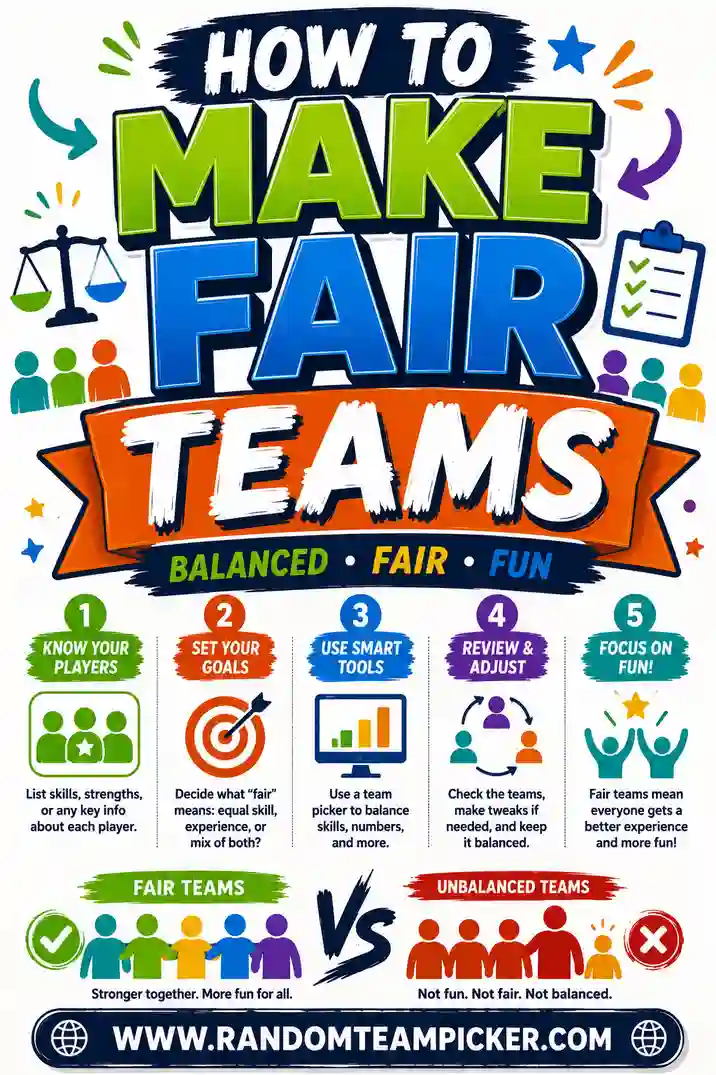
Praise good at-bats, not just hits: a long at-bat, a smart take, a hard run to first. Post the lineup in the dugout so kids know who's on deck and in the hole, and name an on-deck helper to keep things moving. Explain the rotation to parents at the first practice. Our guide on how to make fair teams has more ideas for keeping things positive.
Tracking lineups across games
A season goes much smoother with a simple record. After each game, write down the batting order and who played where each inning, either on an index card or in a note on your phone. Copy teams makes it easy to paste the order from this page into the note. Before the next game, glance at the record: who hasn't led off yet, who hasn't caught, who sat the most last time. Then adjust the rotation so those players get their turn. You can also paste the roster into the full team picker and print the list for the dugout wall.
A good lineup card has the batting order with first names and jersey numbers, each player's position by inning, who's on deck, subs and late arrivals, and league rules like pitch counts or innings limits. For other sports, the soccer lineup generator and basketball rotation generator use the same fair-time ideas.
Kickball, practice scrimmages and PE class
The same tool makes a kicking order for kickball: paste the team, set teams to the number of players, and the cards are the order. Kickball usually uses nine fielders with a pitcher who rolls the ball, though rules vary by league and school. In PE class or at field day, shuffle each inning so different kids lead off. The field day team generator makes the color teams first, and the team generator for sports and PE covers whole-class splits.
For a practice scrimmage, split the roster into two sides with the free Random Team Picker, which can also balance by skill and keep two strong pitchers apart. Use the who goes first generator to decide which side bats first. Need team names for the scrimmage? The sports team name generator has clean ideas kids like.
When older teams set the order by skill
On older, more competitive teams, coaches often build the lineup on purpose. A common general approach puts a player who gets on base often and runs well at leadoff, a good contact hitter second, the strongest hitters third and fourth, solid run producers fifth and sixth, and developing hitters lower, sometimes with speed in the last spot to turn the lineup over. Even then, a random order is handy for early-season scrimmages. For younger kids and rec leagues, fairness matters more than strategy, so a random or rotating order is the friendliest choice. For a team to follow, pick a random MLB team.
Quick answers about batting orders and lineups
How do I make a random batting order?
Paste the players at today's game into the Names box, set Teams to the number of players, and press Split into teams. Each card is a lineup spot: Batting 1st, Batting 2nd and so on. Press Shuffle again for a new order, and Copy teams to paste it into your scorebook app or a parent group chat.
What if my roster has more than 12 players?
The in-page tool goes up to 12 teams, so 12 batting spots. For a bigger roster, press Open in the full team picker, choose people per team and set it to 1. Every player becomes a team of one, and the order of the teams is your random batting order, however long the roster is.
How do I give every player a different field position?
Put the players who are in the field in the Names box, then press One for each player in the Pick a random position box. Each name gets a different position. Use the Infield, Outfield or Battery chip to control the mix, and set any extra players aside for the bench first.
How often should youth players rotate positions?
Every inning or every two innings works well for most rec teams. Aim for each child to play at least one infield and one outfield inning per game, and track bench turns so nobody sits twice before everyone sits once. Pitcher and catcher should go only to players who have practiced those spots safely.
What is a continuous batting order?
It means everyone on the roster bats in turn, including players who aren't in the field that inning. Many youth and recreational leagues use it so every child gets the same chances at the plate. Rules differ between leagues and age groups, so check your league's handbook before the first game.
What gear does a youth catcher need?
A catcher's helmet with face mask, a chest protector and shin guards, plus a throat guard and protective cup if your league requires them. Make sure everything fits, especially the helmet. Catchers should gear up for bullpen sessions and warm-ups too, not only during the game, because foul tips and wild pitches happen anywhere.
Should I rotate or reshuffle the batting order each game?
Both are fair. Rotating one spot each game guarantees every player leads off and bats last equally over a season. Reshuffling is quicker but can repeat by chance. A good middle path is to reshuffle, keep a tally, and move up any player who has landed near the bottom too often.
Can I use this for softball and kickball?
Yes. Softball uses the same nine positions as baseball, though some rec leagues add a tenth fielder in the outfield, so check your rules. For kickball, the cards become your kicking order. The position picker works for both, since the field positions are nearly the same.