Random Order Generator: A Fair Order for Presentations, Turns and Lines
To put a list of names in a fair random order, paste the names into the tool below, set the number of teams to the number of names, and press "Split into teams." Each person lands on their own card, labeled 1st, 2nd, 3rd and so on. Read the cards from top to bottom and that is your order, whether it is for class presentations, turns in a board game, the line to the door or breaking a tie.
A random order is fair because nobody chose their spot, not even the person running it. This guide shows how to use the order for the most common jobs, with a worked example for scheduling 22 presentations, simple rules for breaking ties, and ways to keep things fair when you use an order every week, so the same person is not first three times in a row.
Key facts
- Set teams equal to the number of names for a full order.
- The tool on this page orders up to 12 names at once.
- For longer lists, use the full picker with 1 person per team.
- Reverse or rotate the order in later rounds to share the advantage.
- Shuffle where people can see it, so the order is trusted.
🎲 Pick a random team
Choose a group, then spin. One for each player gives everyone in the names list below a different team.
👥 Random Team Picker: split your list into teams
The sample names are from this page. Replace them with yours, one per line or separated by commas.
The tool starts with ten sample names already set to ten teams. Replace them with your list, one name per line or separated by commas, then use the minus and plus buttons so the number of teams matches the number of names. Press "Split into teams" and each card shows one spot in the order, from 1st up to 12th. Press "Shuffle again" for a fresh order, or "Copy teams" to paste it into a message or slide. For a longer list, press "Open in the full team picker," which opens in a new tab. There, choose people per team and set it to 1, and every name becomes its own team in a random order, however long the list.
Quick reference: reading the order
| Use | What the 1st card means |
|---|---|
| Presentations | Presents first |
| Board or card game | Takes the first turn |
| Line order | Line leader |
| Tie-breaker | Wins the tie |
| Draft | Picks first in round 1 |
| Gift exchange | Chooses a gift first |
Presentation order in class
Presentation order is the most common reason teachers reach for a random order, and it is one of the places where fairness really matters. Students care a lot about whether they go first or last. Some want to get it over with; others want the extra days to prepare. A random order sidesteps the argument because nobody can say they were treated differently.
Shuffle in front of the class, on the projector, so students see it happen. Then post the order with dates next to each name, not just numbers. A list that says "Thursday: Ana, Ben, Cleo" is far clearer than "you are 14th." It also lets families help students plan. I like to allow one trade between two willing students, agreed by both and told to the teacher by a set day. That handles real clashes, like a sports trip, without turning the order into a free-for-all.
For absences, keep a simple rule: if someone is away on their day, the next name moves up and the absent student goes to the end of the list or to a make-up slot. Decide this before you shuffle and say it out loud, so nobody feels it was invented on the spot. In a debate class, the same order can decide which pair speaks first, and our team generator for debate class covers setting up the sides.
A worked example: 22 presentations over four days
Say you have 22 students and four class periods for presentations. Twenty-two divided by four is 5.5, so two days will have 6 presenters and two days will have 5. Because 22 names is more than the 12 slots on this page, open the full Random Team Picker, paste the class list and set people per team to 1. You get 22 single-name teams in a random order.
Now cut the list into days. Names 1 to 6 present on day one, 7 to 12 on day two, 13 to 17 on day three and 18 to 22 on day four. Copy the order, add the dates, and post it. If one presentation runs long, the last name of the day simply becomes the first name of the next day, and everyone after moves along by one. Because you agreed the rule in advance, nobody minds.
Turn order for games
For a board game or card game, put the players' names in the tool and set the teams to match the number of players. The 1st card takes the first turn, and play goes down the list. In many games, play then continues around the table, so it helps to seat people in the order the tool gives. That way nobody has to remember the list.
If you only need to know who goes first, and play then just goes clockwise, the 1st card is all you need. Our who goes first generator has quick options like a coin flip or a dice roll for that job. For a series of games, the next game can start with the player who was 2nd, so the first turn moves around the group. Tournaments with many matches need a schedule too, and the team generator for tournaments guide shows how to set one up.
Line order and daily routines
A random order is useful for small daily routines that children notice: line leader, who washes hands first, who chooses the read-aloud, or lunch line order. Make one random order at the start of the week and work down it day by day. Each child can see when their turn is coming, which cuts down on "it's never me."
The same list works for classroom helpers. If you run a weekly job rotation, an order is a quick way to decide who picks a job first. Our classroom jobs list has ideas and a weekly job picker. At home, a random order can decide who picks the Friday movie, who showers first on a busy morning or who chooses dessert each night. During the holidays, advent calendar turns are a sweet use, and gift exchanges have their own guide to white elephant turn order.
Breaking a tie fairly
Ties happen in quizzes, contests and team votes. A random order is a clean way to break them, as long as you set the rule before the tie happens. Put only the tied names in the list, set the number of teams to match, and press split. The 1st card wins the tie, or takes the higher place. If three people tie for second, the order gives you 2nd, 3rd and 4th in one go.
When the tie is for a prize or a spot in a final, show the shuffle to everyone involved. If the tie can be settled by play, such as one more quiz question, many people prefer that, and the random order can decide who answers first. Keep the random tie-break for when there is no time or no fair extra round.
Drafts and snake order
In a draft, whoever picks first gets the best choice. A snake order balances that. Round 1 follows the random order, round 2 runs in reverse, and round 3 goes back to the start. The person who picked last in round 1 picks first in round 2, so they get two picks in a row. Snake drafts are common in fantasy sports, schoolyard captain picks and gift exchanges. The team generator for fantasy drafts goes into more detail, and baseball coaches can use a random batting order generator for lineups.
Is it better to go first or last?
It depends on the situation, which is exactly why random feels fair. In presentations, going first means it is done early but there is no chance to watch others first. Going last means more time to prepare but more nerves while waiting. In a gift exchange with steals, the first person picks from all the unopened gifts, but the last person can choose from everything already opened. In many games, going first is a small advantage. In a draft it is a big one unless you use a snake order. Because each spot has upsides and downsides, nobody can claim the order was rigged against them.
Keeping it fair week after week
One random order is fair. Many random orders in a row are fair on average, but chance will sometimes put the same person first twice or three times running, and people notice. If you use an order every week, there are two simple fixes. The first is rotation: make one random order, then each week move the top name to the bottom. Over a full cycle, everyone has every spot once. The second is reversing: run the order forward one week and backward the next.
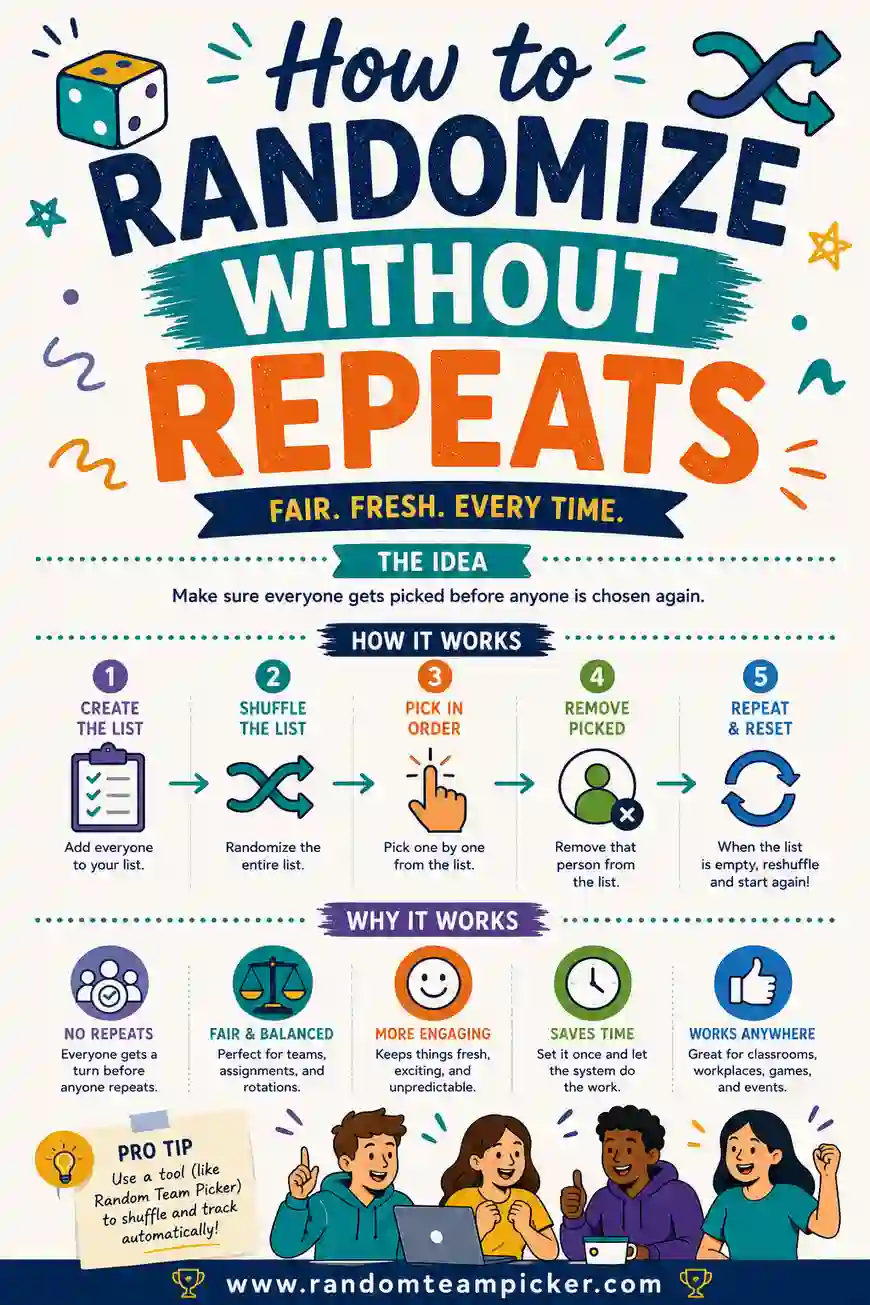
If you prefer a fresh shuffle every time, keep a short record of who went first and check it before you post. Our guide on how to randomize without repeats explains rotations in more detail. When you only need one name, not a whole order, the name picker is quicker. If you need partners rather than an order, try the random pair generator.
A no-screen method
No projector or device? Write numbers 1 to N on slips of paper, fold them, mix them in a cup and let each person draw one. That is the same fair order, done by hand. It works well for a small group at a party or a game night. For a large class, the tool is quicker and leaves no slips to lose, and you can copy the result straight into your plans.
Quick answers about random order
How do I make a random order of names?
Paste your names into the tool, set the number of teams to the number of names and press "Split into teams." Each card holds one name and is labeled 1st, 2nd, 3rd and so on. Read the cards in label order. Press "Shuffle again" if you need a completely new order.
How many names can I put in order?
The tool on this page orders up to 12 names, one per card. For longer lists, open the full team picker, set people per team to 1, and every name becomes its own team in a random order. That works for a whole class or a large club with no extra steps.
How do I decide who goes first fairly?
Put everyone's name in the list and split them into a random order. The 1st card goes first. To keep it fair over several rounds, move the first player to the end each round, or reverse the order in round two so the person who went last gets to go first.
Can I randomize presentation order for my class?
Yes. Paste the class list, shuffle in front of the students, then post the order with dates beside each name. Agree on a rule for absences before you shuffle, such as the next name moving up, and allow one trade between two willing students.
How do I break a tie with a random order?
Put only the tied names in the list and set the teams to match. Press split, and the 1st card wins the tie or takes the higher place. Agree the rule before the contest starts, and show the shuffle to everyone involved so the result is trusted.
What is a snake order?
A snake order reverses direction every round. Round 1 follows the random order, round 2 runs from last to first, and round 3 goes forward again. It balances the advantage of picking first, which is why drafts and team picks often use it.
Can the same person keep coming up first?
With a fresh shuffle each time, yes, by chance. If that matters, rotate one fixed order by moving the top name to the bottom each week, or keep a record and reshuffle if the same person lands first again.
Is this the same as picking one random name?
Almost. The 1st card works as a single pick, but this page gives you everyone's position at once. If you only ever need one name, the name picker is quicker. When everyone needs a spot, use the full order. The full team picker handles lists of any length.