White Elephant Turn Order: Draw Numbers Fairly Online
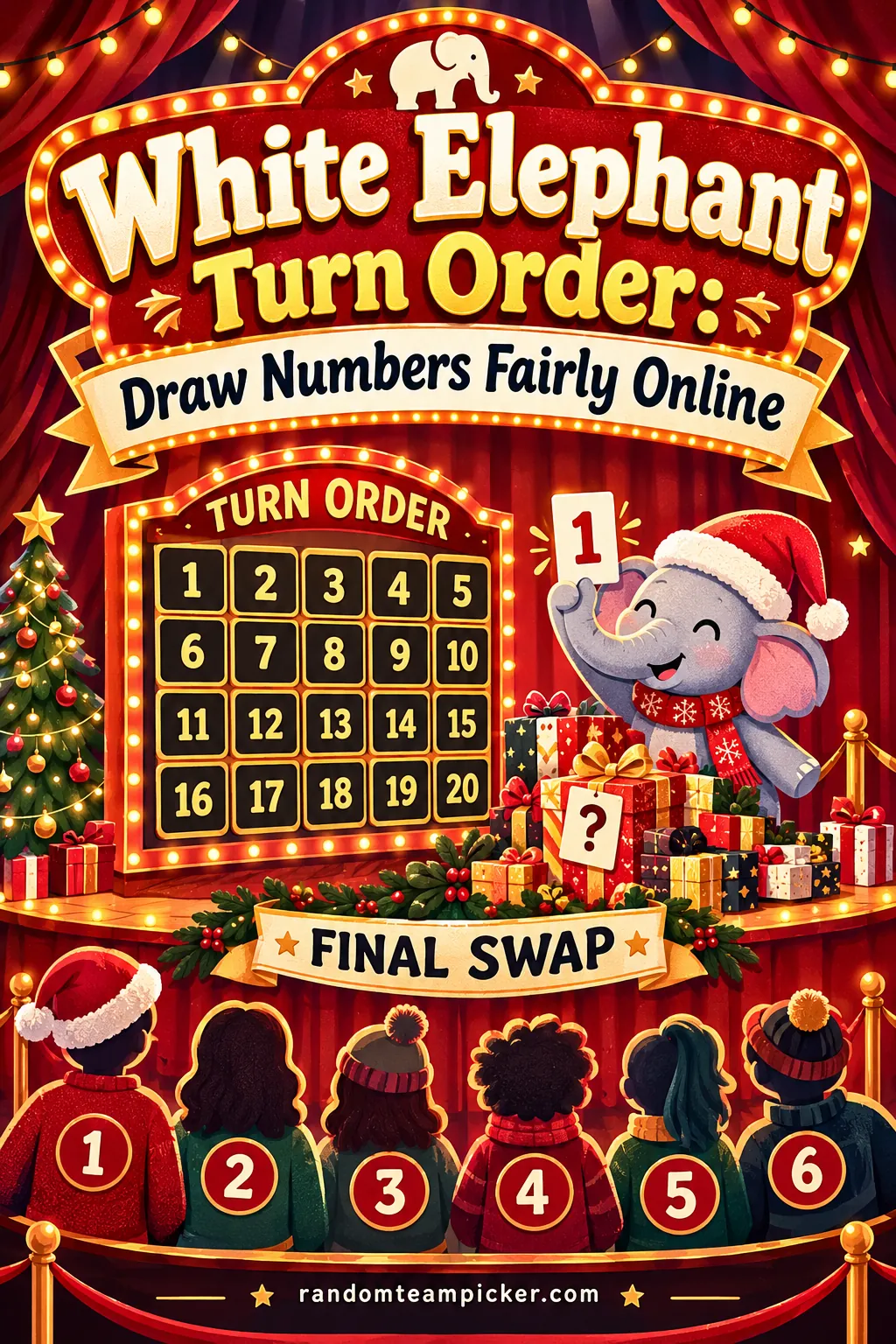
The fastest fair way to run a white elephant number draw online is to paste every player's name into a random team generator, set it to one person per team, and read the numbered teams as your turn order: Team 1 picks first, Team 2 picks second, and so on. Then announce one extra rule before anyone unwraps a thing: player 1 gets a final swap after the last turn. That rule is what makes the draw truly fair.
You can do the whole draw in under a minute with the free random team generator. There are no slips to cut, no bowl to pass around, and no "wait, I didn't get a number" moments. This guide covers the exact settings, how to show the order to the room, the rules that keep the game fair from first pick to last, and fixes for late guests, kids, couples and remote players.
Why the Number Draw Matters More Than People Think
In white elephant (also called Yankee swap or a gift swap), every player brings one wrapped gift and every player takes one turn. On your turn you either open a new wrapped gift or steal one that's already been opened. That sounds simple, but your turn number shapes your whole game.
Here's why turn position matters so much:
- Player 1 has nothing to steal. They have to pick a wrapped gift blind, and they're the most likely person to lose it, because every later player can take it.
- Middle players get a few choices. By turn 6 or 7, there are several opened gifts on display, so a steal is a real option.
- The last player sees everything. They can look at every opened gift and take the best one, often with no one left to steal it back.
Without a fix, going last is the best seat in the house and going first is the worst. So the draw itself has to be fair, and the rules around it have to even out the gap. People notice when either part is off. If a host "just happens" to draw a late number, or the same aunt goes last three years running, the grumbling starts before the first bow comes off.
Paper slips in a bowl are the classic method, and they work. They also have small problems that show up every year:
- Someone has to write and fold the slips ahead of time, and it's easy to skip a number or write one twice.
- Slips get lost in couch cushions or dropped under the table.
- Two people unfold their slips at the same time and both say "I'm 4."
- The bowl reaches the last three people, and they feel they had no real choice.
- Nobody wrote down who drew what, so turn 9 and turn 10 argue about whose turn it is.
An online draw fixes all of that. Every person has the same chance at every position, the list is written down the moment it's made, and you can show it on a screen or send it to a group chat.
Who Picks First in White Elephant? The Fair Answer
Who picks first in white elephant? Whoever the random draw says. It shouldn't be the host, the oldest guest, the person who arrived first, or whoever shouts loudest. Any of those can feel unfair to someone. A random draw gives each player the same 1 in N chance of being first, where N is the number of players.
Here's what that looks like for common party sizes:
| Players | Chance of going first | Chance of going last | Chance of landing in the first half |
|---|---|---|---|
| 6 | 1 in 6 | 1 in 6 | 3 in 6 (half) |
| 8 | 1 in 8 | 1 in 8 | 4 in 8 (half) |
| 10 | 1 in 10 | 1 in 10 | 5 in 10 (half) |
| 12 | 1 in 12 | 1 in 12 | 6 in 12 (half) |
| 15 | 1 in 15 | 1 in 15 | 7 or 8 in 15 (about half) |
| 20 | 1 in 20 | 1 in 20 | 10 in 20 (half) |
That's the whole point of a fair draw: nobody starts with an edge. The team generator uses a standard, unbiased shuffle, so every possible order is equally likely, the same as a well-mixed bowl of slips.
Other ways families decide turn order, and how they compare:
| Method | How it works | Fair? | Main problem |
|---|---|---|---|
| Slips from a bowl | Numbered slips, everyone draws one | Yes, if slips are mixed well | Prep, lost slips, no record |
| Online draw | Names into a random generator, one per team | Yes | Needs a phone or laptop |
| Roll dice | Highest roll goes first, reroll ties | Mostly | Ties eat time in big groups |
| Youngest first | Order by age | Not random | Same people get the same spots every year |
| Alphabetical | Order by first or last name | Not random | The A names always go first |
| Order of arrival | First guest in picks first | Not random | Rewards people who live closest |
| Birthday closest to the party | Order by birth date | Not random | Same order every year |
Age, alphabet, arrival time and birthdays aren't bad ideas for a quick game with kids. They just aren't random, so they give the same people the same advantage every year. For a group that plays every December, a fresh random draw is the only method that stays fair over time.
If you want more ways to settle who goes first in any game, our guide on how to pick captains fairly walks through coin flips, draws and other quick options.
How to Do It With the Free Tool (Exact Settings)
Here's the full walkthrough on the free random team generator. The tool was built to split names into teams, but if every team has exactly one person, the numbered teams become a numbered list. That's your turn order.
Step 1: Add every player's name
Type each player's name on its own line in the names box, or paste a list. If you collected sign-ups in a spreadsheet or a notes app, copy the column of names and paste it in. Each line becomes one player.
A few tips before you go on:
- Only list people who brought a gift. One gift, one turn. If someone came without a gift, they can watch, help keep score or run the timer, but they shouldn't get a number.
- Make repeated names clear. Two cousins named Sam? Type "Sam R." and "Sam T." so everyone knows who's up.
- Use the names people answer to. "Grandpa Joe" is easier to call out than a full name.
Check the counter under the box. It shows how many names it found. If you have 14 gifts on the table, it should say 14 names.
Step 2: Set one person per team
Under Split mode, click People per team. Then type 1 in the number box, or use the minus button until it reads 1.
That's the key setting. With one person per team, the tool makes as many teams as you have players: 14 players means 14 one-person teams.
Step 3: Keep the plain number labels
In the Team names menu, choose Team 1, Team 2…. This puts a number on every card, so "Team 1" reads as turn 1, "Team 2" as turn 2, and so on. The fun name styles (animals, space, colors and the rest) are great for real teams, but they hide the numbers you need here.
Step 4: Turn off the extras you don't need
- Pick a captain: turn this off. It stars the first name on every team, and since every team has only one name, every player gets a star.
- Balance by skill: leave it off. It's for spreading strong and newer players across teams, which doesn't apply to a turn order.
- Constraints: leave the Keep together and Keep apart boxes empty. With one person per team, nobody shares a team anyway.
- Reveal animation: leave this on if you're showing the draw on a TV or laptop for the room. The cards appear one after another starting with Team 1, which builds a little suspense. Turn it off if you just want the list fast.
Step 5: Click Generate Teams
Click Generate Teams. You'll see a colored card for each player, in order: Team 1, Team 2, Team 3 and onward. Each card shows one name. Read them out in order and that's your turn list.
If someone spots a typo, fix the name in the box and generate again. Do that before you show the list to the room, not after (more on that below).
Step 6: Show it and save it
Above the cards, you'll find these buttons:
- Copy puts the results on your clipboard as text, ready to paste into a family group chat or a notes app.
- Copy link gives you a link that opens this exact draw. Send it to anyone who wants to check their number on their own phone.
- Share opens your phone's share menu so you can send the list to a message thread.
- Print gives you a clean printout with the controls and menus hidden. Tape it near the gift table.
- CSV and TXT download the list as a file, if you like keeping records from year to year.
Many hosts just take a screenshot of the cards and pin it in the group chat. That works too. The point is that the list exists somewhere everyone can see it, so turn 9 and turn 10 never have to argue.
A second way: one team, shuffled list
There's another setting that gets you the same result. Choose Number of teams, set it to 1, and generate. The tool shuffles everyone into a single card, and the names appear in random order from top to bottom. The top name goes first.
This version is handy on a small phone screen, since it's one tall card instead of many small ones. The only catch is that the names aren't numbered, so count down the list or number them by hand on a printout. If you turn on Pick a captain in this mode, only the top name gets a star, which makes it clear who opens first.
Both methods are equally random. Use whichever is easier to read for your group.
The Player 1 Final Swap: The Rule That Makes the Draw Fair
A random draw gives everyone the same chance at every number. But as we covered above, the numbers aren't worth the same. Turn 1 is the weakest spot and the last turn is the strongest. A fair draw into an unfair seat is still a rough deal for whoever lands it.
The fix most groups use is simple: after the last player takes their turn, player 1 gets one final turn. On that turn, player 1 can keep the gift they're holding or swap it for any opened gift that isn't frozen. Whoever loses their gift in that swap takes player 1's old gift. Then the game is over.
Here's why that one rule changes everything:
- Player 1 now gets the last word. They see every opened gift before making a final choice, the same advantage the last player had.
- The last player loses their sure thing. They can't assume their pick is safe, since player 1 might take it.
- Middle players stay interested. Their gift could still move at the very end, so nobody checks out after their turn.
This is also the rule groups forget most often. People draw numbers, play the game, and then someone says "Wait, doesn't player 1 get another turn?" after half the gifts are already in bags. Announce it before turn 1, put it on the rules card, and remind the room when the last player finishes.
How the final swap works, step by step
- The last numbered player finishes their turn, including any steal chain it causes.
- The host says, "Player 1, you get the final swap."
- Player 1 either keeps their current gift or picks any opened gift that isn't frozen.
- If they swap, the person who had that gift takes player 1's old gift. No further stealing.
- The game ends. Everyone keeps what they're holding.
Frozen gifts and the final swap
If your group freezes a gift after a set number of steals, decide ahead of time whether a frozen gift can be taken in the final swap. Most groups say no: frozen means frozen, even for player 1. That keeps the freeze rule meaningful. Whatever you pick, say it out loud before the first turn.
Should the final swap start a chain?
Some groups let the final swap trigger one more chain of steals. That's fun in a group of six and messy in a group of twenty. The cleaner version is a straight one-for-one trade: player 1 takes a gift, and the person who lost it gets player 1's old gift. No chain, no confusion, and the game ends on a clear moment.
House Rules to Announce Before Turn 1
The turn order is only fair if everyone plays by the same rules, and rules that get made up halfway through feel unfair to somebody. Pick your rules before the party, write them on one card, and read them out right after you show the turn order.
Here's a rule set that works well for most family and friend groups. None of these are official. They're common house rules, and you can change any of them, as long as you decide before the game starts.
| Rule | What it means | Why it helps |
|---|---|---|
| Player 1 final swap | Player 1 takes one more turn after the last player | Makes turn 1 as good as the last turn |
| Steal limit | A gift is frozen after its 3rd steal | Stops one gift from bouncing around all night |
| No immediate steal-back | You can't take back the gift that was just stolen from you | Prevents two people trading the same gift forever |
| One steal per turn | A turn ends once you steal or open | Keeps turns short |
| Steal chains end with a new gift | If you lose a gift, you steal from someone else or open a new one; the chain ends when someone opens | Keeps the game moving forward |
| Open gifts stay visible | Opened gifts sit in front of their owner, not in a bag | Everyone can see what's up for grabs |
| Turn timer | 30 to 60 seconds to choose | Helps big groups finish on time |
| Same spending guideline | Everyone follows one spending limit set ahead of time | Gifts are worth about the same, so stealing feels fair |
For the spending guideline, set one limit in the invitation and stick to it. When most gifts are close in value, people steal because a gift is fun, not because it cost more than everything else on the table.
A rules script you can read word for word
Here's a short script for the host, right after the turn order goes up:
"Here's the order, and it's in the group chat too. When your number comes up, you can open a wrapped gift or steal one that's already open. If your gift gets stolen, you can steal a different gift or open a new one, but you can't take back the one that was just taken from you. A gift is frozen after three steals. And here's the important one: after the last person goes, player 1 gets one final swap. So if you drew number 1, you're not stuck. Okay, player 1, pick a gift."
That last line matters. Saying it right as player 1 stands up takes the sting out of drawing first, and it keeps the group from forgetting the rule later.
Running the Draw at the Party: Timing and Room Setup
You can draw numbers days ahead or right before the game. Both are fair, and each one has its own upside.
Option 1: Draw ahead of time
Generate the order the night before, then send it out with Copy link or a screenshot.
This works well when:
- Your group is big. People can find their number before they arrive, and the game starts the moment gifts hit the table.
- Some players are joining remotely. They know when their turn comes and can be ready.
- You won't have a screen at the party. Print the list and tape it near the gifts.
The one rule for drawing ahead: if someone drops out or joins late, don't redraw the whole list. Remove the person who dropped (everyone after them moves up one) and add new people to the end. A full redraw after the list is public makes people suspect it was rigged.
Option 2: Draw live in the room
Put the generator on a TV, a laptop or a tablet everyone can see, with Reveal animation turned on. Click Generate Teams and let the cards appear one by one. People cheer when they get a late number and groan when they land on Team 1, which is half the fun.
Live draws work best when:
- Everyone is in one room.
- You want a little ceremony before the game starts.
- Your guest list is uncertain, since you draw only the people who actually showed up with a gift.
The one-click rule
Whichever option you pick, agree on this: the first draw everyone sees is the draw. No "best two out of three," no redraws because someone didn't like their number.
You can redraw before anyone has seen the list. Maybe you misspelled a name or forgot a guest. Fix it and generate again before you turn the screen around. But once the room has seen the order, it stands. The Re-shuffle button is great for making new teams for a party game later in the night. It isn't for redoing a turn order people already saw.
Room setup that helps the game run
- Gifts in the middle, where everyone can reach them.
- Chairs in a circle or horseshoe, so everyone can see every unwrap.
- Turn order posted where people can glance at it: a printout on the wall, a TV screen, or the group chat.
- One person calling turns. That's usually the host, but it can be anyone with a loud voice and the list in hand.
- A trash bag for wrapping paper, so the floor doesn't disappear under it by turn 8.
Sample timeline for a 12-person game
| Time | What happens |
|---|---|
| 0:00 | Guests arrive and put gifts in the middle |
| 0:10 | Host does a quick headcount and checks it matches the gifts |
| 0:12 | Live draw on screen, or post the list drawn the night before |
| 0:14 | Host reads the rules card, including the player 1 final swap |
| 0:15 | Turn 1 starts |
| 0:15 to 0:55 | Turns 1 through 12, with steals |
| 0:55 | Player 1 takes the final swap |
| 1:00 | Photos, trading thank-yous, cleanup |
With 12 players, plan on about 40 minutes of actual play, and more if your group loves long steal chains. If time matters, add a turn timer. A phone timer set to 45 seconds keeps things moving without feeling rushed.
Variations by Group Size and Age
The same draw works for any group, but the details shift a bit with the crowd.
Small groups: 4 to 7 players
With only a handful of players, there aren't many gifts to steal, so turn order matters less. You can loosen the rules a bit:
- Skip the steal limit, or set it at 2.
- Keep the player 1 final swap. It still matters, since player 1 is still picking blind.
- Try a two-round variation. Each person gets two turns, in the same order, and each player brings two gifts. It stretches a short game without adding new people.
Medium groups: 8 to 15 players
This is the sweet spot. Use the full rule set: the player 1 final swap, a three-steal freeze and no immediate steal-back. A turn timer is optional, but helpful past about 12 players.
Big groups: 16 to 25 players
Past about 15 players, the game slows down. Each late turn has more choices, and people at the far end of the room lose track.
- Use a turn timer. Thirty seconds to choose, with unwrapping off the clock.
- Freeze after 2 steals instead of 3.
- Post the order where everyone can see it, so the next player is ready.
- Consider splitting into circles. For 25 or more, two or three smaller games running side by side finish much faster. Our guide to the team generator for large groups explains how to split a big crowd evenly, and then you run the one-per-team draw separately inside each circle for turn order.
Kids' gift swaps
Kids love white elephant, but stealing can bring tears fast, especially for younger children. A few tweaks help:
- Steal limit of 1 or 2, so gifts don't change hands for long.
- Keep the player 1 final swap. It gives the kid who went first something to look forward to.
- Show the order live with the reveal animation. Kids love watching the cards pop up.
- Read names out loud for kids who can't read the screen yet.
- Set gift guidelines that suit the age group, so a 6-year-old doesn't end up with a gift meant for a teenager.
For more ideas on keeping kids' games fair and calm, check out our team generator for kids' games page.
Fixing Common Turn-Order Problems
Even a fair draw runs into real-life snags. Here's how to handle the ones that come up most.
Late arrivals
Someone walks in at turn 5 with a gift under their arm. Don't stop the game to redraw. Give them the next number after the current last player. If the list ends at 12, they're 13. If two people arrive together, flip a coin or let the tool decide between them: put just their two names in the box, keep People per team at 1, and generate. Team 1 takes 13, Team 2 takes 14.
Late arrivals actually get a decent deal, since they go near the end. That's fine. It's the most practical fix, and nobody has to give up a number they already have.
No-shows
If someone who's on a list drawn ahead of time doesn't come, cross them off. Everyone after them moves up one spot. Turn 7 is skipped, so the person who was 8 goes seventh. Don't redraw.
If the no-show sent their gift with someone else, you have two clean choices. Either set that gift aside so the number of gifts still matches the number of turns, or have a stand-in play the absent person's turn at their original number and take the gift they end up with to them later. Don't leave the extra gift in the pile with no matching turn, or one unopened gift will be left over at the end.
Someone forgot to bring a gift
They don't get a number. That's the simplest way to keep things fair, since every turn should add one gift to the table. They can still have fun as the turn caller, the timer keeper or the photographer. If it's a kid or a guest who didn't know about the game, the host can keep one spare wrapped gift on hand and give them a number at the end of the list.
Couples and families who want to sit together
Couples can sit side by side and still have numbers far apart. Don't adjust the draw so partners or siblings land next to each other. Once you start moving people around, it's no longer random, and someone will notice.
Remote players on a video call
Remote players can join the same turn order. Put their names in the list with everyone else and draw once. When a remote player's turn comes, they either:
- Have a stand-in in the room who picks and steals for them while they watch on camera, or
- Play a mailed-gift version, where everyone mailed gifts ahead and remote players unwrap on camera when it's their turn.
Send the list with Copy link so remote players can see the order on their own screen. If people are mailing gifts, remind them to check their carrier's official holiday shipping dates and send early.
Troubleshooting table
| Problem | Likely cause | Fix |
|---|---|---|
| Name counter shows more names than gifts | A blank line with a stray space, or a repeated name | Scroll through the box and delete extra lines |
| Every card has a star on it | Pick a captain is on | Turn off Pick a captain and generate again before showing the room |
| Cards show animal or color names, not numbers | Team names style is set to a theme | Switch Team names to Team 1, Team 2… |
| Only a few cards with several names each | Split mode is on Number of teams with a value above 1 | Choose People per team and set it to 1 |
| You want a fresh draw after everyone saw it | Nothing is wrong with the draw | Keep it. The first draw everyone sees is the draw |
| Someone arrives at turn 5 | Late arrival | Add them after the last number |
| Someone on the list didn't show | No-show | Cross them off; everyone after moves up one |
| The player 1 final swap got forgotten | Rule wasn't announced | Put it on the rules card and announce it before turn 1 and again after the last turn |
| The game is running long | Big group, long steal chains | Add a 30-second timer and freeze gifts after 2 steals |
Making It a Yearly Tradition
If your family or friend group plays every December, a few small habits keep the draw fair from one year to the next.
Save your list
At the top of the generator, type a name like "Holiday swap" in the Saved lists box and click Save. The list is stored in your own browser, so next year you can open the generator on the same device, pick the list and click Load. Add new people, remove anyone who isn't coming, and draw.
The list is saved only in that browser. If you switch phones or clear your browser data, it's gone, so keep a copy in a notes app too.
Keep a record of past orders
Download the CSV or TXT file each year, or keep the screenshot in a shared album. It's fun to look back on, and it settles any "I always go first" complaint with facts. Over several years, a random draw spreads the good and bad numbers around. A record lets you show that.
Don't adjust for past years
It's tempting to say, "You went last last year, so you can't go last again." Resist it. A fresh random draw each year already gives everyone the same chance. Once you start adjusting, you're back to choosing by hand, and someone will feel left out. The player 1 final swap does a better job of keeping things even than any manual fix.
Use the tool for the rest of the party, too
After the gift swap, the same generator can split everyone into teams for a party game: charades, trivia or a cookie-decorating contest. Switch Split mode back to Number of teams, set it to 2 or 3, and pick a fun name style. Our team generator for parties page has more ideas for holiday party games with teams.
Your next step
Here's the whole plan in four lines:
- Open the free random team generator and paste in the name of everyone who brought a gift.
- Choose People per team, set it to 1, and pick Team 1, Team 2… for team names.
- Click Generate Teams, show the room, and share the list with Copy link or a screenshot.
- Read the rules card, and remind everyone that player 1 gets the final swap.
It takes less time than cutting paper slips, and nobody can say the draw was rigged. When you're ready, draw your turn order now and get the gifts moving.
Frequently Asked Questions
How do you draw numbers for white elephant online?
Paste every player's name into the random team generator, choose People per team, and set it to 1. Click Generate Teams, and each name lands on its own numbered card. Team 1 picks first, Team 2 picks second, and so on through the list.
Who goes first in a white elephant gift exchange?
Whoever draws number 1 in a random draw. Every player has the same chance of going first. Because going first is the weakest position, most groups give player 1 a final swap after the last turn to make up for it.
Is it bad to be number 1 in white elephant?
Without any special rule, yes. Player 1 has to pick a wrapped gift blind, and every later player can steal it. The player 1 final swap fixes this by letting them trade for any unfrozen gift at the very end, which turns the worst number into one of the best.
Can player 1 take a frozen gift in the final swap?
That's up to your group, but most say no. Frozen means frozen, even at the end. Decide before the game starts and put it on your rules card so nobody argues later.
Is a Yankee swap draw the same as a white elephant draw?
Yes. Yankee swap and white elephant are two names for the same kind of gift-stealing game, and both use a numbered turn order. The same online draw works for either, along with any other swap where each player gets one turn.
What do you do if someone arrives late?
Give them the next number after the last player on the list. Don't redraw the whole order, since people have already seen their numbers. If several people arrive together, run a quick draw with just their names to decide who goes first among them.
Can I redraw the turn order if I don't like it?
Only before anyone has seen it, for example to fix a misspelled name or add a guest you forgot. Once the room has seen the order, it should stand. Redrawing after people know their numbers makes the draw look rigged, even when it wasn't.
How long does a white elephant game take?
It depends on group size and how much stealing happens. A group of 12 often takes around 40 minutes of play, and bigger groups can run much longer. A 30- to 60-second turn timer and a steal limit help keep things moving.
Does the online draw work for remote players?
Yes. Put remote players' names in the list with everyone else, draw once, and send the results with Copy link. When it's their turn, they can have someone in the room pick for them while they watch on a video call, or unwrap a mailed gift on camera.