Golf Scramble Team Generator: Fair Foursomes, Handicaps and Shotgun Starts
To make fair golf scramble teams, sort your golfers into four skill tiers, A for the strongest down to D for the newest, and build each foursome with one player from each tier. Then set a team handicap so groups of different strength can compete on equal terms, and assign each foursome a starting hole. That one A-B-C-D rule does most of the work: no team is stacked, every beginner has an experienced partner, and the winner is decided on the day rather than at sign-up.
The tool below handles the split. List your golfers, choose the number of foursomes (your headcount divided by four), and press Split. The rest of this page covers how a scramble works shot by shot, how to build the tiers, how team handicaps are usually worked out, and a complete plan for a 36-golfer outing with a shotgun start.
Key facts
- In a scramble, everyone hits, the team picks the best shot, and all play from there.
- Divide your field by 4 to get the number of foursomes: 36 golfers make 9.
- One A, B, C and D player per team is the classic way to balance a scramble.
- A full shotgun start on 18 holes fits 72 golfers in foursomes.
- Your event's rules sheet sets drive minimums, handicaps and pace rules.
🎲 Pick a random team
Choose a group, then spin. One for each player gives everyone in the names list below a different team.
👥 Random Team Picker: split your list into teams
The sample names are from this page. Replace them with yours, one per line or separated by commas.
The sample in the tool has 16 golfers with a tier letter after each name, such as "Al (A)" and "Mo (D)", and Teams is set to 4, so the groups come out labeled Foursome 1 to Foursome 4. The checkbox says it spreads each age group evenly, but here the groups are the A, B, C and D tiers, so with it ticked every foursome gets one player from each tier. Replace the names with your own field (up to 200, one per line or comma-separated), set the number of teams with the minus and plus buttons (2 to 12), and press Split into teams; press Shuffle again for different pairings and Copy teams to paste the list into an email. For your own field, the surest way to balance tiers is Open in the full team picker, which opens the same teams in the full Random Team Picker, where you can give each golfer a skill rating (I use 4 for A down to 1 for D), keep two players apart, and print the pairings sheet.
Quick reference: scramble formats
| Format | How it works | Best for |
|---|---|---|
| Classic scramble | All hit every shot; play from the best one each time | Charity and company outings, mixed skill |
| Texas scramble | A scramble with a minimum number of drives used from each player | Keeping every golfer involved |
| Shamble | Pick the best drive, then each player plays their own ball into the hole | Groups that want more individual play |
| Best ball | Everyone plays their own ball; the team takes the best score on each hole | More experienced golfers |
| Two-person scramble | The same scramble rules with pairs instead of foursomes | Small fields and club events |
Exact rules vary by course and organizer, so whichever format you choose, print it on the scorecard or rules sheet and read it out before play starts.
How a scramble works, shot by shot
On each tee, every player on the team hits a drive. The team walks or drives to the balls and chooses the one they like best. That might be the longest drive, but often it's the one in the fairway with a clear angle to the green. The other players pick up their balls and place them near the chosen spot, and everyone hits their second shot from there. The team chooses the best of those, and the process repeats until a ball is in the hole. The team writes down one score for the hole.
Most events add a few simple rules about placing the ball. A common one is that each player places within one club length of the chosen spot, no nearer the hole, and in the same kind of area: if the chosen ball is in the rough, you place in the rough, and if it's in a bunker, you play from the bunker. On the green, players usually place within a few inches of the marked spot and take turns putting. Once a putt drops, the hole is over.
Because the team always plays from its best shot, scramble scores are low and the format is forgiving. A newer golfer can hit one great shot that the whole team uses, and a bad shot simply gets left behind. That's why scrambles are the go-to format for charity events and company outings.
Choosing a team size
Foursomes are the standard because they fit a tee time and a pair of carts, and they give the team four chances at every shot. Threesomes work when your numbers don't divide by four, and two-person scrambles are good for a smaller club event or a family day where you'd like everyone to hit more meaningful shots. A good rule: the bigger the team, the more forgiving the format, and the more important it is to spread skill evenly. If you're deciding on group size in general, the guide on how many people per team is best covers the trade-offs.
For two-person teams, the same tier idea works with two tiers: pair one stronger golfer with one newer golfer. The random pair generator makes quick pairs if you'd rather keep it simple.
Building A, B, C and D tiers
Start by ranking your field. If players have a handicap index, sort from lowest to highest. If many don't, ask a simple question on the sign-up form, such as "About what do you usually shoot for 18 holes?" or "How often do you play?", and use that instead. Then cut the list into four equal blocks. The top quarter are your A players, the next quarter B, then C, and the newest or highest-handicap quarter are D.
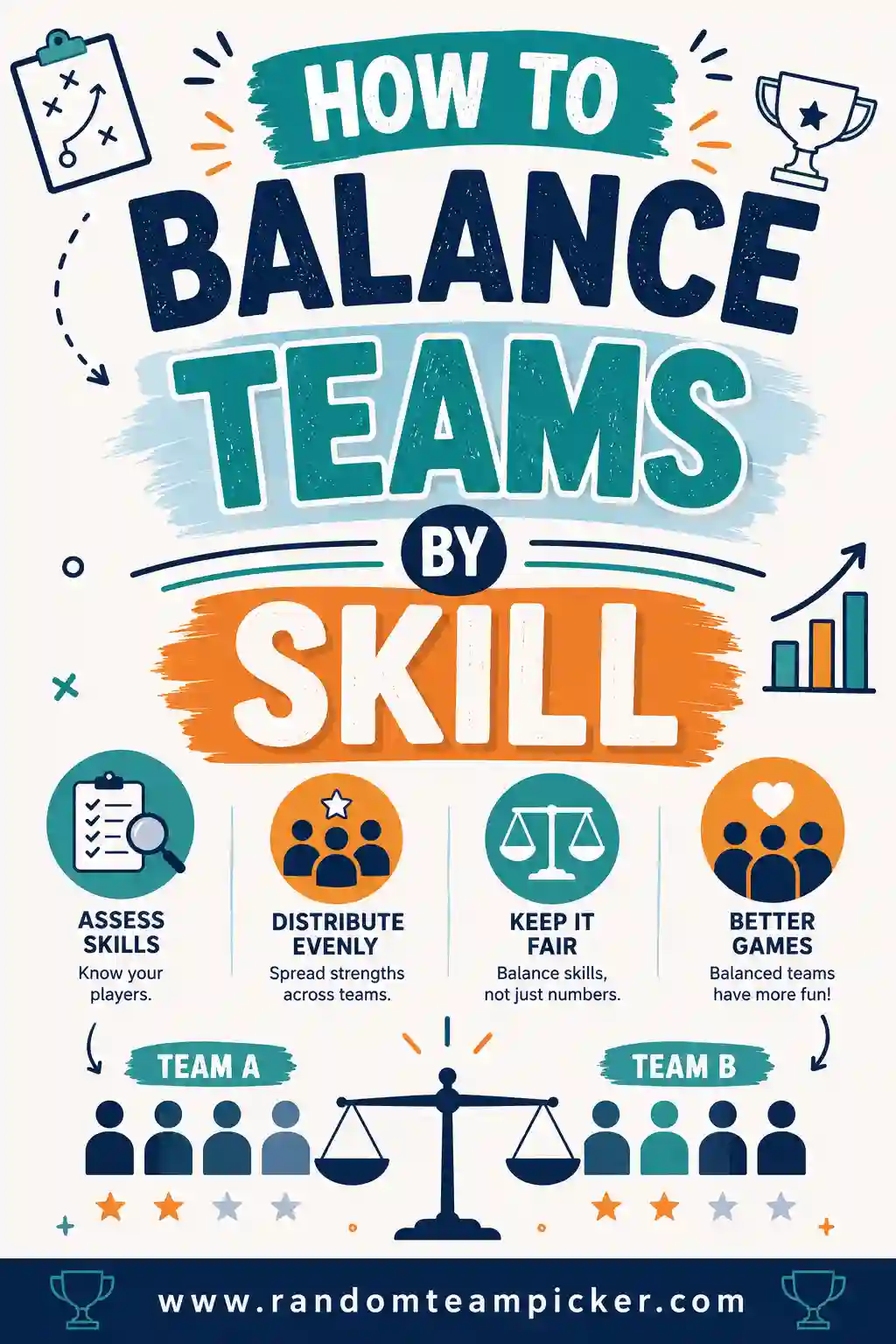
Write the letter after each name, like "Sam (B)", before you paste the list in. It keeps the tiers visible on the printed sheet, so anyone checking the pairings can see they're fair. If you'd like a deeper look at rating methods and snake drafts, read how to balance teams by skill. And if two golfers ask to play together, it's fine to honor that, as long as they're in different tiers or you balance the rest of the foursome around them.
Team handicaps without the headache
Tiers make teams similar, but a handicap evens out what's left. Many clubs follow the allowances recommended in the World Handicap System for a four-player scramble: 25 percent of the lowest player's course handicap, 20 percent of the second, 15 percent of the third and 10 percent of the highest, added together. For a two-person scramble, the recommendation is 35 percent of the lower handicap plus 15 percent of the higher. Your course's golf professional can confirm which allowances they use.
Here's how it works for one team. Say the course handicaps are 4 for the A player, 12 for B, 19 for C and 28 for D. That's 1.0 plus 2.4 plus 2.85 plus 2.8, which comes to 9.05, so the team handicap rounds to 9. If the team shoots 60, its net score is 51. For a casual outing where many players have no handicap, it's perfectly fine to skip handicaps and rely on the A-B-C-D split alone.
Worked example: a 36-golfer charity outing
Imagine 36 golfers signed up for a Saturday morning charity scramble on an 18-hole course. Thirty-six divided by four is nine, so you need nine foursomes, and each tier has nine golfers. Rank the field, mark nine names A, nine B, nine C and nine D, paste the full list into the tool, set Teams to 9 and split. Check that every foursome has one of each letter, swap any two same-tier players if friends asked to be together, and you're done.
Next, assign starting holes. With nine groups on 18 holes, a neat trick is to use every other hole, so no group starts right behind another and nobody waits on the first tee.
| Foursome | Starting hole | Finishes on |
|---|---|---|
| Foursome 1 | 1 | 18 |
| Foursome 2 | 3 | 2 |
| Foursome 3 | 5 | 4 |
| Foursome 4 | 7 | 6 |
| Foursome 5 | 9 | 8 |
| Foursome 6 | 11 | 10 |
| Foursome 7 | 13 | 12 |
| Foursome 8 | 15 | 14 |
| Foursome 9 | 17 | 16 |
Every group plays all 18 holes and finishes on the hole just before the one it started on, so the whole field comes in at about the same time for lunch and awards. If you'd like set tables for the meal afterward, the seating chart generator can mix foursomes so people meet new faces.
Running a shotgun start
In a shotgun start, every group begins at the same moment on a different hole, usually signaled by a horn. It means the whole event starts and ends together, which suits charity outings with a meal or a program. On an 18-hole course, one foursome per hole gives you 72 golfers. Bigger fields often double up on some holes, usually the longer par 5s, with an "A" group teeing off first and a "B" group following once the first group has moved on.
Post the pairings and starting holes at check-in, and put a card on each cart with the team name and hole number. A clear sheet saves more time on the day than anything else you do.
Threesomes and fields that don't divide by four
Fields rarely land on a multiple of four. With 38 golfers, for example, you could make eight foursomes and two threesomes. Many events give threesomes a small boost, such as one extra drive per hole taken in turn, or let one player hit twice from the tee. Whatever you decide, write it on the rules sheet. Spread the tiers across the threesomes too, so each still has a strong player. For more ways to handle uneven counts, see how to split an odd number into teams.
Pace of play and newer golfers
A friendly scramble should feel welcoming to someone who plays twice a year. Pair newer players with patient A players, and remind teams that they don't have to finish every putt from every player. A maximum score per hole, such as double par, keeps things moving when a team has a rough hole. On-course contests like longest drive and closest to the pin give everyone something to aim for, and simple prizes such as a sleeve of balls or a gift card from the pro shop are plenty.
For a work outing, the office team building generator has ideas for mixing departments, and the large group team generator helps when you're splitting a big crowd for the lunch program. Running a club championship with brackets? The tournament team generator covers draws and seeding.
Mistakes that spoil a scramble
The classic mistake is letting the four best players form a team. They win every year, and newer golfers quietly stop signing up. The A-B-C-D split prevents it. The second is leaving drive rules vague. If the event uses a Texas scramble with a minimum number of drives per player, teams need to know before they reach the first tee, not on the 16th. The third is posting pairings late. Have them printed before check-in opens, with a spare copy for the starter.
The last is forgetting the weekly regulars. Men's, women's and senior groups can paste whoever turns up into the Random Team Picker, split into foursomes, and shuffle so everyone plays with different people. The random order generator can even set who tees off first.
Quick answers about golf scramble teams
How do you make fair golf scramble teams?
Rank your golfers by handicap or typical score, split them into four equal tiers, and give each foursome one A, one B, one C and one D player. Add a team handicap if most players have one. The tool does the split in one press, and you can shuffle until the groupings look right.
How does a golf scramble work?
Every player hits a tee shot, the team picks the best ball, and everyone places near that spot to hit the next shot. The team keeps choosing the best shot until the ball is holed, then records one score. Events usually set rules for placing the ball and for putting.
What are A, B, C and D players?
They're skill tiers. A players are the strongest quarter of the field, usually the lowest handicaps. D players are the newest or highest-handicap quarter. Putting one from each tier on every team is the simplest way to make a scramble fair without a complicated formula.
How is a team handicap calculated for a scramble?
A common method for four-player teams takes 25 percent of the lowest course handicap, 20 percent of the next, 15 percent of the next and 10 percent of the highest, then adds them up. For two-person teams it's 35 and 15 percent. Ask your course which allowances they use.
How many golfers fit in a shotgun start?
One foursome per hole on an 18-hole course gives 72 golfers. Larger events double up on some holes, often the par 5s, with two groups starting one after the other. Smaller fields can use every other hole so groups don't wait on each other.
What do you do with threesomes in a scramble?
When your field isn't a multiple of four, make a few threesomes and give them a small boost, such as one extra drive per hole taken in turn. Spread the tiers so each threesome still has a strong player, and print the rule on the rules sheet so nobody is surprised.
Can I use the tool for my weekly golf group?
Yes. Paste whoever shows up, set Teams to the number of foursomes, and split. Press Shuffle again each week so people play with new partners. Add tier letters after the names if you want even matches, and copy the groups into your group message before tee time.