Field Day Team Generator: Split Your Class Into Fair Color Teams
To make field day teams, paste your class roster into a team generator, set the number of teams to match your stations, and split. The picker mixes students at random, so the fast runners and best friends don't all land together. Then keep any known pairs apart, give each team a color, and print the list for the gym teacher and parent helpers.
The whole job takes a few minutes, and the payoff is a field day where every team is busy, every child knows their color, and nobody stands on the grass waiting to be picked last. Below are the numbers for any class size, the color sets that work, how to handle pairs and speed, station ideas and a sample rotation schedule you can copy.
Key facts
- Match the number of teams to the number of stations.
- Four to seven kids per team is the sweet spot.
- Keep team sizes within one of each other.
- Red, Blue, Green and Yellow is the classic four-team set.
- Many schools hold field day in May and plan teams in April.
🎲 Pick a random team
Choose a group, then spin. One for each player gives everyone in the names list below a different team.
👥 Random Team Picker: split your list into teams
The sample names are from this page. Replace them with yours, one per line or separated by commas.
The tool above starts with a sample class of 20 split into four color teams: Red, Blue, Green and Yellow, each with its own color stripe. Replace the sample names with your roster, one per line or separated by commas, then use the − and + buttons to set the number of teams (2 to 12) and press "Split into teams." Not happy with the mix? Press "Shuffle again." The sample also has a checkbox that keeps two pairs from the sample class, Caleb and Ethan, and Jade and Piper, on different teams. For your own pairs, press "Open in the full team picker," which opens the same teams in a new tab where you can set keep-apart rules, balance by skill, pick captains and print. "Copy teams" puts the final list on your clipboard for helpers and parent volunteers.
Quick reference: teams for every class size
| Students | Stations | Teams | Kids per team |
|---|---|---|---|
| 20 | 4 | 4 | 5 |
| 24 | 6 | 6 | 4 |
| 28 | 4 | 4 | 7 |
| 50 (two classes) | 10 | 10 | 5 |
| 100 (a grade) | 10 | 10 | 10 |
Plan backwards from your stations
The single best field day rule is one team per station. When the number of teams equals the number of stations, every team is busy at the same time and nobody waits around in the sun. So decide your stations first, then set the team count to match.
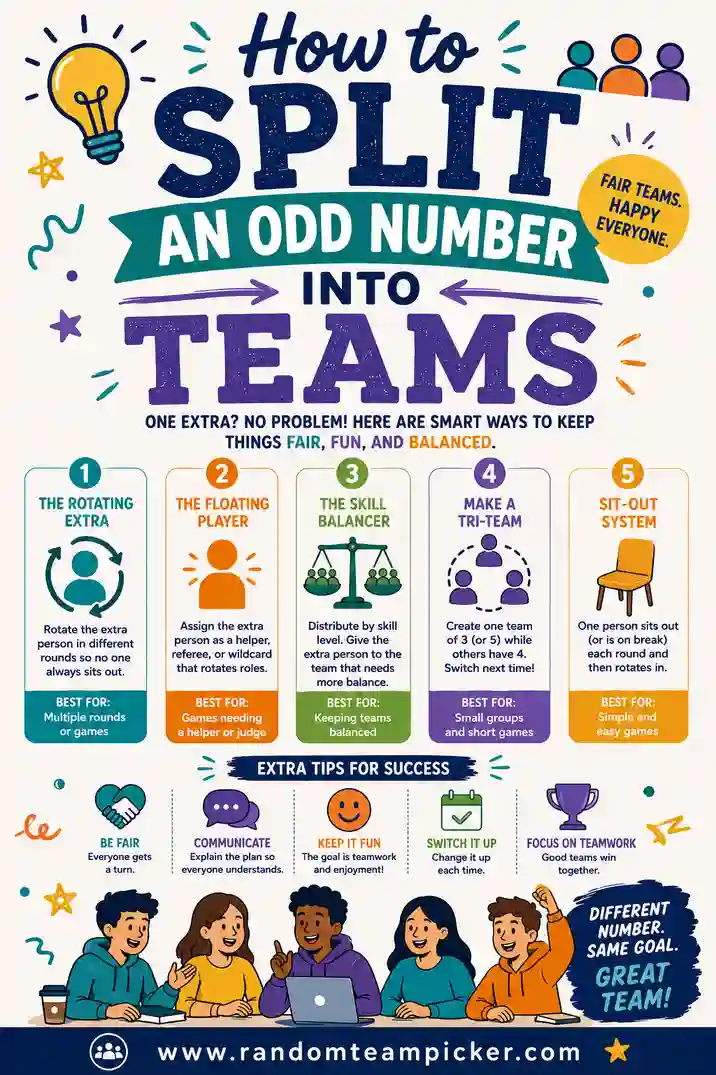
Four to seven kids per team is the sweet spot. Everyone gets plenty of turns, and the team is small enough for one parent helper to keep track of. If a team grows past eight, kids spend more time in line than playing. If it drops below four, relays and tug of war get thin. When your numbers don't divide evenly, keep team sizes within one of each other, such as 26 students as two teams of 7 and two teams of 6. Our guide on splitting an odd number into teams covers more ways to handle leftovers.
For a whole grade of 100, ten stations with ten teams of ten works, but it's easier to run two smaller field days side by side, each with its own set of stations. The team generator for large groups explains how to split big crowds in stages.
Making the teams the week before
- Paste your roster. First names and a last initial are plenty.
- Set the number of teams to match your stations and split.
- Check for pairs who need to be apart, and shuffle again or make one swap.
- Copy the final list for the gym teacher, helpers and a note home.
Doing this a week ahead gives parents time to find a shirt in the right color, and it gives you time to spot problems before the morning of the event. Keep a printed copy in your pocket on the day, because someone will always ask "What team am I on?"
A worked example: one class, four stations
Take the sample class of 20 on this page. You're running four stations: a sack race, a water sponge relay, a bean bag toss and an obstacle course. Twenty students divided by four stations is five per team. You tick the keep-apart box so Caleb and Ethan, who get too silly together, end up on different teams, as do Jade and Piper. You press split and get Red, Blue, Green and Yellow, five students each.
With 15 minutes per station and 3 minutes to walk between them, the four rotations take about 70 minutes. Add a 10-minute water break in the middle and a 15-minute all-teams finale, like a parachute game, and you have a tidy hour and a half to two hours. If you want a printed rotation grid that shows which team is at which station each round, the station rotation generator builds one.
Color teams beyond the classic four
Colors are the easiest team names for young kids to remember, and they make it simple to spot your team across a field. For four teams, use Red, Blue, Green and Yellow. For six, add Orange and Purple. For eight, add Pink and Black, or Teal and White. For ten, add Gray and Brown, or use school colors plus numbers, like Gold 1 and Gold 2.
Ask kids to wear a T-shirt in their team color, or hand out colored bandanas, wristbands or stickers at check-in for anyone who forgets. A note home a week ahead with each child's color saves a lot of morning panic. Older grades often prefer real team names, like the Thunderbolts or the Flamingos, and you can grab some from our random team names or running team names lists.
Keeping friends apart, or together on purpose
Every teacher knows the pairs who shouldn't share a team. Maybe they get too silly together, or one always takes over. The fair approach is to split first and check second. Let the picker mix the class at random, and if two kids who need to be apart land together, swap one of them with a student from another team. One or two swaps keeps the teams random; hand-building the whole list brings back the "the teacher picked" complaints.
Sometimes the kind choice is to keep a pair together. A new student, a child who needs a buddy, or a student with a classroom aide may do best with a familiar friend. That's a good reason to adjust, and nobody needs to know why the swap happened.
Balancing speed without making it obvious
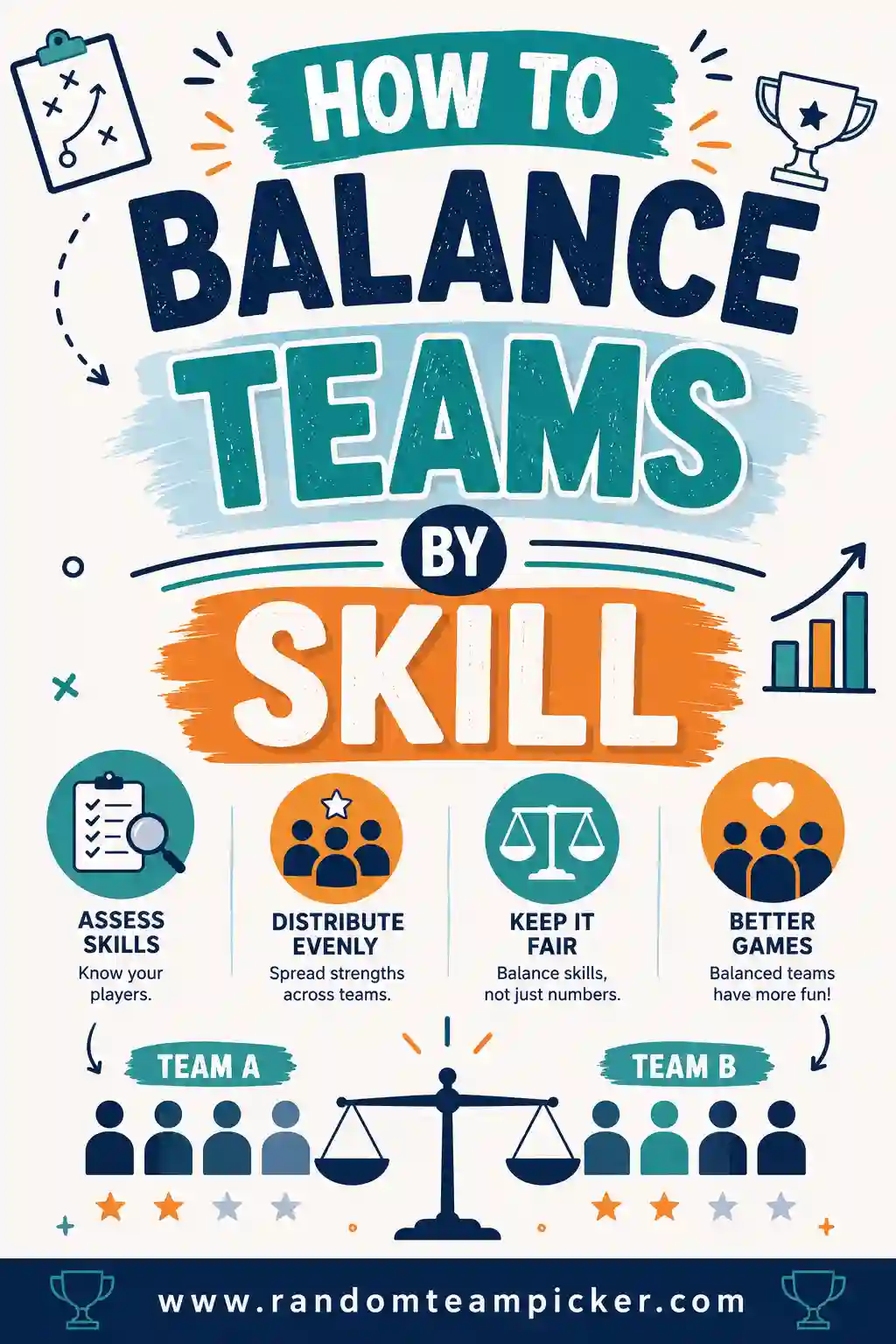
A random split is fair, but now and then it hands one team all the speedy runners. A quick fix is a two-pass split. First, divide your list into two groups, such as kids who love races and kids who'd rather do the bean bag toss. Split the first group into your color teams, then split the second group the same way, and combine them. Every team gets a mix, and no child ever sees a label. Our guide on balancing teams by skill walks through it, and the full Random Team Picker can balance by a 1 to 5 skill rating if you'd rather let it do the work.
Station ideas that work for color teams
Relay races are the heart of most field days: a sack race, an egg-and-spoon race with plastic eggs or ping-pong balls, and a classic baton relay. The relay race team generator splits teams into a running order too. A water station is a winner on warm days, with a sponge relay, fill-the-bucket or a water balloon toss.
Tug of war pits two color teams at a time, on soft grass. Bean bag toss and ring toss are great for younger kids and calmer players. A hula hoop pass has teams hold hands in a circle and pass a hoop around without letting go. An obstacle course with cones, hoops and a crawl tunnel can be timed for each team. For a big finish, parachute games bring every team together. For more ideas suited to little ones, see the team generator for kids' games, and for summer events, our 4th of July team games use red, white and blue teams.
Heat, safety and including everyone
Plan shade, water breaks and sunscreen reminders between stations, especially on a hot afternoon in May. Put a water cooler at every station, or schedule a full water break halfway through. Mark the crawl tunnel and any wet areas so nobody slips.
Every child should be able to play at every station. Offer a walking option in relays, a closer throwing line in the bean bag toss, and a scorekeeper or cheer captain job for any student who can't run that day. Students with a classroom aide can stay with their aide's team. Small changes like these keep the whole class part of the fun.
Where field day teams usually go wrong
The most common mistake is letting kids pick their own teams. It's quick, but the same kids get picked last every year, and best friends end up together. Our list of the best ways to pick teams explains why random splits feel fairer. The other big mistake is uneven team sizes. A team of 8 racing a team of 5 isn't fun for anyone, so match teams to stations and keep sizes within one.
A quieter mistake is turning every station into a competition. Many schools keep field day about participation, with ribbons for every team or a points total nobody worries about. If you do keep score, rotate who carries the team flag or leads the cheer, and choose those leaders fairly too; our guide on picking captains fairly has simple methods. For gym class the rest of the year, the team generator for sports and PE is built for it, and the Random Team Picker splits your real class in one click.
Quick answers about field day teams
How do you split a class into field day teams?
Paste your roster into a team picker, set the number of teams to match your stations, and split. Then check for pairs who need to be apart and make one or two swaps. Copy the final list for helpers and send each child's team color home a week ahead.
How many field day teams should I have?
Match the number of teams to your stations so every team is busy at once. Four to seven kids per team works well, such as 4 teams of 5 for a class of 20, or 6 teams of 4 for a class of 24 with six stations.
What are good color teams for field day?
Red, Blue, Green and Yellow for four teams. Add Orange and Purple for six, and Pink and Black or Teal and White for eight. Colors are easy for young kids to remember and make teams easy to spot across a field.
How do I keep certain students apart on field day teams?
Split at random first, then swap one student if two kids who need to be apart land together. Small swaps keep the teams fair and random. If you use the full team picker, you can set keep-apart rules before you split so the pairs never land together.
When do schools have field day?
Many schools hold field day in May or near the end of the school year, when the weather is warm and testing is done. Teachers usually plan the teams and stations in April, so there's time to send team colors home and line up parent volunteers.
How long should each field day station last?
Ten to fifteen minutes per station works for most elementary grades, with two to three minutes to walk to the next one. Younger children do better with shorter stations, and a full water break halfway through keeps energy up on hot days.
What if a team is short a player on the day?
If one or two children are absent, move a student from the biggest team to the smallest so sizes stay within one. In relays, let one child on the smaller team run twice. Everyone understands the fix, and it takes ten seconds.
Should field day have winners?
It's up to your school. Some keep points and crown a winning color, while others focus on participation and give every team a ribbon. Either way, fair random teams matter most, because a close, mixed team is more fun than an easy win.