Basketball Rotation Generator: Equal Minutes for Youth Basketball Teams
The fairest way to rotate a youth basketball team is to split the game into equal shifts, decide before tip-off who sits in each shift, and move the bench down your roster in order so everyone sits the same number of times. With 10 players it's simple: make two groups of five, balanced by skill, and alternate them. With 8, 9 or 11 players you use a rotating bench, and the charts below show exactly how.
The tool on this page does the first step for you. Paste your roster and it splits the players into Group A and Group B with strong, middle and newer players spread across both, so neither five is stacked. Then pick the rotation chart that matches your numbers, write it on your clipboard, and track the minutes as you go.
Key facts
- Five players from each team are on the court at a time.
- With N players and N equal shifts, a rotating bench gives everyone exactly 5 shifts.
- With 10 players, two balanced groups of five each play half the game.
- Sub at natural breaks: quarter ends, timeouts or a set time on the clock.
- Many rec leagues have minimum playing time rules, so check your handbook first.
🎲 Pick a random team
Choose a group, then spin. One for each player gives everyone in the names list below a different team.
👥 Random Team Picker: split your list into teams
The sample names are from this page. Replace them with yours, one per line or separated by commas.
To use the tool, replace the sample names with your roster (one per line or separated by commas) and leave Teams at 2. Press Split into teams, and the players are divided into Group A and Group B. The sample roster of 10 has three skill tiers, Strong, Middle and Newer, and the checkbox labeled for age groups spreads those tiers evenly, so each group gets a fair mix. Shuffle again if you want a different pairing, Copy teams to paste the groups into a message to parents, or Open in the full team picker, which opens the same groups in the full Random Team Picker where you can rate players by skill from 1 to 5, keep two players apart, pick a captain and print.
Quick reference: equal rotations by roster size
| Roster | On the bench each shift | Shifts for an even cycle | Each player plays | Share of the game |
|---|---|---|---|---|
| 7 players | 2 | 7 | 5 shifts, sits 2 | About 71% |
| 8 players | 3 | 8 | 5 shifts, sits 3 | About 63% |
| 9 players | 4 | 9 | 5 shifts, sits 4 | About 56% |
| 10 players | 5 | 2 (repeat) | Every other shift | 50% |
| 11 players | 6 | 11 | 5 shifts, sits 6 | About 45% |
| 12 players | 7 | 12 | 5 shifts, sits 7 | About 42% |
The pattern behind every row is the same. Number your players, then bench the next group in order each shift, wrapping back to the top of the list when you reach the end. When the number of shifts equals the number of players, everyone sits the same number of times. When it doesn't, a few players get one extra shift, and you move that extra to different players next game.
The simple math behind equal minutes
Basketball puts five players per team on the court, so the total playing time available is five times the length of the game. In a game of four 8-minute quarters, that's 32 minutes times 5, or 160 player-minutes. Divide by your roster and you get the fair share: 16 minutes each for 10 players, about 17.8 for 9, and 20 for 8.
You can't sub on every second, so you work in shifts. Shorter shifts make the numbers come out more even, but they also mean more stoppages and fewer minutes for a group to settle. For most youth games I like 4-minute shifts, which means two per quarter, or one change at the midpoint of each quarter plus one at each quarter break. If your league plays 6-minute quarters, 3-minute shifts work the same way. If your league uses halves, split each half into equal shifts instead.
Worked example: 9 players, eight 4-minute shifts
Here's a full chart for a nine-player roster in a game of four 8-minute quarters. The players are listed in an order that mixes skill: Andre (strong), Bri (middle), Caleb (newer), Elena (strong), Dom (middle), Frankie (newer), Ivan (strong), Gus (middle) and Hailey (newer). Shifts 1 and 2 make up the first quarter, 3 and 4 the second, and so on. Each shift, the next four names in the list go to the bench. Because the list alternates tiers, every five on the court has a mix of experience.
| Shift | On the court (5) | On the bench (4) |
|---|---|---|
| 1 | Dom, Frankie, Ivan, Gus, Hailey | Andre, Bri, Caleb, Elena |
| 2 | Andre, Bri, Caleb, Elena, Hailey | Dom, Frankie, Ivan, Gus |
| 3 | Elena, Dom, Frankie, Ivan, Gus | Hailey, Andre, Bri, Caleb |
| 4 | Andre, Bri, Caleb, Gus, Hailey | Elena, Dom, Frankie, Ivan |
| 5 | Caleb, Elena, Dom, Frankie, Ivan | Gus, Hailey, Andre, Bri |
| 6 | Andre, Bri, Ivan, Gus, Hailey | Caleb, Elena, Dom, Frankie |
| 7 | Bri, Caleb, Elena, Dom, Frankie | Ivan, Gus, Hailey, Andre |
| 8 | Andre, Frankie, Ivan, Gus, Hailey | Bri, Caleb, Elena, Dom |
Add it up and Andre, Bri, Caleb, Elena and Dom each play four shifts, or 16 minutes, while Frankie, Ivan, Gus and Hailey each play five, or 20 minutes. Nobody sits two shifts in a row, and every lineup has at least one strong player and at least one newer one. Since eight shifts can't split evenly among nine players, the fix happens across games: next time, start the bench at Frankie, so the four extra shifts go to a different group. Over two or three games the totals even out. If you'd rather have it perfectly even in one game, use nine shifts of equal length, and every player plays five and sits four.
The 10-player rotation: two groups of five
Ten players is the easiest roster to manage, and it's exactly what the tool's sample shows. Split the team into Group A and Group B with the tiers spread evenly, then alternate. Group A plays the first quarter, Group B the second, A the third and B the fourth. Everyone plays half the game, and each five gets a full quarter together to find a rhythm.
Two things keep it feeling fair. First, flip which group starts in the next game, because starting can feel like a big deal to kids even when the minutes are the same. Second, don't keep the same two groups all season. Press Shuffle again every week or two so players learn to play with different teammates. If you want more mixing within a game, use 4-minute shifts and swap only two or three players at a time; the rule is just that each child's total should still come to four shifts out of eight.
Tracking minutes during the game
A plan only works if you follow it, and that's easier with a helper. Ask an assistant coach or a parent to hold the chart and call the changes. Make a simple grid with one row per player and one column per shift, and tick each box as the player goes in. At halftime, glance across the rows: if anyone is behind because of an injury or a late arrival, give them a shift in the second half.
At the end of each game, write each player's total shifts in a season column. That running total is the best answer to a worried parent, and it also helps you notice patterns, such as one child always sitting at the end of close games. The random order generator is a quick way to set a fair starting order for the first game.
Late arrivals, fouls and injuries
Real games never go exactly to plan. When a player arrives late, add them to the list at the point where the bench will reach them soonest, and let them catch up on shifts in the second half. When a player picks up fouls, you may need to rest them early. In school rules a player is out of the game after five personal fouls, though some youth leagues use different limits, so know your league's number.
Injuries and illness always come first. Take the player out, check on them, and use the next name on the bench list to fill the spot. Don't send an unwell child back just because the chart says it's their turn. If the roster drops to an odd number mid-game, switch to the matching row of the quick reference table for the rest of the game, and balance it out next week. For more help with numbers that don't split neatly, see how to split an odd number into teams.
Balancing skill so every five can compete
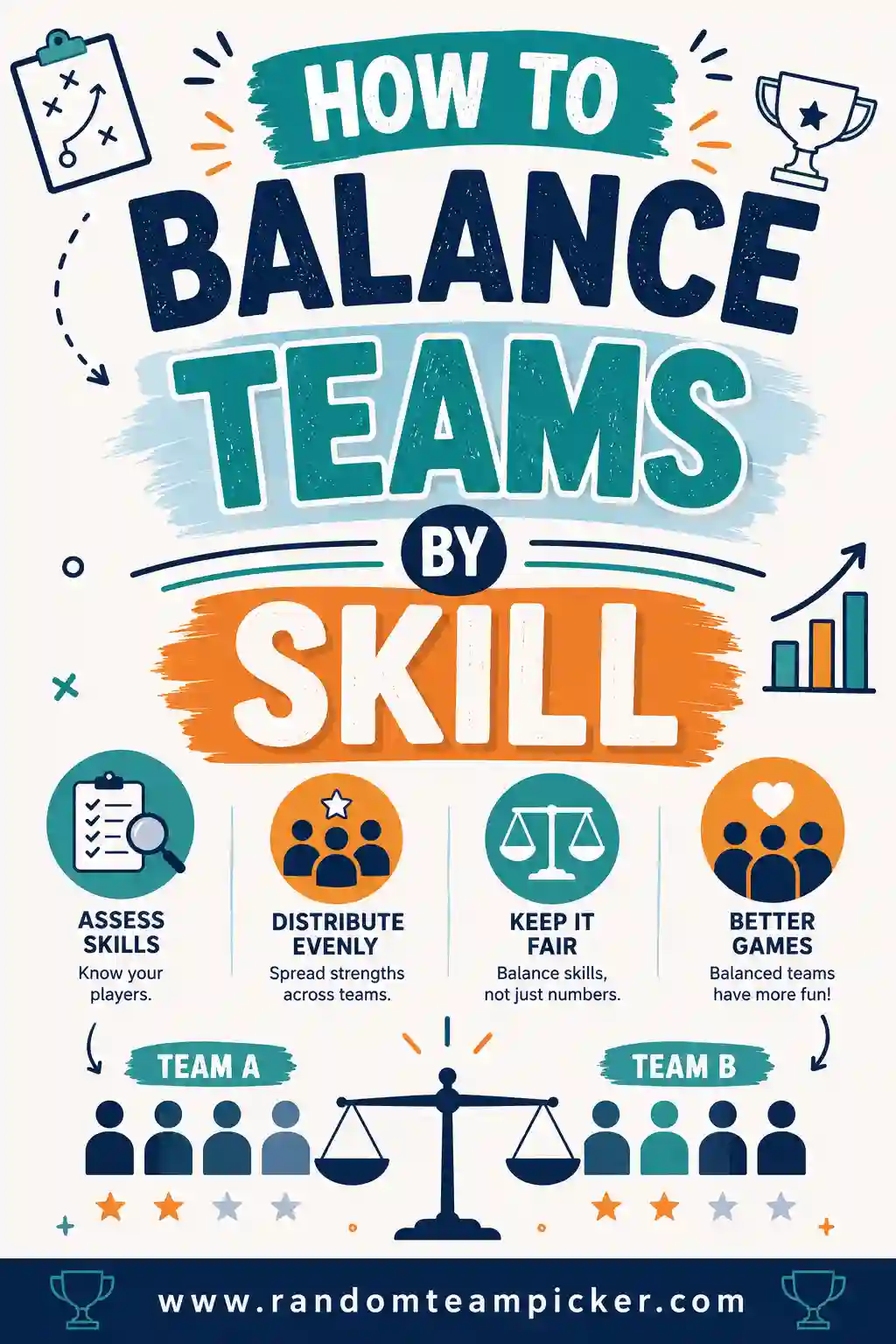
Equal minutes can backfire if one five is all your experienced players and the other is all beginners. The newer group gets run over, and the experienced group never learns to share the ball. The fix is to sort your roster into three simple tiers, the way the tool's sample does: Strong, Middle and Newer. Then spread each tier across the groups, or alternate the tiers in your bench list, as in the nine-player example above.
Tiers don't need to be precise, and kids don't need to see them. Think about who can bring the ball up the court under pressure, who knows where to stand on defense, and who is still learning to dribble with their weaker hand. If you'd like a more detailed method, the guide to balancing teams by skill walks through ratings and snake drafts, and you can rate players 1 to 5 in the Random Team Picker.
Keeping the bench part of the team
Sitting is easier when it has a job. Give bench players something to watch for, like counting the other team's fast breaks or spotting who is open on the weak side, and let them tell the next five before they go in. Keep the bench in the order of your chart so the next group is always ready at the scorer's table. If you name captains for each game, rotate that too; the guide to picking captains fairly has simple methods, and the who goes first generator settles who leads warm-ups. For the bigger picture, see how to make fair teams.
Common rotation mistakes
The biggest one is letting the scoreboard change the plan. When a game gets close, it's tempting to keep the best five on and leave the newer players waiting. Make the plan before tip-off and stick to it unless someone is hurt, in foul trouble or unwell. The second mistake is shifts that are too short.
A third mistake is benching the same child at the end of every game. Even when total minutes are equal, always sitting for the final minutes sends a message. Rotate who closes the game the way you rotate who starts. Finally, tell the team the plan. A quick word at warm-up, such as "everyone gets four shifts today, here's the order," removes most of the worry and lets kids focus on playing.
What youth leagues often require
Rules vary a lot, so the league handbook is your guide. Many recreational leagues have a minimum playing time rule, for example that every player must play a set portion of each game, and some require that no player sits twice before everyone has sat once. Younger divisions often limit full-court pressing or zone defense, use smaller balls and lower hoops, and play shorter quarters. Competitive and school teams usually leave minutes to the coach.
Whatever your league says, the rotation charts on this page meet the most common rule of all: everyone plays a fair share. For practices and scrimmages, the two-team splits guide helps you make even sides from whoever shows up, and the team generator for sports and PE covers gym classes. Coaching a fall sport as well? The soccer lineup generator uses the same rotating-bench idea, and the sports team name generator can name your scrimmage sides.
Quick answers about basketball rotations
How does a basketball rotation generator work?
It splits your roster into groups that take turns on the court. In the tool here, paste your players, keep Teams at 2 and press Split into teams. You get Group A and Group B with skill tiers spread across both. Alternate the groups every shift so everyone gets about the same playing time.
How do I rotate 8 players in basketball?
Use eight equal shifts and bench three players each shift, moving down the roster in order and wrapping back to the top. Every player plays five shifts and sits three. In a game of four 8-minute quarters with 4-minute shifts, that's 20 minutes each, which matches the fair share exactly.
How do I rotate 9 players?
For a perfectly even game, use nine equal shifts and bench four players each time; everyone plays five and sits four. With eight 4-minute shifts, five players get 16 minutes and four get 20. Start the bench at a different player next game so the extra minutes move around.
How many minutes should each player get?
Multiply the game length by five and divide by your roster size. In a 32-minute game, that's 160 player-minutes: 16 each for 10 players, about 17.8 for 9 and 20 for 8. Shifts won't always match exactly, so even it out over two or three games.
When should I make substitutions?
At natural breaks: quarter ends, timeouts, or a set time on the clock such as the midpoint of each quarter. With a running clock, sub at fixed times. With a stopped clock, use the next dead ball after your planned time. Avoid changing all five players every couple of minutes.
Should the best players start every game?
In a recreational league, no. Rotate starters the same way you rotate minutes, and flip which group starts each game. Starting matters to kids even when total minutes are equal. Track starts in your season chart so every player gets a fair number of them.
Can I use this for a team of 12?
Yes. Use twelve equal shifts and bench seven players each time, moving down the roster in order. Every player gets five of the twelve shifts, about 42 percent of the game. Shorter shifts, such as 2 or 3 minutes, keep a big roster fresh and stop anyone from sitting too long between turns.