Family Reunion Team Generator: Mix Ages and Family Branches
The best way to split a family reunion into teams is at random, with each age group spread evenly and couples and siblings kept apart. That way every team gets a few kids, a teen or two, some parents and a grandparent, and the family branches get mixed so cousins actually meet each other. Paste your list, choose the number of teams, split, then make one or two swaps if a team looks lopsided.
Mixed teams turn a reunion from "everyone sits with their own household" into a day where a teenager and a great-aunt are cheering for the same water balloon toss. Below you'll find how many teams to make, a simple layered method for spreading ages with your own list, team names, games that work from age 6 to 86, and ways to include relatives who would rather sit in the shade.
Key facts
- Six to ten people per team is the sweet spot.
- Spread each age group evenly across teams.
- Keep couples and siblings on different teams.
- Four color teams suit 20 to 30 relatives.
- Give non-runners real jobs, like judge or scorekeeper.
🎲 Pick a random team
Choose a group, then spin. One for each player gives everyone in the names list below a different team.
👥 Random Team Picker: split your list into teams
The sample names are from this page. Replace them with yours, one per line or separated by commas.
The tool above starts with a sample family of 22: four grandparents, eight adults, four teens and six kids, split into Red, Blue, Green and Yellow teams. Two checkboxes do the mixing for the sample: one spreads each age group evenly across the teams, and the other keeps the sample's couples and siblings on different teams. Press "Split into teams" to see it, and "Shuffle again" for a new mix. To use your own family, replace the names (one per line or separated by commas) and set the number of teams with the − and + buttons, from 2 to 12. The two checkboxes are built around the sample names, so with your own list, use the layered method below to spread ages. "Copy teams" puts the result on your clipboard for the family group chat, and "Open in the full team picker" opens the teams in a new tab, where you can set your own keep-apart rules, pick captains and print the list.
Quick reference: how many teams for your reunion
| People at the reunion | Teams | People per team |
|---|---|---|
| 12 to 20 | 2 or 3 | 6 to 7 |
| 20 to 30 | 4 | 5 to 8 |
| 30 to 50 | 5 or 6 | 6 to 9 |
| 50 to 100 | 8 to 10 | 6 to 10 |
Why mixed-age teams beat branch teams
Here's the thing about reunion games: they aren't really about winning. They're about a grandpa showing a 7-year-old how to toss a horseshoe, and teenage cousins who've never met cheering for the same team. Mixed-age teams make that happen on purpose.
When teams are split by family branch, you get the same people as always, plus a little sibling rivalry. When they're split by age, one team of fast teenagers crushes everybody, and the little kids feel left out, so age teams are only useful for age-specific races. A totally random split is usually fine, but now and then one team ends up with all the toddlers. Random with ages spread evenly and couples apart gives you fair teams that mix the whole family, and that's the method I'd use every time.
There's a quiet bonus too. When a computer makes the teams, nobody can blame Aunt Lisa for "stacking" hers.
The sample family, team by team
The sample on this page shows what a good split looks like. There are 22 people and 4 teams, so teams of 5 or 6. With the age-group box ticked, each of the 4 grandparents goes to a different team. The 8 adults split two per team, the 4 teens one per team, and the 6 kids land as two teams with 2 kids and two teams with 1. With the keep-apart box ticked, Grandma Rose and Grandpa Lou are on different teams, as are the other couples and sibling pairs like Mia and Leo or Jordan and Riley.
So a typical team might be Grandpa Walt, Aunt Maria, Uncle Ray, Tyler and Ava. That's three generations on one team, and one very proud grandpa. A team with a single child can pair that child with an adult from another branch for the three-legged race, which is exactly the kind of mixing you want.
Spreading ages with your own family list
With your own list, the simplest reliable method is to split in layers. It takes a couple of extra minutes, and it guarantees each team gets a fair share of every age.
- Write your list in age groups: grandparents, adults, teens and kids.
- Paste only the kids, set your number of teams and split. Write down who went to Red, Blue, Green and Yellow.
- Do the same for teens, then adults, then grandparents, keeping the same team count.
- Combine the layers, then swap one person if a couple or two siblings landed together.
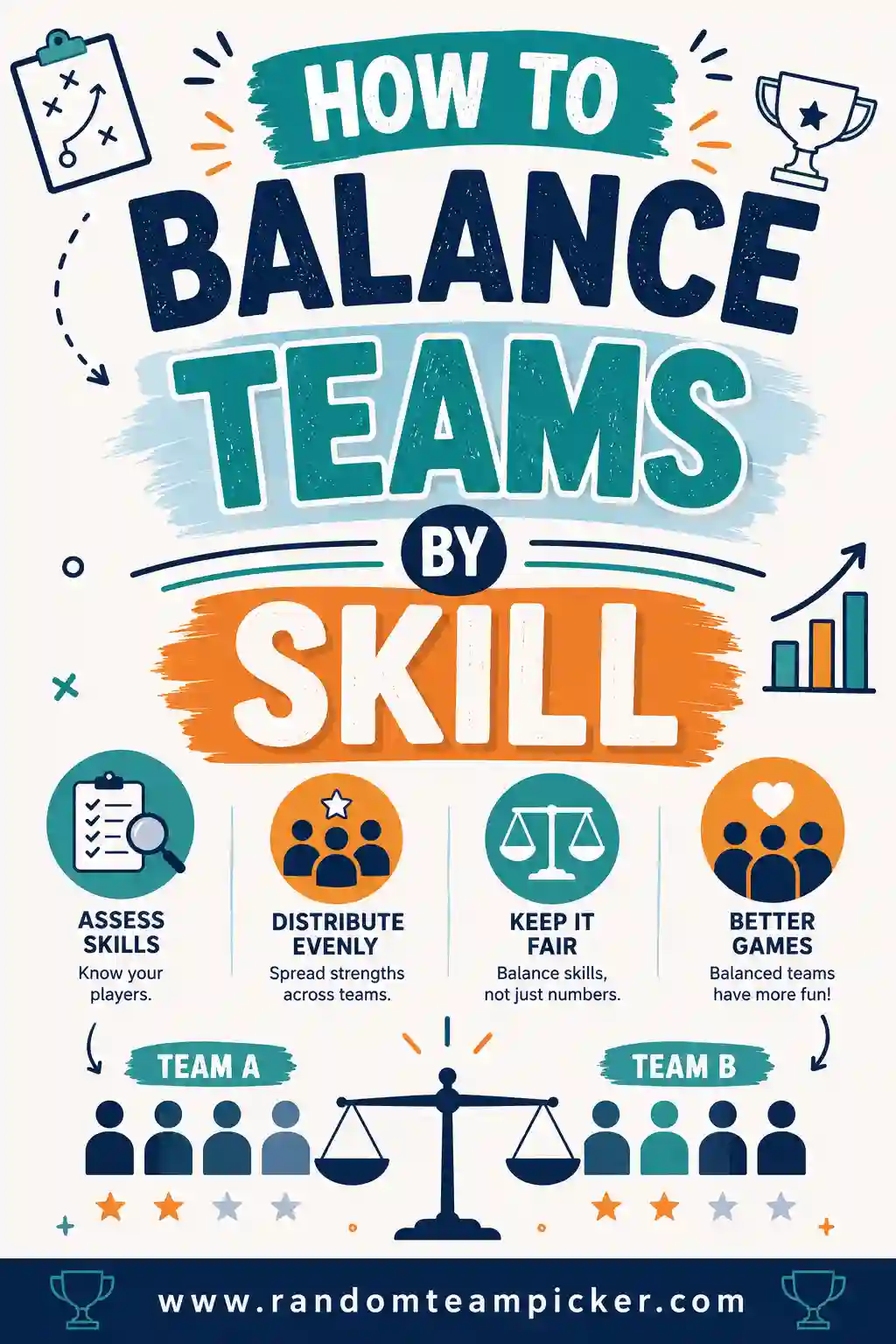
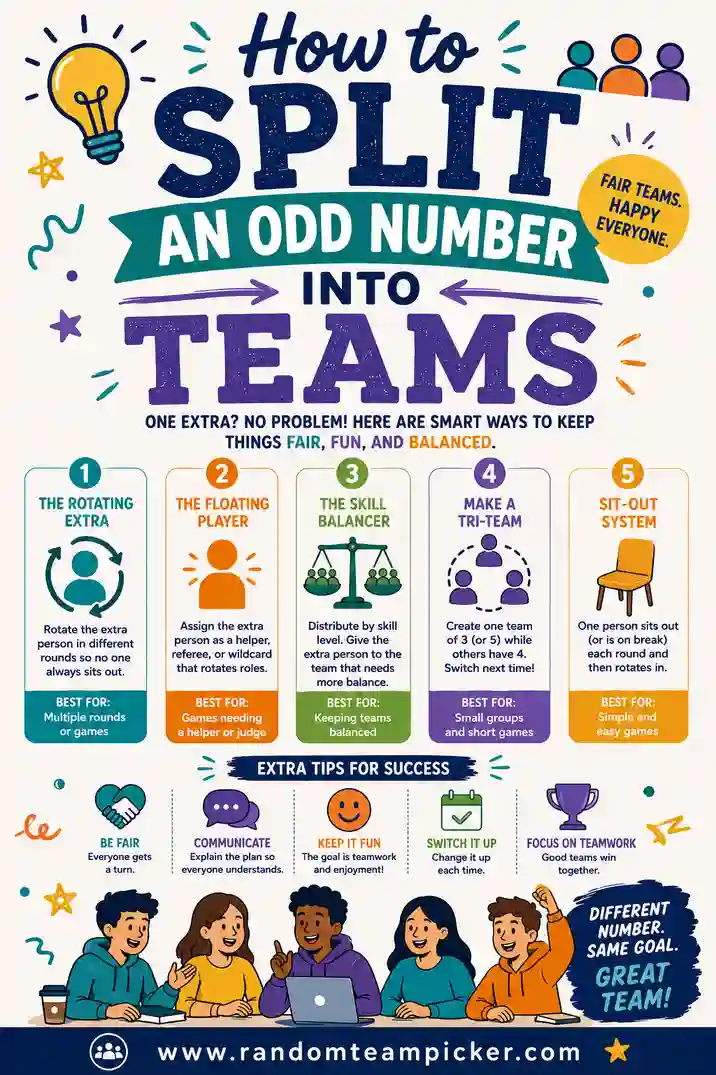
Because each layer is split separately, no team can end up with all the toddlers or all the teenagers. If your numbers in a layer don't divide evenly, give the extra person to whichever team is smallest overall. Our tips on splitting an odd number into teams help with that, and how to balance teams by skill explains how to even out speed too. For very big gatherings, the team generator for large groups covers splitting 50 or more people.
Sharing the teams before the big day
Use nicknames in your list, like "Grandma Rose" or "Uncle Dave," since that's what the kids call them anyway. Once you're happy with the teams, copy them into the family group chat a few days ahead, so people can pack a T-shirt in their team color. It also gives shy kids time to get excited about who's on their team. On the day, print one copy for the picnic table and tape it somewhere everyone walks past.
Team names and colors
Colors are the easiest choice. Order or bring T-shirts in four colors, and everyone can spot their team across the park. Red, Blue, Green and Yellow work for four teams; add Orange and Purple for six. Bandanas or colored stickers are a cheaper backup for relatives who forget.
If you want more personality, try family-flavored names like The Grill Masters, The Casserole Crew, The Pie Bakers or The Porch Sitters. Outdoor names work too: The Fireflies, The Lake Monsters, The Sunflowers, The Thunderbirds. Silly names get a laugh, like The Second Cousins Once Removed, The Leftovers or The Group Chat. Heritage names, after the towns or states the family came from, are a lovely touch for older relatives. Our random team names list has hundreds more.
Games where a 6-year-old and a 66-year-old both help
A water balloon toss has pairs step back after every catch, and it's great for grandparent and grandchild pairs. A three-legged race works best when you pair an older cousin with a younger one. Tug of war lines teams up with little kids in front and grown-ups in back. Relay races with plastic eggs on spoons, sacks and a baton let each team decide who runs which leg, and the relay race team generator can set the running order.
Family trivia is where older relatives shine: where did Grandma and Grandpa meet, who was born in a snowstorm, what was the family's first car? Our team generator for trivia nights has tips for running rounds. A scavenger hunt can mix nature and family: find a pinecone, a red leaf, someone born in another state and the oldest photo at the reunion. A cornhole or ring toss tournament is easy for anyone who'd rather sit between turns. And a family photo challenge, where each team recreates an old family photo for the grandparents to judge, is often the highlight of the day. For more ideas, try the team-building game ideas or the random activity generator.
A job for every relative
Not everyone wants to run, and that's fine. Relatives who'd rather not can be scorekeepers, judges, the trivia host or the team photographer, and they're still on the team. Grandparents make excellent judges for the photo challenge. A teen who's too cool for the sack race might happily be the team's official hype person. Rotating who leads each game keeps it fair; our guide on picking captains fairly has simple ways to choose.
If a little one is shy, it's fine to put them on a team with a parent or favorite aunt. Just swap someone else to keep the teams even.
Keeping the day comfortable
Summer reunions get hot. Plan the active games for the morning or late afternoon, keep water at every station, and set up shade for anyone watching. Run the calmer games, like trivia and the photo challenge, in the middle of the day. Make the prize silly rather than serious: a homemade trophy, first in line for dessert, or bragging rights until next year's reunion. For a July gathering, our 4th of July team games fit right in, and the team generator for parties has more ideas for mixed crowds.
What most families get wrong
The most common mistake is letting families pick their own teams. It feels easiest, but you end up with each household as a team, and the reunion turns into the same old groups. A random split with ages spread and couples apart is the quickest way to get second cousins laughing together. The second mistake is choosing games only the fast or strong can win, which leaves the youngest and oldest on the sidelines. The third is skipping the team list until the day itself, so nobody brings the right color shirt. When you're ready, the Random Team Picker handles your full guest list, and you can open the teams in the full team picker to print them for the picnic table.
Quick answers about family reunion teams
How do you split a family reunion into teams?
Split everyone at random, then make sure each team has a mix of kids, teens, adults and grandparents, and that couples and siblings are on different teams. Splitting each age group separately and combining the results is the most reliable way. One or two swaps is usually all it takes after that.
Should family reunion teams be split by family branch?
Usually not. Branch teams keep everyone with the people they already know and can stir up old rivalries. Mixed teams get cousins and second cousins talking, and they give grandparents a chance to bond with grandkids from other branches of the family.
How many people should be on a family reunion team?
Six to ten people per team works well for most games. For 25 relatives, try 4 teams of about 6. For 50 or more, use 8 to 10 teams so everyone gets plenty of turns and no team is too big to organize.
What are good family reunion team names?
Colors are easiest, like Red, Blue, Green and Yellow T-shirts. For fun, try The Grill Masters, The Casserole Crew, The Fireflies or The Porch Sitters. Naming teams after the towns your family came from is a thoughtful choice that older relatives tend to enjoy.
What games work for family reunion teams of all ages?
Water balloon toss, three-legged races, tug of war, family trivia, scavenger hunts, cornhole and relay races with plastic eggs all work across ages. Relatives who'd rather not run can judge, keep score, host trivia or take team photos, so they're still part of the team.
How do I keep couples apart on reunion teams?
Split at random first, then look for couples who landed together and swap one of them with someone of a similar age on another team. In the full team picker, you can set keep-apart rules before splitting, so couples never end up together in the first place.
What if relatives arrive late?
Add late arrivals to whichever team is smallest, or to the team missing their age group. If several people arrive together, split them across teams rather than putting them all on one. Keep the printed list handy so you can write new names in.
What prizes work for family reunion games?
Keep prizes silly and cheap: a homemade trophy that travels to next year's host, first in line for dessert, or a crown for the winning team captain. The fun is in the bragging rights until next year's reunion, not in the prize itself, so there's no need to spend much.