Secret Santa Draw When Spouses and Housemates Can't Draw Each Other
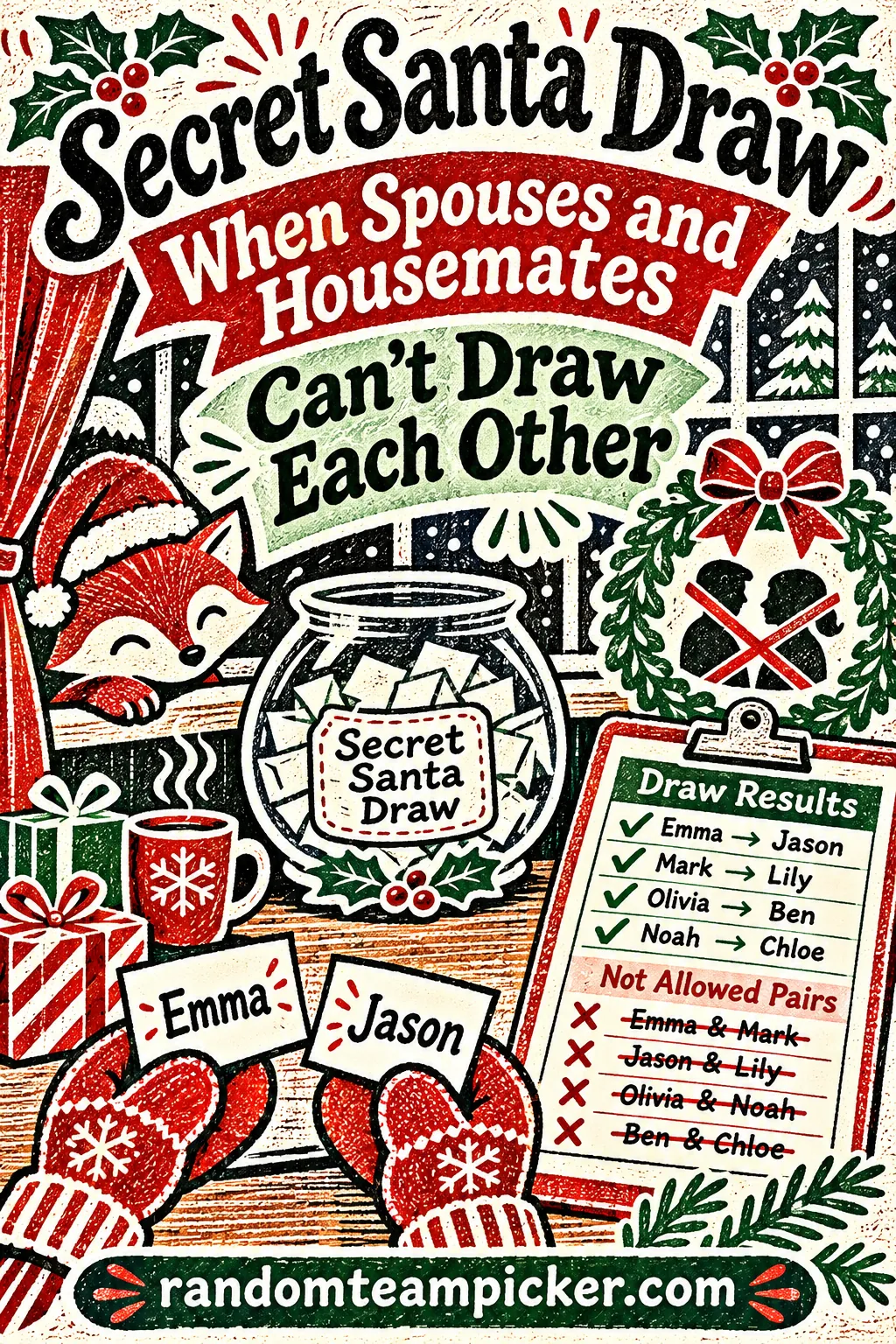
When Secret Santa couples can't draw each other, skip the paper slips: shuffle everyone into one random chain where each person gives to the next name on the list (and the last name gives to the first), then re-shuffle until no partners or housemates sit side by side. Because it's a single loop, nobody can draw themselves, and you can see at a glance whether the draw breaks a rule.
The free random team generator makes that chain in one click when you set it to a single team. This guide shows the exact settings, how many re-shuffles to expect, how to block last year's match too, how to tell when your exclusions make a fair draw impossible, and how to send everyone their name privately.
Why Paper Slips Can't Keep Couples Apart
The classic hat draw works fine when there are no rules. Everyone writes a name, folds the slip, and pulls one out. The trouble starts the moment you add "spouses can't draw each other."
Here's what goes wrong with slips:
- There's no way to check without peeking. If Mia draws Theo, her husband, she has to say so, and now the whole room knows who she drew. Then she puts it back and draws again, and everyone watches.
- Redraws give things away. If the last two people both draw their partners, you have to reshuffle the whole hat, or swap slips in front of everyone. Either way, people figure out who has whom.
- Couples can quietly trade. If two people agree to swap slips "because it's easier," your exclusion rule is gone, and the draw isn't random anymore.
- The last person gets stuck. Slips are drawn one at a time, so a draw can reach the last person with only their own name, or their partner's name, left in the hat.
- Remote family can't draw at all. Grandparents across the country can't reach into the hat, so someone draws for them, which adds another person who knows extra.
Couples are the most common exclusion, but they're rarely the only one. Families also want to keep apart housemates, parents and young kids who shop together, siblings who share a room, and last year's giver and receiver. Every new rule makes slips harder to manage.
What you need is a draw that's random, checked against your rules before anyone sees it, and recorded somewhere in case someone forgets their name. That's what the chain method does.
The Gift Chain Method, Explained
Picture everyone standing in a circle. Each person gives a gift to the person on their left. That's the whole idea of a gift chain.
To make it random, you shuffle the order of names. The shuffled list becomes the circle:
- Name 1 gives to name 2.
- Name 2 gives to name 3.
- And so on down the list.
- The last name gives to name 1, which closes the loop.
This has three nice properties:
- Nobody draws themselves. In a circle, your "left" is always someone else.
- Everyone gives once and gets once. Every name has exactly one name after it and one name before it.
- Exclusions are easy to check. Two people only give to each other's side if they're next to each other in the list. So "Mia and Theo can't draw each other" just means "Mia and Theo can't be neighbors in the list," including the wrap from last to first.
That last point is the key. Instead of checking a tangle of who-drew-whom, you're scanning a list for couples standing side by side. It takes about ten seconds for a family of ten.
There's one more benefit families love: a chain never splits into tiny loops. In a hat draw, it's possible for two people to draw each other, which feels a bit flat ("so we're just trading?"). In a single chain, gifts travel all the way around the group.
How to Do It With the Free Tool
Here's the full walkthrough on the free team generator. You'll use one team, which makes the tool return your whole list in a shuffled order. That order is your chain.
Step 1: Enter everyone's names
Type each person's name on its own line in the names box, or paste a list. Use the names people actually go by, and make every name unique. If two cousins are both named Sam, write "Sam K." and "Sam R." so you can tell them apart in the results.
Check the counter under the box. It should match the number of people taking part.
Step 2: Set the split to one team
Under Split mode, choose Number of teams and type 1 in the box (or press the minus button until it reads 1).
With one team, nobody gets split up. The tool still shuffles the whole list with a fair, unbiased shuffle before dealing it out, so the names come back in a brand-new random order every time.
Step 3: Turn off the extras you don't need
- Turn Reveal animation off. You may re-shuffle several times, and the animation slows that down.
- Turn Pick a captain on if you like. It puts a star next to the first name, which reminds you where the chain starts and that the last name loops back to that star.
- Leave Avoid repeat pairings and Balance by skill off. They're built for splitting people into several teams and don't help with a chain.
- Leave the Keep apart box empty for this method. Keep apart only works between different teams, and here everyone is on the same team. You'll check couples by eye instead (it's quick, as you'll see).
Step 4: Generate and read the chain
Click Generate Teams. You'll get one card with every name in a shuffled order. Read it top to bottom, then from the last name back to the first:
- Is any couple or housemate pair right next to each other?
- Are the last name and the first name a couple?
If the answer to both is no, you have a valid draw.
Step 5: Re-shuffle until it passes
If a couple sits side by side, click Re-shuffle. You get a fresh random order with the same names and settings. Check again. Most families get a clean chain within a few tries (there's a table of odds below).
Don't hand-edit the list to fix one bad spot. Moving one name changes several givers at once and makes the draw less random. A fresh shuffle keeps it fair.
Step 6: Save a private record
Once the chain passes, save it before you do anything else:
- TXT downloads the list as a text file.
- Copy puts the list on your clipboard so you can paste it into a private note.
- A screenshot works too, and it's the simplest record to find in December when someone asks, "Wait, who did I get?"
Keep this record to yourself. Don't send the Copy link to the group: that link opens the whole chain, so anyone who clicks it sees every assignment. Save that link only for a co-organizer who's not taking part.
A worked example: a family of 10
Say your family draw has ten people:
- Grandma Rose and Grandpa Walt (married)
- Mia and Theo (married)
- Sam and Jess (married)
- Nora and Ben (engaged, living together)
- Lily and Owen (teen siblings who share a car and shop together)
That's five pairs who shouldn't draw each other. You type the ten names, set Number of teams to 1, and generate. The first result reads:
- Theo
- Rose
- Walt
- Lily
- Nora
- Sam
- Mia
- Ben
- Jess
- Owen
Rose and Walt are next to each other at spots 2 and 3, so Rose would be buying for her own husband. That fails. You click Re-shuffle. The next result:
- Theo
- Rose
- Sam
- Lily
- Walt
- Nora
- Jess
- Owen
- Mia
- Ben
Check each neighbor pair: Theo and Rose, Rose and Sam, Sam and Lily, Lily and Walt, Walt and Nora, Nora and Jess, Jess and Owen, Owen and Mia, Mia and Ben, then the wrap, Ben and Theo. None of those are partners or the two siblings. Mia and Theo are at spots 9 and 1, but Ben sits between them on the wrap, so they're not neighbors.
That chain passes. Here's what it means in plain terms:
| Giver | Buys a gift for |
|---|---|
| Theo | Rose |
| Rose | Sam |
| Sam | Lily |
| Lily | Walt |
| Walt | Nora |
| Nora | Jess |
| Jess | Owen |
| Owen | Mia |
| Mia | Ben |
| Ben | Theo |
You save a screenshot, and you're done with the hard part.
How Many Re-shuffles to Expect
Every shuffle is a fresh roll of the dice, so sometimes you'll get a clean chain on the first try and sometimes on the fifth. The math gives a good sense of what's normal.
The odds below come from the size of the group and how many pairs must stay apart. "Pass rate" is the chance that any single shuffle keeps every couple apart. "Typical tries" is roughly how many shuffles that adds up to on average.
| Group size | Couples to keep apart | Pass rate per shuffle | Typical tries |
|---|---|---|---|
| 4 | 1 | About 33 percent | About 3 |
| 4 | 2 | About 33 percent | About 3 |
| 6 | 1 | About 60 percent | 1 to 2 |
| 6 | 2 | About 40 percent | 2 to 3 |
| 6 | 3 | About 27 percent | About 4 |
| 8 | 2 | About 52 percent | About 2 |
| 8 | 4 | About 30 percent | 3 to 4 |
| 10 | 3 | About 49 percent | About 2 |
| 10 | 5 | About 31 percent | About 3 |
| 12 | 6 | About 32 percent | About 3 |
| 20 | 8 | About 42 percent | 2 to 3 |
Two patterns stand out:
- Bigger groups pass more easily. With more people, any one couple is less likely to land side by side.
- Groups made almost entirely of couples take a few more tries, but even then, three or four shuffles is typical.
Since each re-shuffle takes a second, this is never a long job. If you've clicked Re-shuffle 15 or 20 times and nothing passes, that's a sign something else is going on. Usually, the rules make a valid draw impossible, which is the next section.
When Too Many Exclusions Make the Draw Impossible
Every exclusion you add removes some possible matches. Add enough and there may be no valid draw left at all, no matter how many times you shuffle. It's worth checking this before you start, especially in small groups.
The half rule
Here's the simplest test. Look at your biggest household or "can't draw each other" group, meaning a set of people where nobody may draw anyone else in the set.
If that group is more than half of everyone taking part, a fair draw is impossible.
Here's why. Every person in that household needs a giver from outside it. If the household has 3 people, it needs at least 3 outsiders to buy for them. With a group of 5, there are only 2 outsiders, and each can only give one gift. Someone in the household is left with no possible giver.
Small groups that can't work
| Group | The rule | Works? | Why |
|---|---|---|---|
| 3 people, 1 couple | Couple can't draw each other | No | In a chain of 3, everyone sits next to both others |
| 4 people, 2 couples | Couples can't draw each other | Yes | Alternate them: A, C, B, D, where A and B are one couple |
| 5 people, a household of 3 | No one in the household draws another | No | The household is more than half the group |
| 6 people, a household of 3 | Same rule | Yes, barely | Households must alternate with outsiders; expect many re-shuffles |
| 6 people, 2 households of 3 | No one draws their own housemate | Yes, barely | The two houses have to alternate all the way around |
| 7 people, a household of 4 | No one in the household draws another | No | 4 is more than half of 7 |
What to do when the rules don't fit
If your draw looks impossible, or you've re-shuffled 20 times with no luck, loosen one rule. Some options, in order of how much they usually bother people:
- Drop the weakest exclusion. "Last year's match" is usually less important than "spouses."
- Treat housemates as optional. Keep spouses apart, but let adult siblings who share a house draw each other.
- Let the household give as a team. Instead of each person giving a gift, the whole household draws one name together and buys one gift. Then the household counts as one entry in the chain.
- Grow the group. Invite another branch of the family or a few close friends.
A good rule of thumb: in groups under 10, keep exclusions to one or two per person. That keeps the draw possible and keeps the re-shuffles quick.
Blocking Last Year's Match, Too
Lots of families want a new pairing each year, so nobody buys for the same person twice in a row. You can add this to the chain method, but it works a little differently from couples.
Couples are a two-way rule: Mia can't give to Theo, and Theo can't give to Mia. Last year's match is usually a one-way rule. If Rose bought for Sam last year, you want to block Rose giving to Sam again. Sam giving to Rose is fine, and it's even kind of nice.
So when you check a shuffle:
- Couples: fail the chain if the two names sit next to each other in either order.
- Last year's match: fail the chain only if last year's giver sits directly above last year's receiver (or is the last name while last year's receiver is the first).
Write last year's pairs on a sticky note next to your screen before you start. It's much easier than trying to remember them while you scan.
Adding a full year of one-way blocks on top of couples does make a clean chain rarer. For groups of 8 to 20 where everyone also has last year's match blocked, a clean chain typically shows up about once every 7 to 12 shuffles. That's still under a minute of clicking.
If you used the chain method last year, you have last year's record already, which is one more reason to save a screenshot or TXT file each year.
Keeping the Draw Secret and Sending Names Privately
The chain method has one honest tradeoff: whoever runs the shuffle sees the whole list. There's no way around that with any draw you check by hand. Here's how families usually handle it.
Who should run the draw
- Best option: someone who isn't playing. A grandparent who's sitting out, a family friend, or an older teen who'd rather help than shop. They run the shuffle, check couples, and send names.
- Next best: the organizer plays and knows. Lots of families are fine with this. The organizer just keeps quiet and enjoys their own gift as a surprise. Say it up front so nobody feels tricked: "I'm running the draw, so I'll know the list. I promise not to spill."
- For a bit more privacy: the organizer checks only for couples while scanning, then immediately closes the results and sends names one at a time without studying the rest. It isn't perfect secrecy, but it helps the organizer forget.
How to send each person their name
Send each person only their own recipient, in a private message, text or card. Never post the full list in a group chat.
Here's a short message you can copy for each person:
"Hi Sam! Your Secret Santa this year is Lily. Our gift limit is the one we agreed on in the family chat, and gifts get opened on Christmas Eve after dinner. Please don't tell anyone who you have. If you have questions about what Lily might like, ask me and I'll find out quietly."
For younger kids, a folded card works better than a text. Write "You're shopping for…" with the name inside, seal it, and hand it to the kid's parent. Just make sure the parent isn't the person the kid drew. In the chain, check that before writing cards.
What the private record is for
Your screenshot or TXT file is the only copy of the full chain, and it earns its keep in three situations:
- Someone forgets their name. It happens every year. You look it up and send it again, privately.
- Someone drops out. You can see exactly who was giving to them and who they were giving to, which makes the fix simple (see the troubleshooting table below).
- Next year's draw. If you block last year's matches, this file is your list.
Store it somewhere only you can open, like a private note or a file on your own computer. If you're not playing, you can also send it to one other non-player as a backup.
A Simpler Option: Gift Buddy Pairs With Keep Apart
Some families don't need full secrecy. They want everyone paired off with a random "gift buddy" who isn't their spouse, and the two buddies swap gifts with each other. This is common at office parties, youth groups and cousin swaps where gifts are opened together.
For this version, the tool's Keep apart box can handle exclusions for you automatically, because each pair is its own team:
- Enter all the names, one per line.
- Under Split mode, choose People per team and type 2.
- In Keep apart, put each couple on its own line:
Rose, Walt
Mia, Theo
Sam, Jess
Nora, Ben
Lily, Owen
- Click Generate Teams. Each card is one pair of gift buddies, and no couple lands on the same card.
If the tool can't honor every rule, it shows a warning with the closest split, and you can just click Re-shuffle.
You'll need an even number of people for neat pairs. With an odd number, one person ends up alone. The easy fix is to make one group of three where each person buys for the next one in line, or to have the organizer join in to even out the count.
Here's how the two methods compare:
| Gift chain (one team) | Gift buddy pairs (teams of 2) | |
|---|---|---|
| Is it secret? | Yes, each person only learns their own recipient | No, buddies know they're swapping |
| Who checks exclusions? | You, by scanning the list | The tool, with Keep apart |
| Can people draw each other? | Never in groups of 3 or more | Yes, that's the point |
| Odd number of people? | Works with any number of 3 or more | Needs one group of three |
| Best for | Family Secret Santa | Swaps where gifts are opened together |
If you also run group games at the same gathering, our team generator for parties page has ideas for splitting the same guest list into teams.
Timeline, Troubleshooting and Your Next Step
A Secret Santa draw only takes a few minutes, but a little planning keeps December calm.
| When | What to do |
|---|---|
| Early November | Agree on who's in, the gift limit, the exchange date and the exclusion rules |
| A few days later | Run the chain draw, save the record, send names privately |
| Mid-November | Remind everyone of the date and the limit in the group chat |
| Before shipping gifts | Tell anyone mailing a gift to check their carrier's official holiday shipping dates |
| One week out | Quietly check that nobody's forgotten their name |
| Exchange day | Gifts get opened; the organizer keeps the record for next year |
Troubleshooting
| Problem | Fix |
|---|---|
| Re-shuffled 20 times and nothing passes | Check the half rule; your exclusions may make the draw impossible. Loosen one rule |
| Someone drops out after names are sent | Look at your record. The person who was giving to them now gives to the person they were buying for. Only one person gets a new name |
| Someone joins late | Pick any spot in the chain where the new person doesn't break a rule. The giver at that spot now buys for the new person, and the new person buys for whoever that giver had. Only one existing person gets a new name |
| Someone forgets who they drew | Look it up in your record and send it again privately |
| Two people admit they swapped names | Ask them to swap back, or check the new pairings against your rules before letting it stand |
| A couple ended up side by side and you only noticed after sending | Re-run the whole draw and resend. It's awkward for a day, but it's better than a spouse opening a gift from their spouse |
| Kids are in the draw and a parent drew their own child | Treat parent and young child as an exclusion pair next year, and re-run this year if it matters to the family |
For more on making shuffles fresh from one event to the next, see our guide on how to randomize without repeats, and for keeping any group draw fair, read how to make random groups without bias.
Your next step
Write down everyone's name and your exclusion pairs, open the random team generator, set Number of teams to 1, and click Generate. Scan for couples side by side (don't forget the last name and the first), re-shuffle until it's clean, save a screenshot, and send each person their name privately. Five minutes from now, the draw can be done.
Frequently Asked Questions
How do you do Secret Santa so couples can't draw each other?
Shuffle everyone into one random chain where each person gives to the next name and the last name gives to the first. Then re-shuffle until no couple sits side by side anywhere in the list, including the last and first names. The free team generator with Number of teams set to 1 gives you that shuffled list.
Can I use the Keep apart box for a Secret Santa chain?
Not for the chain itself, because Keep apart separates people into different teams, and the chain uses just one team. It does work for the gift buddy version: set People per team to 2 and put each couple on its own Keep apart line, and no couple lands in the same pair.
Why does the last name give to the first?
That closes the loop so everyone gives once and receives once. Without the wrap, the first person would get nothing and the last person would buy for nobody. It's also why you check the last and first names as a pair.
How many exclusions are too many for a small group?
If any household or "can't draw each other" group is more than half of everyone taking part, a fair draw is impossible. Beyond that, in groups under 10, one or two exclusions per person keeps things workable and re-shuffles quick.
How do I stop people from getting the same person as last year?
Treat last year's match as a one-way rule. When you scan the chain, fail it if last year's giver sits directly above last year's receiver, including the last-to-first wrap. Keep last year's saved record handy so you can check quickly.
Is the organizer allowed to play if they see the whole list?
Yes, as long as everyone knows and is okay with it. For more secrecy, ask someone who isn't taking part to run the draw and send names. Either way, keep the full record private.
What if we have an odd number of people?
The chain method works with any number of people from 3 up, odd or even. Only the gift buddy pairs version needs an even count, and there you can make one group of three to cover the extra person.
Can I share the draw with the group using Copy link?
It's best not to. That link opens the full chain, so anyone who clicks it sees every assignment. Send each person only their own recipient in a private message, and keep the link, screenshot or TXT file for yourself.