Random Seating Chart Generator for Christmas Dinner: Mix Up the Family Tables
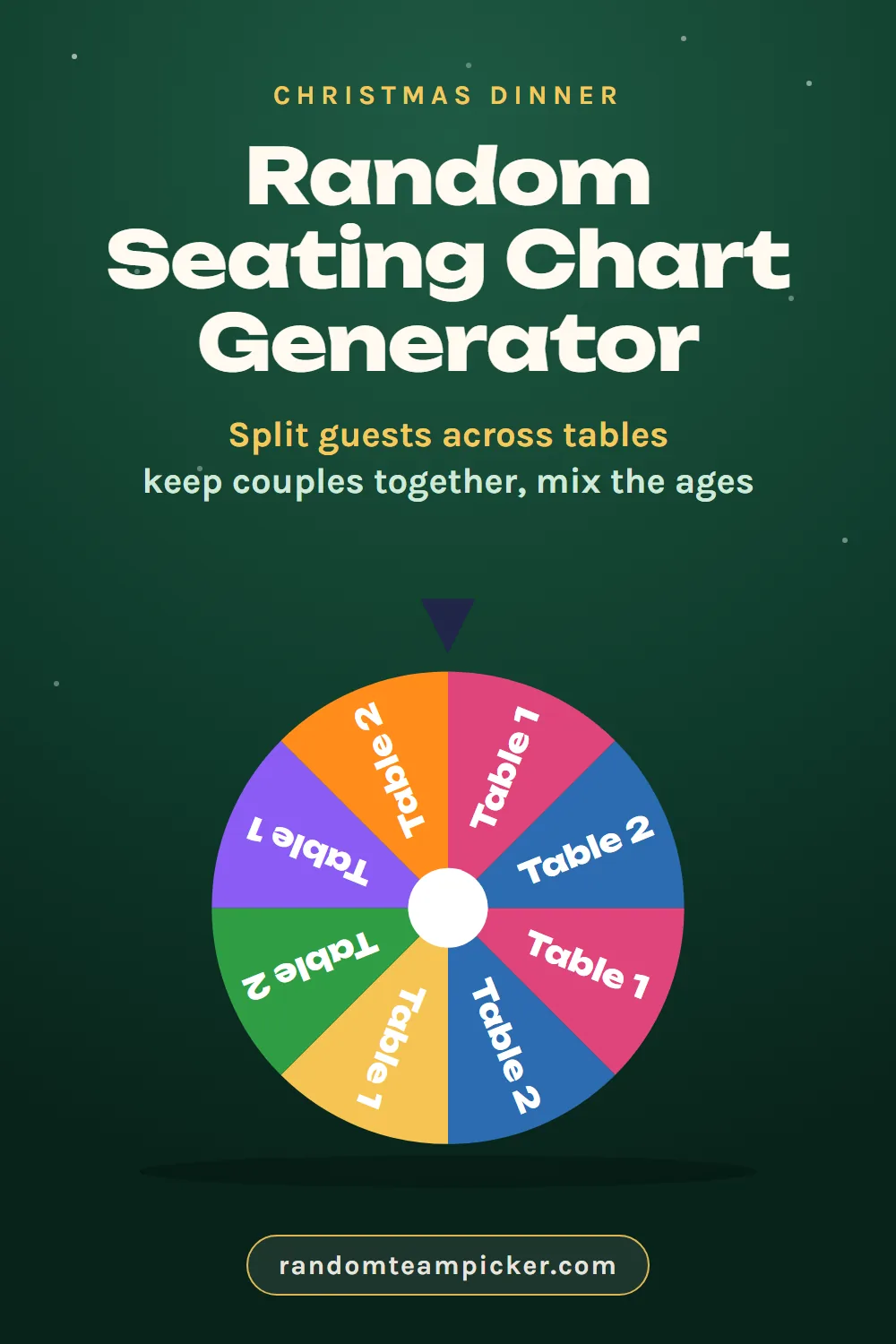
To make a random seating chart for Christmas dinner, list your guests, type each household or parent-and-little-one pair on one line so they stay together, set the number of tables you have and press split. Then check each table once for a mix of ages and at least one easy talker, write the place cards, and you're done. It takes about five minutes, and nobody can blame you for where they ended up.
A random chart solves the two classic Christmas dinner problems at once. There's no lonely kids' table squeezed into the hallway, and no corner where the same four people have the same conversation they had last year. Grandparents end up next to teenagers, cousins catch up with aunts they rarely see, and the host gets to stop worrying about who sits where. Below you'll find table sizes, a worked example with real head counts, tips on where to put grandparents and toddlers, and gentle fixes for relatives who don't get along.
Key facts
- Each "team" in the tool is one table.
- Type a household on one line, like "Mom & Dad", to keep it together.
- A 6-foot table seats 6 to 8; an 8-foot table seats 8 to 10.
- Put one parent at every table that has small children.
- Christmas Day 2026 is Friday, December 25.
🎲 Pick a random team
Choose a group, then spin. One for each player gives everyone in the names list below a different team.
👥 Random Team Picker: split your list into teams
The sample names are from this page. Replace them with yours, one per line or separated by commas.
The tool above is set up with a sample family split across three tables named Dining Room Table, Kitchen Table and Sunroom Table. Pairs such as "Grandma Rose & Grandpa Lou" are typed on one line, so they always land at the same table. Tick the age box to spread grandparents, grown-ups, teens and kids evenly across the tables, and tick the keep-apart box so the two teens who bicker (Jordan and Riley) and the two little ones who wind each other up (Mia and Leo) sit at different tables. To use it for your own dinner, replace the sample with your guest list, one line per person or household, set 2 to 12 tables with the minus and plus buttons, and press Split into teams. Shuffle again if you'd like a different mix, then Copy teams to make place cards. Open in the full team picker sends the same tables to the full Random Team Picker in a new tab, where you can print or share the chart.
Quick reference: how many guests each table seats
| Table | Seats comfortably |
|---|---|
| Round, 48 inches | 4 to 6 |
| Round, 60 inches | 8 |
| Rectangle, 6 feet | 6 to 8 |
| Rectangle, 8 feet | 8 to 10 |
| Kitchen island with stools | 3 to 5 |
Those numbers leave elbow room for platters, the gravy boat and the extra pie someone always brings. If you're tight on space, count serving dishes as a seat and put them on a side table instead.
Step by step: making the chart
Start with the guest list. Write one line per person, using the names the family actually uses, like "Grandma Rose" or "Uncle Ray," so the place cards feel warm rather than formal. Then decide who must sit together. A parent with a baby or toddler, a grandparent who needs a helping hand, or a household that arrived together and wants to stay together: type them on one line with an ampersand, such as "Aunt Maria & Uncle Joe" or "Dad & baby Sam." The tool treats that line as one name, so the pair always lands at the same table.
Next, count your tables. Each table is one team in the tool, so a dining table plus a kitchen table makes two teams. Press split, then read each table once. You're checking three things: a mix of ages, at least one person who keeps conversation going, and a head count that fits the table. If something feels off, press Shuffle again. A few shuffles usually turns up a chart you're happy with, and the result still feels random to your guests because it is.
Finally, make it real. Copy the tables, write the names on folded place cards and set them out when you set the table. Kids love making place cards, and it gives restless cousins something to do while the turkey or ham rests.
A worked example: 19 guests, three tables
The sample in the tool has 14 lines but 19 people, because five lines are pairs: Grandma Rose & Grandpa Lou, Aunt Lisa & Uncle Dave, Aunt Maria & Uncle Joe, Mom & Dad, and Cousin Ben & Kate. The other nine lines are singles: Great-Aunt Ruth, Uncle Ray, three teens (Jordan, Riley and Tyler) and four kids (Mia, Leo, Ava and Noah).
Fourteen lines across three tables gives two tables of five lines and one of four. But the real head count depends on how many pairs land at each table. A table of five lines with three pairs seats eight people, while a table of five singles seats only five. So after you split, count heads, not lines. If the Dining Room Table seats 8 and the Sunroom Table seats 6, put the busiest group in the dining room, or press Shuffle again until the numbers suit your space.
With the age box ticked, the two grandparent lines go to two different tables, and every table gets a mix of grown-ups, and a teen and a kid or two. With keep-apart on, Jordan and Riley never share a table, and neither do Mia and Leo. The result is three tables that each sound like a small family dinner, rather than one loud kids' corner and two quiet grown-up tables.
Kids' table or mixed tables?
Honestly, it depends on your family. The classic kids' table works well when you have lots of children under ten: they have fun, the grown-ups get quieter conversation, and spills stay in one place. The downside is that teens feel stuck with the little ones, and the kids miss out on time with grandparents they may only see a few times a year.
One long table with families sitting together is easy for small dinners of under ten, but people tend to talk to the same people as always. Random tables with ages mixed are best for big gatherings and blended families. Grandparents chat with teens, cousins meet in-laws, and kids sit with a favorite aunt. If you go mixed, put one parent at each table that has little kids, so someone can cut food and handle a spilled cup without crossing the room. There's no set age for graduating from the kids' table; many families move kids up around 12 or 13, but a mixed chart skips the question entirely.
Seats that matter more than you think
Random doesn't mean careless. Once the tool has chosen the tables, you still choose the seats within each table, and a few spots deserve thought. Grandparents get the comfortable chairs, closest to the kitchen and the bathroom, away from drafty doors and never on a folding stool. Little kids sit at the ends, where it's easy to get up and easy to wipe up. A guest who is new to the family, like a cousin's housemate or a neighbor who'd otherwise be alone for the holiday, sits beside someone they already know and across from someone friendly who will draw them in.
Every table also needs a good talker: the uncle with stories, the teen who asks questions, the aunt who remembers everyone's news. If one table ends up with three quiet people in a row, swap one person. And think about the carving. Whoever carves or serves should sit closest to the kitchen door, so platters don't pass over a toddler's head.
Keeping the peace at the table
Most families have two people who need a little space. The simplest fix is the keep-apart box in the tool, or in the full picker you can add any pair yourself. If they must share a table, seat them at opposite ends, and put a calm, cheerful person beside each of them.
A plainly random chart helps here more than anything. Nobody feels singled out when the seating was drawn by a tool, and "the picker put you there" is a very handy sentence on Christmas Day. Our guide to making random groups without bias explains why people accept a random draw more easily than a hand-made one. Giving each person a small job also helps: one carves, one pours water, one hands out dessert. Busy hands make for calmer conversations.
Shake things up for dessert
One of my favorite tricks is a second shuffle before pie. When the main course is cleared, press Shuffle again and let everyone move to their new seat for dessert. It feels like a little game, it gets people stretching their legs, and everyone gets two conversations out of one meal. Kids especially love racing to find their new place card.
The same tool works for other parts of the holiday. If you host on both Christmas Eve (Thursday, December 24, 2026) and Christmas Day, make a separate chart for each night so people sit with someone new each time. For a buffet with lots of small tables, our seating chart generator handles bigger events, the team generator for large groups helps when you have 40 or more guests, and a big extended-family gathering can borrow ideas from the family reunion team generator. For a holiday cookie swap, the cookie exchange table groups page rotates guests so everyone mingles.
Give the kids a job
Children who are bored before dinner tend to be grumpy during it, so hand them part of the planning. Older kids can type the guest list into the tool and press split themselves, which makes them proud of the chart. Younger ones can decorate the place cards with stickers, snowflakes or a drawing for each guest. You can also draw a random order for small jobs, such as who carries in the rolls, who rings the dinner bell and who helps clear plates, with the random order generator. If you'd like two kids to work together on each job, the random pair generator matches them up fairly, and siblings who squabble can be kept on different jobs. It all builds a little excitement before everyone sits down.
Mistakes hosts make with seating
The most common mistake is doing the chart in your head at 4 p.m. on Christmas Day, with the oven timer beeping. You end up with households clumped together and the kids' table in the hallway. Make the chart a day or two ahead and set the place cards out with the table.
The second mistake is counting lines instead of heads, which is how one table ends up with ten people and another with four. The third is forgetting the practical needs: a high chair next to a parent, a wheelchair with space at the end of the table, a guest with food allergies seated away from the shared nut bowl. The fourth is treating the chart as a rule. If Grandpa wants to swap seats with his grandson, let him. The chart is there to start conversations, not to stop people moving.
Late guests, extra chairs and odd numbers
Someone always brings an extra guest. Keep one spare chair at each table, and seat a surprise guest at the table with the fewest people. If the numbers come out uneven, a table of five next to a table of seven is completely fine. For a guest who arrives after the meal has started, seat them near the end with a plate kept warm, and they'll join the dessert shuffle with everyone else.
After dinner, the tool's cousins can keep the evening fair. Our white elephant turn order page draws gift-swap numbers, the Secret Santa draw where housemates can't draw each other sets up next year's exchange, and the Christmas games for large groups page has team games to play once the plates are cleared.
Quick answers about Christmas dinner seating
How do you make a random seating chart?
List your guests, type any household or parent-and-child pair on one line so they stay together, set the number of tables and press split. Then check each table for a mix of ages, one good talker and a head count that fits. Shuffle again if anything looks wrong.
Should families sit together at Christmas dinner?
Parents of babies and toddlers should sit with their little ones, and grandparents who need help should sit near someone who can help. Beyond that, mixing is part of the fun. Older kids and teens often enjoy sitting with aunts, uncles and grandparents they don't see every week.
What age should kids move from the kids' table?
There's no set age. Many families move kids up around 12 or 13, or when the kids' table runs out of room. A random chart with ages mixed across every table skips the question entirely, so nobody has to feel too old or too young for where they're sitting.
How do you seat relatives who don't get along?
Put them at different tables, or at opposite ends of one long table, and seat a calm, friendly person beside each of them. A plainly random chart takes the pressure off the host, since nobody can say they were placed on purpose. Giving each of them a job helps too.
How many people fit at one table for Christmas dinner?
A 6-foot rectangular table seats 6 to 8, an 8-foot table seats 8 to 10, and a 60-inch round table seats 8. Leave room for serving dishes, and seat one fewer person per table if you're serving family style with lots of platters.
Can I print the seating chart?
Yes. Press Copy teams to paste the tables into a document, or open them in the full team picker, which can print or share the list. Many hosts also write the names on folded place cards so guests find their seats quickly.
Should we change seats for dessert?
If your family enjoys it, yes. Shuffle the tables after the main course and let everyone move to new seats for pie. It doubles the conversations, gives people a chance to stretch, and kids love the scramble to find their new place card.