Christmas Trivia Teams: Fair, Mixed-Age Teams for a Family Trivia Night
The fairest way to pick Christmas trivia teams is to split everyone at random into teams of three to six, with ages mixed so each team has someone who knows the old carols, someone who knows the new movies and a kid who knows every cartoon. Leave the quizmaster off the list, decide how many teams you want, split, and read out the team names. That's it. The whole thing takes less than a minute.
Mixed teams matter more at Christmas than at almost any other quiz. Holiday questions cover a huge stretch of time, from carols written in the 1800s to classic films from the 1940s and animated movies the kids watched last week. Nobody knows all of it, so a team that has a grandparent, a parent, a teen and a kid can answer nearly anything together. Below you'll find a ready-made plan for a five-round family trivia night, scoring rules that keep it friendly, and 15 sample questions to get you started.
Key facts
- Three to six players per team is the sweet spot.
- Keep the host off the player list.
- Mix grandparents, adults, teens and kids on every team.
- Five rounds of 5 to 10 questions take about an hour.
- One answer sheet and one pen per team keeps it fair.
🎲 Pick a random team
Choose a group, then spin. One for each player gives everyone in the names list below a different team.
👥 Random Team Picker: split your list into teams
The sample names are from this page. Replace them with yours, one per line or separated by commas.
The tool above is loaded with a sample family of 17: three grandparents, six grown-ups, four teens and four kids, split into four teams. Tick the box to spread each age group evenly, so every team gets a fair share of grandparents, grown-ups, teens and kids. The teams are labeled with festive names in order, starting with Jingle Brains, The Smart Cookies, Elf Help Group and The Merry Minds, and adding names like Sleigh All Day and The Nutcrackers as you raise the number of teams. Replace the sample names with your own players, one per line or separated by commas, set 2 to 12 teams with the minus and plus buttons, and press Split into teams. Press Shuffle again for a new mix, Copy teams to paste the list into a message, or Open in the full team picker to carry the same teams to the full Random Team Picker in a new tab, where you can balance by skill, pick a captain and print the teams for the scoreboard.
Quick reference: 15 family-friendly Christmas trivia questions
| Question | Answer |
|---|---|
| Which reindeer has a red nose? | Rudolph |
| Where does Santa live? | The North Pole |
| How many reindeer pull the sleigh in "A Visit from St. Nicholas"? | Eight |
| What was Frosty the Snowman's nose? | A button nose |
| What is the Grinch's dog called? | Max |
| How many sides does a snowflake usually have? | Six |
| What comes on the fifth day of Christmas? | Five golden rings |
| What three gifts did the Wise Men bring? | Gold, frankincense and myrrh |
| What does "Feliz Navidad" mean? | Merry Christmas |
| What is Scrooge's first name? | Ebenezer |
| Who wrote "A Christmas Carol"? | Charles Dickens |
| Who composed "The Nutcracker" ballet? | Tchaikovsky |
| Which country sends London's Trafalgar Square tree each year? | Norway |
| In which country was "Silent Night" first sung? | Austria |
| What is December 26 called in the UK and Canada? | Boxing Day |
How to set up your trivia teams
Start by choosing your host. The quizmaster reads the questions, keeps time and marks the answer sheets, so they shouldn't be on a team. If you have a big crowd, add a helper to collect sheets and keep the scoreboard. Everyone else goes on the player list.
Next, pick the number of teams. With 6 to 9 players, two teams of three to five works well. With 10 to 16 players, go for three or four teams. With 17 to 24, make four or five teams of four to six. With 25 to 40, make six to eight teams. The reason for the limits is simple: on a team of two, one person carries everything, and on a team of seven or eight, the quieter players never get a word in. Our guide to how many people per team is best explains the same rule for other games.
Then split, glance over the result once and read the teams out loud. If you didn't use the age-spread box and one team got all three grandparents, shuffle again or swap one person. Seat each team together at its own corner of the table or room, hand out one answer sheet and one pen per team, and you're ready for question one.
Why mixed-age teams win at Christmas trivia
Each generation has its own Christmas superpower. Grandparents tend to know carol lyrics, classic films and older traditions. Parents remember the holiday TV specials and songs from their own childhood, and they often know the food questions cold. Teens are quick on newer movies and songs and are fearless guessers. Kids know the animated films, Santa facts and every reindeer's name.
Split a family by age, and the grandparents' team cleans up on the carols round while the kids' team gets nothing. Mix the ages, and every team has a fighting chance in every round. It also changes the feel of the night. Instead of grown-ups against kids, you get a grandpa and a ten-year-old whispering over the same answer sheet, which is the whole point of a family game.
A worked example: 17 players, four teams
Take the sample family in the tool. Grandma Jean, Grandpa Frank and Nana Sue are the grandparents. Aunt Beth, Uncle Tom, Dad, Mom, Uncle Rob and Aunt Amy are the grown-ups. Jake, Sophie, Ethan and Hannah are the teens, and Lily, Ben, Maya and Caleb are the kids. Seventeen players into four teams makes one team of five and three teams of four.
With ages spread evenly, the three grandparents land on three different teams, each team gets one teen and one kid, and the six grown-ups spread out so every team has at least one. Jingle Brains might end up with Grandma Jean, Mom, Uncle Rob, Sophie and Caleb, for example, while The Merry Minds have Aunt Amy, Dad, Ethan and Maya. The team without a grandparent may struggle in the carols round, but it usually makes up for it on the movie questions. If you'd like every team to have a grandparent, simply set three teams instead of four.
A five-round family trivia night
Round one is Christmas movies. Mix classic films with newer animated ones so every generation gets a turn to shine. Round two is carols and songs: the host reads or hums a line, and teams write the title. Round three is traditions around the world, with questions like the meaning of "Feliz Navidad" or where the Trafalgar Square tree comes from. Round four is the kids' round, where only players under 12 may answer and the grown-ups sit on their hands. Round five is a picture round: print photos of ornaments, cookies, famous Christmas buildings or movie scenes, and have teams name them.
With 5 to 10 questions per round, the night takes about an hour. I like a short snack break after round three, which is also a good time for the host to tally scores and pin them up. Save the funniest or easiest round for last, so the evening ends on laughter rather than a nail-biting argument about spelling.
Scoring rules that keep it friendly
Give one point per correct answer, and announce the rules before round one so nobody argues later. Each team gets one answer sheet and one pen, which forces teammates to agree and whisper instead of shouting answers across the room. Phones go face down in a basket. Spelling doesn't count unless the question is about spelling. Half points work well for answers that are nearly right, like naming seven of the eight reindeer.
Two small rules make a big difference with young players. First, give a bonus point when the youngest player on a team gives the right answer. Second, in the kids' round, allow the kids to confer with each other but not with the grown-ups. If one team pulls far ahead, make round five worth double points so everyone stays in it until the end. Use the who goes first generator to decide which team picks the category or answers first in any spoken round.
Writing your own questions
The sample questions above are a starter set. When you write the rest, aim for a mix: plenty of easy questions that a six-year-old can shout out, some medium ones that need a teammate's help, and a few hard ones that make the grown-ups think. A round of only hard questions leaves kids bored, and a round of only easy ones leaves teens on their phones.
Keep questions short and clear, with one right answer. Avoid questions with fuzzy answers, like "most popular Christmas song," because people will argue. Check every answer before the night, and write the answers on the host's sheet, not in your head. Personal family questions are great fun too, such as "Which year did Grandpa dress up as Santa?" as long as everyone at the table could plausibly know the answer.
Variations to try
Lightning round: the host reads ten quick questions in a row, and teams write answers as fast as they can, with no repeats. Buzzer round: each team gets a bell or a squeaky toy, and the first team to buzz answers out loud, losing a point for a wrong answer. Team names round: before round one, let each team invent its own name, or keep the festive ones from the tool; our holiday team name generator has many more. Office version: at work, split across departments so new hires and long-timers mix, keep questions to movies, songs and traditions, and see our office Christmas party games for more ideas. Remote version: for coworkers or relatives on a video call, put each team in its own breakout room, as our guide to virtual holiday party breakout rooms explains.
Have a large group from church, school or a youth club? Trivia scales well. The Christmas games for large groups page and our Christmas youth group games both show how to run it with dozens of players, and the team generator for trivia nights covers the year-round quiz setup.
Common mistakes hosts make
Letting people pick their own teams is the big one. Siblings and best friends team up, the kids end up together on a team that can't win, and the one trivia buff in the family gets fought over. A random split with ages spread fixes all of that in one tap, and nobody can say the host rigged it.
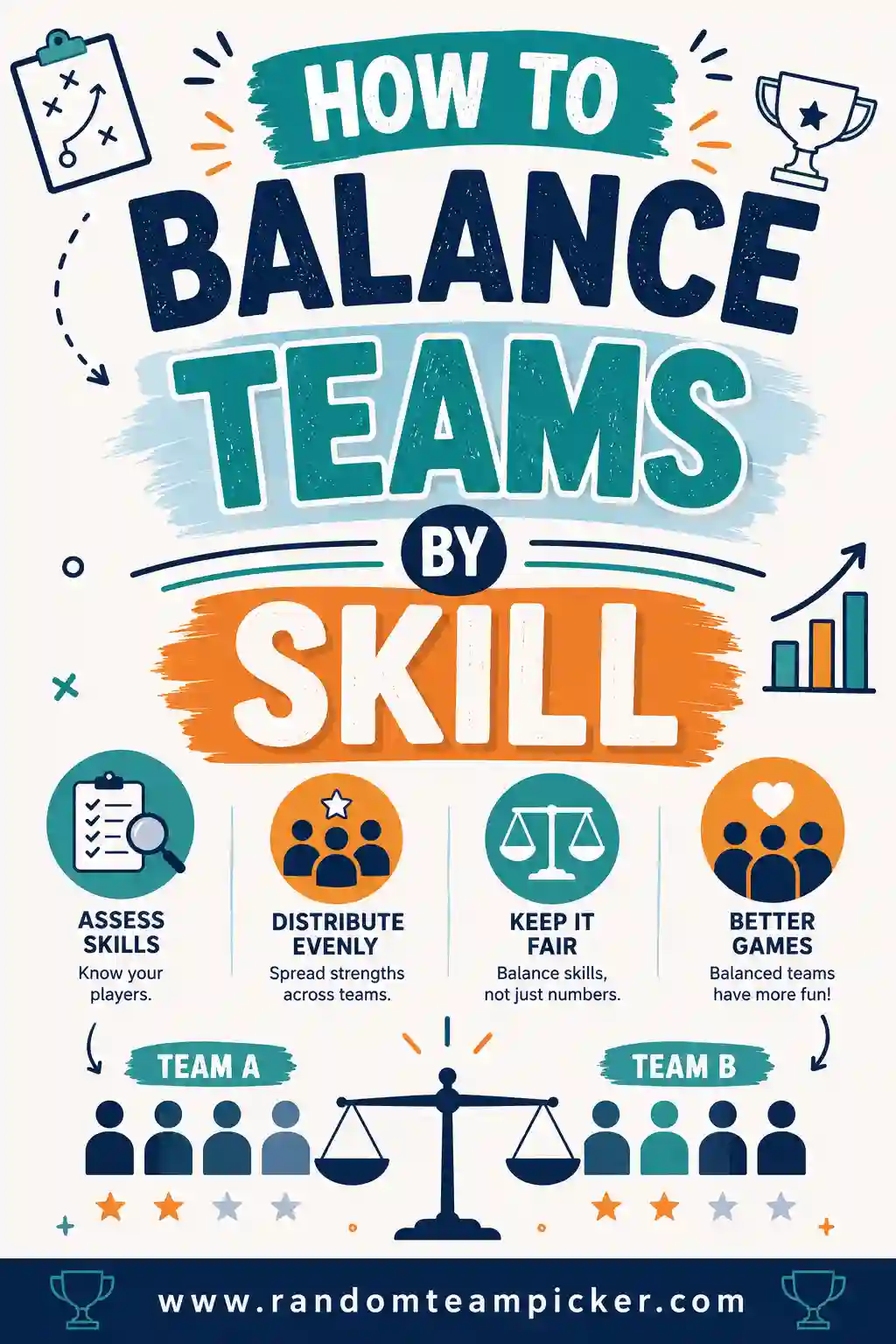
The second mistake is a quiz that's too long. Fifty questions sounds fine on paper, but after an hour, the little ones drift off and the grown-ups start checking the pie. Thirty to forty questions is plenty. The third is a skill gap nobody planned for, such as one team with a cousin who memorizes film trivia. If your crowd is very uneven, rate players from 1 to 5 and balance them in the full tool; our guide to balancing teams by skill shows how.
Ties, late arrivals and odd numbers
For a tie, use a sudden-death question with a number answer, like "In what year was 'A Christmas Carol' first published?" (1843). The closest guess wins. When someone arrives late, add them to the smallest team, or to the team in last place. If you end up with an odd number, a team of three next to teams of four is fine, but give the smaller team a small bonus or let them answer first in the buzzer round. Our guide to splitting an odd number into teams has more fixes.
Quick answers about Christmas trivia teams
How do you split teams for holiday trivia?
Split at random, then make sure every team has a mix of ages: a grandparent for the old carols, a teen for the newer movies and a kid for the cartoons. The tool on this page spreads age groups evenly in one tap, and the full team picker adds skill balancing. Leave the host off the list, since they read questions and mark answers.
How many people should be on a Christmas trivia team?
Three to six. With fewer than three, one person carries the team. With more than six, the quiet players never get to answer, and the team spends too long arguing. For a big crowd, add more teams rather than making teams bigger.
What are good Christmas trivia team names?
Try Jingle Brains, The Smart Cookies, Elf Help Group, The Merry Minds, Sleigh All Day, The Nutcrackers or Snow Problem. The tool on this page labels teams with festive names like these in order, and you can let each team pick its own before round one.
How do you run a family Christmas trivia night?
Pick a host, split mixed-age teams and play five rounds of 5 to 10 questions on movies, songs, traditions and pictures, plus a kids-only round. Give each team one answer sheet and one pen, take a snack break halfway, and announce the scores after each round.
How do you make Christmas trivia fair for kids and adults?
Mix ages on every team, include plenty of easy questions, add a round only kids can answer, and give a bonus point when the youngest player answers correctly. A picture round helps too, because young kids are often quicker than grown-ups at spotting what's in a photo.
How long should a Christmas trivia game last?
About an hour is ideal for a family. That's five rounds of 6 to 8 questions with a short break. Office or adult groups can go to 90 minutes. Stop while people are still having fun, and save the easiest round for last.
Can you play Christmas trivia over video call?
Yes. Split teams in advance, put each team in its own breakout room or group chat to agree on answers, and have one person per team send the answers to the host. Keep rounds shorter than in person, because talking over a call takes longer.