New Year's Eve Team Games: Fair Family Teams and 15 One-Minute Challenges
The easiest New Year's Eve team games are quick one-minute challenges, like balloon keep-up, cup stacking and a cotton ball scoop, played in three or four teams with kids, teens and grown-ups mixed together. Split the teams at random, play eight to twelve rounds over about an hour, keep score on a big sheet of paper and crown the winning team just before your countdown.
You don't need special gear. Balloons, plastic cups, paper plates, cotton balls, a spoon and some music cover almost every game below. And you don't need to stay up until midnight. Plenty of families count down at 8 p.m. or even noon, so the youngest players are still smiling when the confetti flies. Below are the rules for all 15 challenges, a timing plan and a scoring system that keeps every team in the race.
Key facts
- New Year's Eve 2026 is Thursday, December 31.
- Three or four teams of 3 to 5 players suit most families.
- Each challenge lasts 60 seconds; 8 to 12 rounds fill about an hour.
- Score 3, 2 and 1 points, with double points on the last round.
- Count down at the time that suits your youngest player, not the clock.
🎲 Pick a random team
Choose a group, then spin. One for each player gives everyone in the names list below a different team.
👥 Random Team Picker: split your list into teams
The sample names are from this page. Replace them with yours, one per line or separated by commas.
The tool above is set up with a sample family of 13: five grown-ups, four teens and four kids, split into Team Confetti, Team Noisemaker, Team Countdown and Team Sparkle. Tick the box to spread each age group evenly, so no team ends up with all the teens, and tick the keep-apart box so the sibling pairs (Zoe and Leo, Emma and Liam, Ruby and Max) land on different teams. Then paste in your own crowd, one per line or separated by commas, choose 2 to 12 teams with the minus and plus buttons, and press Split into teams (or Shuffle again). Copy teams copies the list, and Open in the full team picker takes the same teams to the full Random Team Picker in a new tab, where you can balance by skill, pick a captain for each team and print the list for the wall.
Quick reference: the 15 one-minute challenges
| Challenge | Who plays | Supplies |
|---|---|---|
| Balloon keep-up | Whole team | 1 balloon |
| Cup stack countdown | One player | 10 plastic cups |
| Cotton ball scoop | One player | Cotton balls, 2 bowls, spoon, scarf |
| Confetti relay | Relay | Paper confetti, spoon, cup |
| Paper plate toss | Relay | Paper plates, basket, tape |
| Year in a minute | Whole team | Nothing |
| Noisemaker freeze | Whole team | Music |
| Penny tower | One player | Pennies |
| Balloon pop sit | Relay | Balloons |
| Resolution charades | Whole team | Paper slips |
| Hat stack | One player | Paper party hats |
| Straw blow race | One player | Ping-pong ball, straw, 2 cups |
| Countdown memory | Whole team | Tray, 10 small items |
| Streamer wrap | Pair | Crepe paper streamers |
| Ten to one | Whole team | Nothing |
Pick your countdown time first, then plan backward
The biggest decision of the night isn't the games. It's when you count down. If your youngest player is four, a midnight countdown means a teary kid by ten. Pick the time that fits the smallest person in the room: noon for toddlers and classrooms, 8 or 9 p.m. for school-age kids, midnight for teens and grown-ups.
Here is a simple plan for an 8 p.m. countdown. At 6:45, split the teams and hand out party hats in team colors if you have them. At 7:00, play rounds one to four. At 7:20, take a snack break. At 7:30, play rounds five to eight. At 7:45, take a short break while the judge adds up the scores. At 7:50, play the double-points final round. At 7:55, announce the winners, and at 8:00, count down together. Shift every time by the same amount for a noon or midnight countdown and the plan still works.
Choose a timekeeper and judge before the first round, ideally a grown-up or teen who isn't playing. A phone timer is fine.
How to play each challenge
Every challenge runs for 60 seconds. Rotate who goes in the one-player and relay games so every person plays at least three times.
Active games
Balloon keep-up: the whole team keeps one balloon in the air, and the judge counts taps until it touches the floor. Best count in a minute wins. Noisemaker freeze: play music and everyone dances; when the music stops, freeze. Anyone still moving sits down, and the team with the most players standing at the end of the minute wins. Balloon pop sit: teammates take turns popping a balloon by sitting on it. Skip this one with toddlers, pets or anyone who hates loud bangs. Streamer wrap: one player wraps a teammate in crepe paper streamers like a mummy, and the most covered player wins.
Hands-on games
Cup stack countdown: stack 10 cups into a pyramid of four, three, two and one, then unstack them into a single pile. Count full pyramids in a minute. Cotton ball scoop: wearing a scarf as a blindfold, scoop cotton balls from one bowl into another with a spoon. Confetti relay: carry a spoonful of paper confetti across the room and tip it into a cup, then hand the spoon to the next teammate. Paper plate toss: toss plates like flying discs into a laundry basket from a tape line. Penny tower: stack pennies as high as you can with one hand. Hat stack: balance paper party hats on your head; the most hats held for five seconds wins. Straw blow race: blow a ping-pong ball across the table through a goal made of two cups.
Thinking and talking games
Year in a minute: the team names as many things the family did this year as it can, and the judge keeps a tally. Resolution charades: one player acts out a fun goal from a slip of paper, like learning to juggle or riding a bike with no training wheels, while teammates guess as many as possible. Countdown memory: the judge shows a tray of 10 party items for 20 seconds, covers it, and the team has 40 seconds to name them. Ten to one: the team counts backward from 10 in as many silly voices as it can, such as robot, whisper, opera singer or mouse, and the judge counts the voices.
A worked example: 13 people, four teams
Let's use the sample family in the tool. There are 13 players: Grandma Lou, Mom, Dad, Aunt Rachel and Uncle Chris as the grown-ups, Emma, Liam, Olivia and Mason as the teens, and Zoe, Leo, Ruby and Max as the kids. Thirteen people into four teams gives one team of four and three teams of three. With ages spread evenly, each team gets at least one grown-up, one teen and one kid, and one team picks up the extra grown-up. With keep-apart on, the three sibling pairs are split up, so nobody spends the hour bossing their own brother around.
In whole-team challenges like balloon keep-up, the four-player team has a small edge, so I give the three-player teams a five-tap head start. If you'd rather avoid uneven teams altogether, our guide to splitting an odd number into teams covers the usual fixes, like adding the judge as a floating player.
A good round order mixes energy levels: balloon keep-up, cup stack, year in a minute and confetti relay, then a snack; paper plate toss, countdown memory, hat stack and straw blow race; and resolution charades for double points. Nine rounds, about an hour.
Scoring that keeps everyone in the race
Keep the scoring simple enough that a nine-year-old can follow it. In each challenge, first place gets 3 points, second place gets 2 and every other team that finished gets 1. Nobody scores zero for trying. Draw a grid on a big sheet of paper or a whiteboard with a row for each team and a column for each round, plus a total column, and tape it where everyone can see it.
Make the final round before the countdown worth double points. It keeps the last-place team hoping right to the end, and it gives the night a real finale. If two teams tie, run a cup stack race between one player from each team; the first full pyramid wins.
Variations for different crowds
Noon year's eve in the classroom
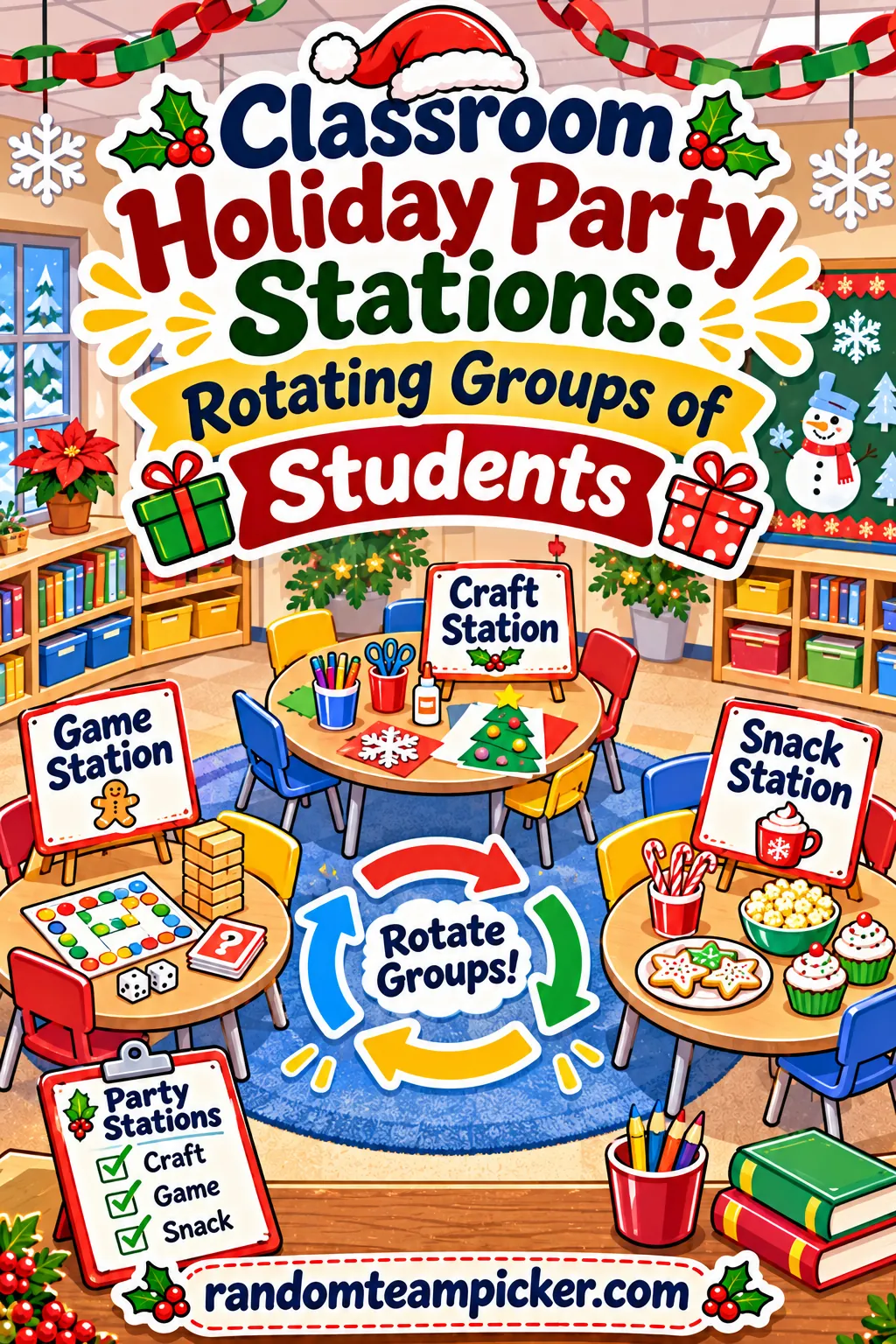
Schools are usually on break by December 31, so classes celebrate on the last day before break or the first day back. Split the class into four to six teams of four or five, add keep-apart pairs for students who shouldn't sit together, and pick five or six challenges that need little space, such as cup stacking, the cotton ball scoop, year in a minute, countdown memory and ten to one. Set them up as stations and rotate teams every five minutes, the same way our classroom holiday party station groups work, or build a rotation grid with the station rotation generator. At 11:59, everyone counts down and tosses paper confetti, then helps sweep it up.
Big party of 25 or more
Make six to eight teams of four and run two challenges at once, with a judge at each. Our team generator for large groups has more ideas for keeping big numbers moving.
Making it work for little kids and grandparents
Mixed-age teams are the heart of a family night, but the games need small tweaks so everyone can play. Give little kids a head start, a bigger target or a second try. Move the tape line closer for the paper plate toss. Let grandparents play the seated games, such as countdown memory, year in a minute, the straw blow race and the cotton ball scoop, and make them the judge for the dancing round if they'd rather.
A few safety notes: uninflated or broken latex balloons are a choking hazard for young children, so pick up the pieces after every balloon round. Keep pennies and ping-pong balls away from toddlers, clear cords and slippery rugs before any running game, and swap balloon pop sit for keep-up if a child hates loud bangs. For more ideas that suit young players, see our team generator for kids' games.
Mistakes I see hosts make
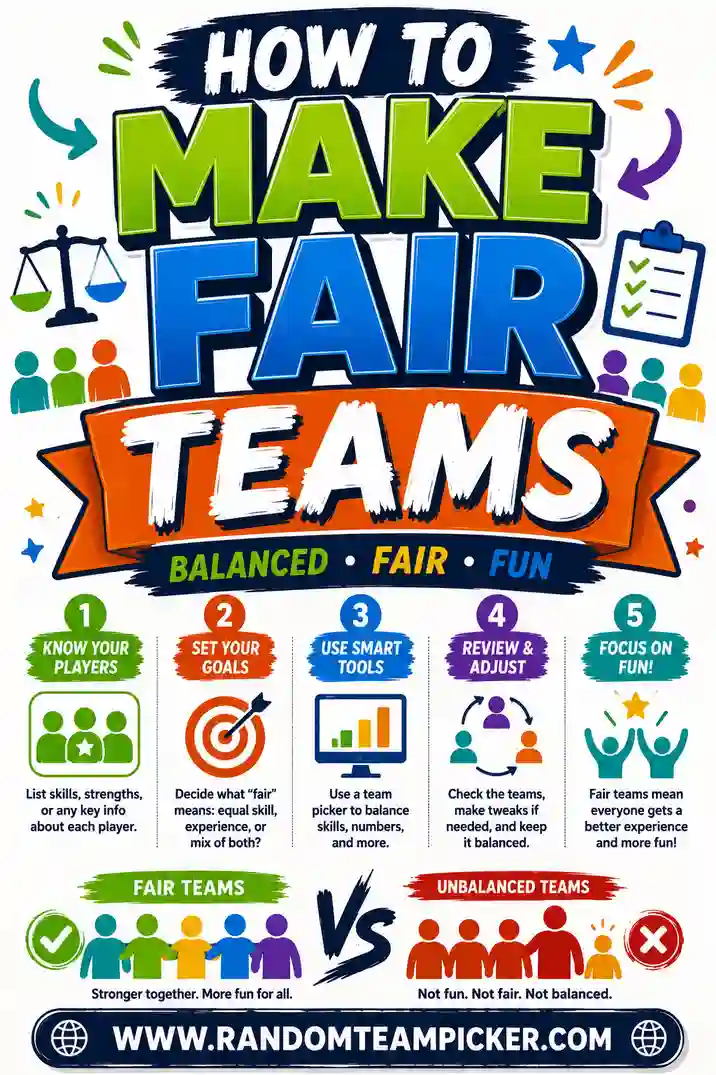
The most common one is planning the games for midnight when the kids crash at ten. Choose the countdown time that fits your youngest player, play in the hour before it and save one last challenge for right after. The second is letting people choose their own teams: the teens cluster, the little ones can't win, and somebody feels picked last. A random split with ages spread and siblings apart fixes all of that, and our guide to making fair teams explains why it works.
The third mistake is long rules. If a game needs more than two sentences, it's too complicated for a party. The fourth is skipping breaks: everyone needs a snack every three or four rounds, or the energy crashes before the countdown.
Late arrivals, odd numbers and a team that keeps winning
When a cousin arrives halfway through, add them to the smallest team or the team in last place. To decide which team goes first in each challenge, use our who goes first generator, or put the teams in a random order once and rotate from there.
If one team is running away with it after five rounds, shuffle the teams for the second half. It's New Year's, so a fresh start fits the theme.
Prizes that cost almost nothing
The best prizes are privileges: the winners pick the countdown song, wear the gold party hats or get first choice of snacks. Give every team a small favor, like a noisemaker, so nobody leaves empty-handed. For a rivalry that lasts all season, our holiday team name generator has plenty of ideas, and the reindeer games for a Christmas party page has more one-minute challenges you can borrow.
Quick answers about New Year's Eve team games
What are good New Year's Eve team games for families?
One-minute challenges work best: balloon keep-up, cup stacking, the cotton ball scoop, paper plate toss and countdown memory. They use cheap supplies, every age can play, and each round is over in 60 seconds. Mix active games with seated ones so grandparents can join in.
How do you split teams for New Year's Eve games?
Split at random, then make sure every team has a mix of kids, teens and grown-ups. The tool on this page spreads each age group evenly and can keep sibling pairs on different teams, so no team is all big kids. For more control, the full team picker also balances by skill.
How many games should you play on New Year's Eve?
Plan 8 to 12 one-minute challenges with a snack break every three or four rounds. That fills about an hour and builds nicely toward your countdown, whether it's at noon, 8 p.m. or midnight. Have two spare games ready in case a round flops or the kids want more.
What time should a family count down on New Year's Eve?
Whatever time suits your youngest player. Many families with small children count down at 8 or 9 p.m., and some play a noon year's eve. Start the games about an hour before your chosen time and end with a double-points round so the evening builds to the countdown.
What are good noon year's eve classroom games?
Split the class into four to six teams and run quick challenges that need little space: cup stacking, the cotton ball scoop, year in a minute, countdown memory and ten to one. Rotate teams through stations every five minutes, then count down to noon together and toss paper confetti.
Are these games safe for toddlers?
Most are, with care. Skip balloon pop sit, keep pennies and ping-pong balls out of reach, and pick up broken balloon pieces straight away, since they are a choking hazard for young children. Let toddlers join balloon keep-up, the dance freeze and the confetti relay with a grown-up teammate.
What's a good prize for New Year's Eve team games?
Let the winning team pick the countdown song, wear the gold party hats, get first choice of snacks or bang the biggest pot at the countdown. Give every team a small party favor too, so the night ends with everyone cheering.