Group Work Roles: Who Does What in Groups of 3, 4 and 5 (With Role Cards)
The five classic group work roles are the facilitator, who keeps the group on task, the recorder, who writes down ideas and answers, the timekeeper, who watches the clock, the reporter, who shares the group's work with the class, and the materials manager, who gets and returns supplies. In a group of 5, everyone gets one role. In groups of 3 or 4, you combine a couple of them so every student still has a clear job.
The part that makes roles actually work is how you hand them out. Assign them at random and rotate them often, so every student practices every job and nobody gets stuck as "the writer" all year. Below you'll find role sets for each group size, what to put on a role card, a simple way to assign roles fairly, and the mistakes that quietly make roles fall apart.
Key facts
- Five core roles: facilitator, recorder, timekeeper, reporter, materials manager.
- Groups of 4 are the sweet spot for most classrooms.
- Groups of 3 or 4 combine roles; groups of 5 get one each.
- Rotate roles every task or every week.
- Random assignment ends the "I always have to write" problem.
🎲 Pick a random team
Choose a group, then spin. One for each player gives everyone in the names list below a different team.
👥 Random Team Picker: split your list into teams
The sample names are from this page. Replace them with yours, one per line or separated by commas.
The tool above starts with a sample class of 24 students split into 6 groups of 4, labeled Group 1 to Group 6. Replace the sample names with your class list, one per line or separated by commas, use the − and + buttons to choose how many groups you need (anywhere from 2 to 12), and press "Split into teams," or "Shuffle again" for a new mix. "Copy teams" puts the groups on your clipboard for a slide or document. The same box can also hand out roles inside one group, as shown below. "Open in the full team picker" sends the groups to the full tool in a new tab for skill balancing or keep-apart rules.
Quick reference: role sets by group size
| Group size | Role 1 | Role 2 | Role 3 | Role 4 | Role 5 |
|---|---|---|---|---|---|
| 3 | Facilitator + timekeeper | Recorder | Reporter + materials | - | - |
| 4 | Facilitator | Recorder | Timekeeper + materials | Reporter | - |
| 5 | Facilitator | Recorder | Timekeeper | Reporter | Materials manager |
What each of the five roles really does
The facilitator is the group's guide, not its boss. They read the task aloud at the start, check that everyone understands what they're making, and make sure each person gets a turn to talk before the group decides anything. A good facilitator line is "Let's hear from everyone first."
The recorder writes down the group's ideas, answers and decisions. They are not the person who does all the thinking, just the one who captures it. A helpful habit is asking "Can you say that again so I get it right?" so the paper matches what people actually said.
The timekeeper watches the clock and gives time checks, such as a halfway warning and a "five minutes left" call. Groups often spend too long on the first question and rush the last, and a timekeeper who speaks up keeps the work balanced. If a task isn't timed, give it a time limit so this student has something real to do.
The reporter shares the group's work with the class, often starting with "Our group found that…" They are also the one person who comes to you with a question on behalf of the group, which cuts down on four hands going up at once. Quiet students often grow the most in this role, because they speak for the group rather than for themselves.
The materials manager picks up supplies, returns them and leaves the table clean. In labs and art projects this keeps the room calm. Pair it with a simple rule: only the materials manager leaves the table during work time.
How to combine roles for groups of 3 and 4
In a group of 3, put the facilitator and timekeeper together, keep the recorder on their own, and pair the reporter with the materials manager. Each pair fits naturally: the person running the discussion is already watching the pace, and the student who stands up to share can also walk to the supply shelf.
In a group of 4, keep the facilitator, recorder and reporter as single roles and combine the timekeeper with the materials manager. Both of those jobs are light during most tasks, so one student can handle both easily. Groups of 4 are a sweet spot for most classrooms: small enough that nobody hides, big enough for real discussion. If you're still deciding on a size, our guide on how many people per team works best compares the options, and how to divide a class into groups covers the practical side of setting them up.
A group of 5 gives everyone their own role, which is tidy, but five is the size where one student can quietly drift. If you use groups of 5, make the materials manager responsible for a small extra job, such as checking that every name is on the paper, so they stay part of the work.
Handing out roles at random, step by step
Letting students choose roles hands the same jobs to the same confident students. Random assignment fixes that in a minute. Here's the method I like with the tool on this page:
- Paste your class list and split it into the number of groups you need.
- Copy the names from one group, paste just those names back into the box, and set the number of teams to the group size, for example 4.
- Split again. Each "group of one" is now a role slot: Group 1 is role 1, Group 2 is role 2, and so on, matching the order in the quick reference table.
- Repeat for each group, or post the first group's result and do the rest with numbered role cards drawn from a cup.
In a group of 4, that means whoever lands in Group 1 is the facilitator and whoever lands in Group 4 is the reporter. Setting the number of teams equal to the number of names gives each student a random slot, which is exactly what a role draw needs. If you'd rather see a single shuffled list, the random order generator does the same job in one step, and the name picker is handy when you just need one reporter from the whole class.
A worked example with a class of 24
Say 24 students have a 30-minute task: read a short article and make a summary poster. You split them into 6 groups of 4. In Group 3 you have Daisy, Mateo, Quinn and Willow. You paste those four names in, set the teams to 4, and split. Quinn lands in Group 1, Willow in Group 2, Daisy in Group 3 and Mateo in Group 4.
So Quinn is the facilitator and reads the article aloud. Willow is the recorder and writes the three main points on the poster draft. Daisy is the timekeeper and materials manager, grabbing markers and calling time at 15 and 25 minutes. Mateo is the reporter and shares the poster with the class at the end. Next week you shuffle again, so over a month most students try most roles.
If your class doesn't divide evenly, say 25 students, make five groups of 4 and one group of 5, and give the group of 5 the full set of roles. More leftover fixes are in splitting an odd number into teams.
Writing role cards students will actually use
A role card works best when it lists two or three concrete jobs, not a paragraph. Students should be able to glance at it mid-task and know what to do next. The facilitator card might say: read the task aloud, make sure everyone talks, keep the group on topic. The recorder card: write the group's ideas, check spelling and names, hand in the paper. The timekeeper card: set the timer, give a halfway and a five-minute warning, help the group finish on time.
The reporter card can read: share the group's answer with the class, ask the teacher questions for the group. The materials manager card: get the supplies, return them, leave the table clean. Add one sentence starter to each card, like "We have five minutes left."
Laminated cards on lanyards, or a clothespin clipped to a sleeve, make roles easy to see from across the room, so you can walk past and ask "Timekeeper, where are we?"
Roles for younger students
Kindergarten to 2nd grade students do best with short, friendly role names and a picture on each card. Call the facilitator the Leader ("I help everyone take turns"), the recorder the Writer ("I write our ideas"), the timekeeper the Timer ("I watch the clock"), the reporter the Speaker ("I share with the class") and the materials manager the Supply Helper ("I get and put away our things").
Model each role in front of the class once before you use them. A quick fishbowl demo, where one group works in the middle while everyone else watches, goes a long way. Pause and ask, "What did the Leader just do?" With young groups, start with only two or three roles and add the rest once routines are steady.
Extra roles for long projects
For bigger or multi-week projects, the five classic roles sometimes don't cover the work. Useful additions are the encourager, who gives praise and keeps the mood positive, the checker, who makes sure everyone understands the answer before the group moves on, the researcher, who finds facts and sources, the designer, who plans how the poster, slides or model will look, and the project manager, who keeps a list of tasks and deadlines.
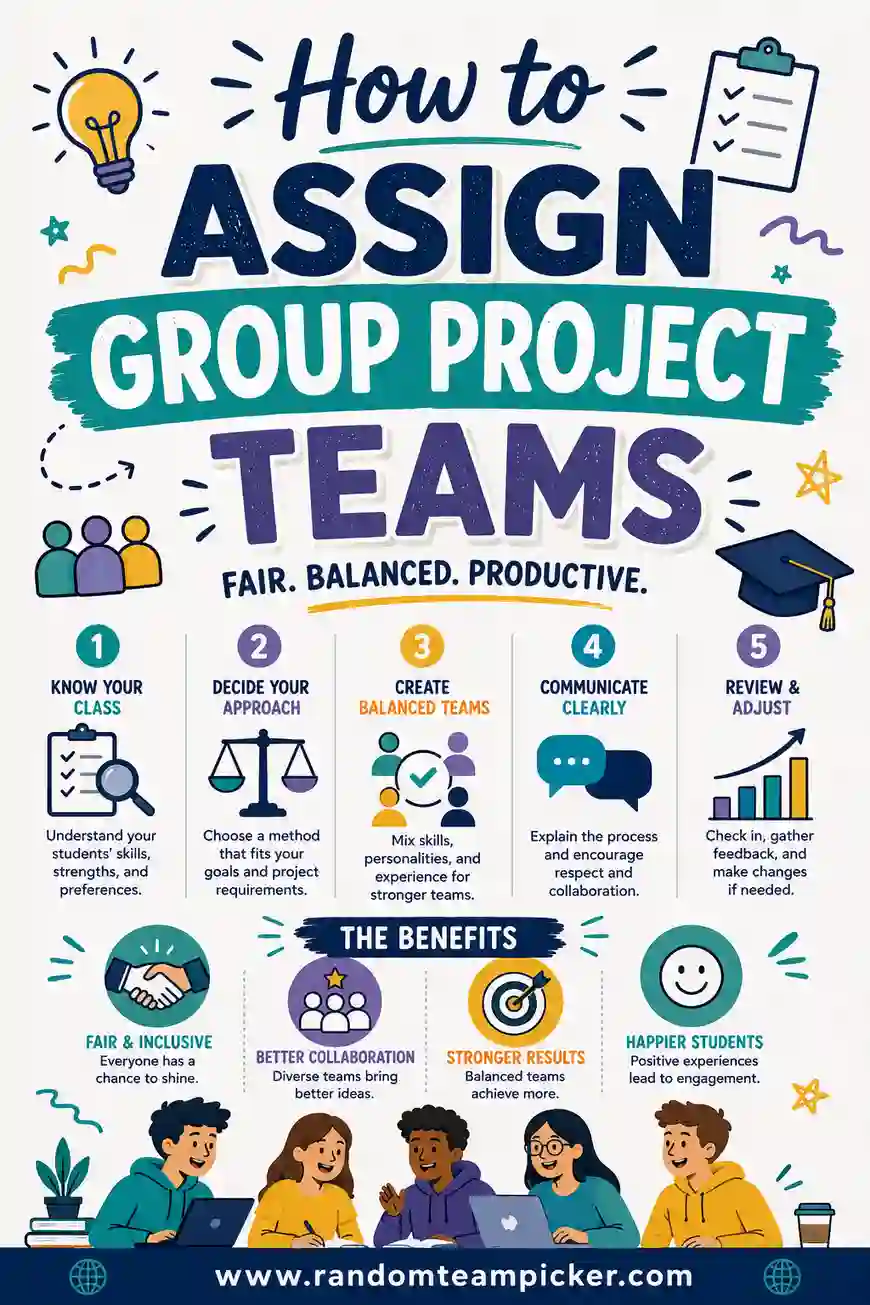
A common long-project set is project manager, researcher, writer, designer and presenter. Rotate these at each checkpoint rather than each day. Our group generator for group projects covers setting up the project groups themselves, and how to assign group project teams explains how to keep those groups fair from the start. For structured arguments, a debate team has its own roles, which our team generator for debate class covers.
Why roles help, and where they go wrong
Roles give every student a job, so nobody coasts and nobody does it all. Quiet students get a guaranteed voice, and over a year everyone practices leading, listening, writing and speaking to a room.
They go wrong in predictable ways: letting students pick (the same few grab the visible jobs), never rotating, handing out a role with no real work in it, and skipping the debrief. Asking "How did your role help the group today?" takes one minute and makes roles stick. Groups themselves should also change every few weeks, and our guide on randomizing without repeats shows an easy way to do it. The full Random Team Picker can also avoid repeat pairings across splits.
Roles, jobs and seating working together
Group work roles last for one task, while classroom jobs like line leader run all week. Our classroom jobs list has ideas for the weekly side of things.
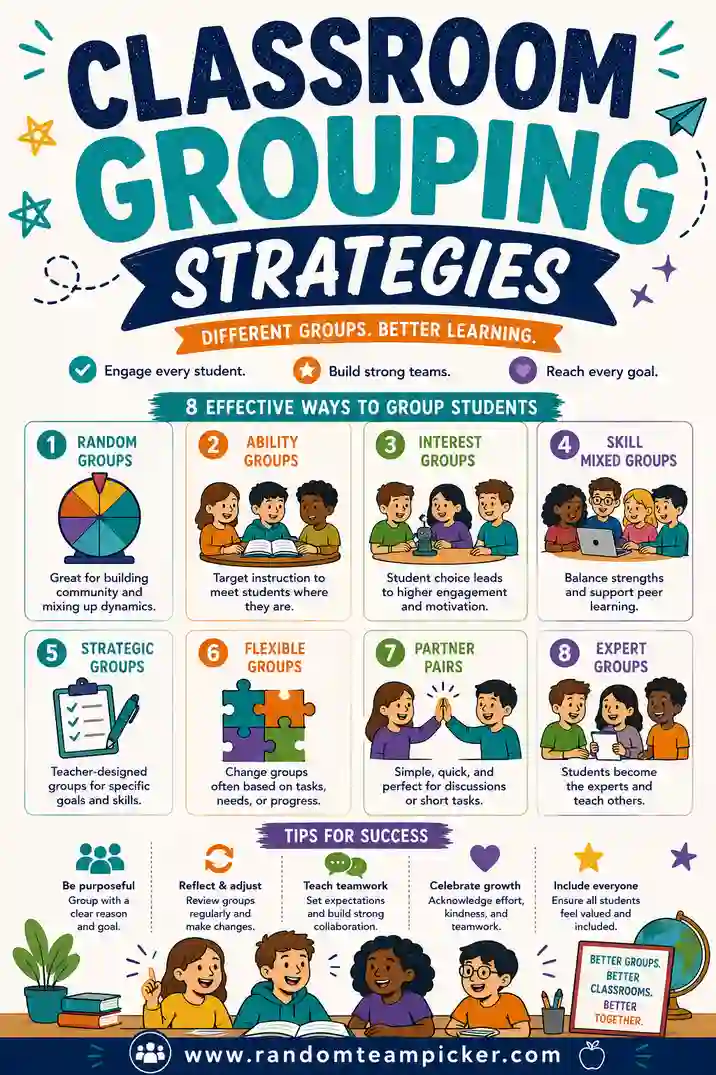
Roles also work best when the seating matches the groups. If your desks are already in pods of 4, each pod can be a standing group with rotating roles, and you only reshuffle the pods every few weeks. Our classroom seating arrangements page compares layouts, and classroom grouping strategies covers when random groups beat chosen ones. When you're ready to split a full roster with skill balancing or keep-apart rules, open the Random Team Picker.
Quick answers about group work roles
What are the roles in group work?
The most common group work roles are facilitator, recorder, timekeeper, reporter and materials manager. Each covers one clear part of the work, from leading to writing to sharing. Smaller groups combine a few of these, and some teachers add an encourager or a checker for longer tasks.
What are cooperative learning roles?
Cooperative learning roles are jobs students take on in a group so everyone has a clear part in the work. Typical examples are leading the discussion, writing down ideas, watching the time and sharing the group's answer. Each student is needed, so nobody sits back and nobody carries the group.
What roles work for a group of 3?
Use three roles: a facilitator who also keeps time, a recorder, and a reporter who also gathers materials. Those pairings fit naturally, because the student running the discussion is already watching the pace and the student who stands to share can also walk to the supply shelf. Everyone stays busy without anyone carrying too much.
What are good roles for group projects?
For longer projects, try a project manager, researcher, writer, designer and presenter. The project manager tracks deadlines, the researcher finds facts and the designer plans the look. Rotate roles at each checkpoint so everyone practices different skills over the course of the project.
How do you assign group roles fairly?
Assign them at random, then rotate every task or every week. One simple method is to paste a group's names into a team picker, set the number of teams to the group size, and treat each slot as a role in a fixed order. A random draw removes the pressure to volunteer and ends the "I always have to write" complaint.
What group roles work for elementary students?
Keep the names short and concrete: Leader, Writer, Timer, Speaker and Supply Helper. Give each child a picture card with two or three things their job does, and model each role once in front of the class before using it. With the youngest students, start with two or three roles and add more as routines settle.
How often should group roles rotate?
Rotate with every new task for short activities, or weekly if your groups stay together for several days. For multi-week projects, rotate at each checkpoint. The goal is that every student tries every role within a few weeks, not just the comfortable one.
What if a student doesn't want their role?
Keep the random result in most cases, because swapping on request quickly brings back the old pattern. Offer support instead, like a sentence starter or a quick private tip. If there's a real reason, such as an injured writing hand, make a quiet swap.