Gingerbread House Contest Teams: Fair Splits, Simple Rules and Judging Ideas
The best gingerbread house contest teams have two to four builders, with at least one grown-up or older kid on every house and the rest picked at random. Count your kits first, because the number of kits is your number of teams. Then list everyone who's building, spread the grown-ups across the houses, split the rest at random and give each team a house name for its spot at the table.
Random teams are the quiet hero of a gingerbread contest. Nobody gets picked last, best friends don't stack one team, and nobody can say the host put all the artistic cousins together. Mixing kids and grown-ups also produces better houses. Little kids are brilliant decorators and terrible engineers, while grown-ups are often the opposite, so together they build a house that stands up and is covered in gumdrops. Below you'll find team sizes, a worked example, a timeline, icing tips that keep roofs on, and judging ideas that let most teams win something.
Key facts
- One kit or base per team, all the same size.
- Three builders per house is the sweet spot.
- Put at least one grown-up or older kid on every house.
- Allow 60 minutes for families and 90 for adults.
- Royal icing should be as thick as toothpaste.
🎲 Pick a random team
Choose a group, then spin. One for each player gives everyone in the names list below a different team.
👥 Random Team Picker: split your list into teams
The sample names are from this page. Replace them with yours, one per line or separated by commas.
The tool above is set up with a sample crowd of 15, seven grown-ups and eight kids, split into five houses: Gumdrop Lane, Peppermint Place, Candy Cane Cottage, Frosting Fort and Snowdrop Chalet. Tick the box to spread the adults and kids evenly, so every house gets a grown-up for the walls. Tick the keep-apart box and Mom and Dad, Aunt Carol and Uncle Mike, and the sibling pairs Ella and Max and Chloe and Owen all land on different houses, so the families truly mix. For your own contest, replace the names with your builders, one per line or separated by commas, set the number of teams to match your number of kits (2 to 12) with the minus and plus buttons, and press Split into teams. Shuffle again for a new mix, Copy teams to make table signs, or Open in the full team picker to take the same teams to the full Random Team Picker in a new tab, where you can pick a captain for each house, balance by skill and print the list.
Quick reference: how many builders per house
| Team size | Works best for | Heads-up |
|---|---|---|
| 2 builders | Small kits, parent and kid pairs | More kits to buy |
| 3 builders | Most families, classrooms, offices | The sweet spot |
| 4 builders | Big kits and big crowds | Most that fit around one house |
| 5 or more | Not recommended | Someone just eats the candy |
Splitting your builders, step by step
Count your houses before anything else. Five kits means five teams, and the number of people simply follows. If you have 15 builders and five kits, that's three per house. If you have 15 builders and only four kits, you'll get teams of four, four, four and three, which is fine for full-size kits but crowded for small ones.
Next, list everyone and note who's a grown-up or a capable older kid. These are your wall builders, and every house needs one. With the age box ticked, the tool takes care of this for you. Then split. Look over the teams once: if a house ended up with three six-year-olds and nobody tall enough to hold the roof, shuffle again or swap one person. Finally, give each team its house name and tape it to the team's spot at the table. A name card makes the judging table more fun later, and our holiday team name generator has plenty more festive ideas if you'd like new ones.
A worked example: 15 builders, five houses
Take the sample in the tool. The grown-ups are Mom, Dad, Aunt Carol, Uncle Mike, Grandma June, Cousin Sarah and Uncle Ben. The kids are Ella, Max, Chloe, Owen, Lucy, Jack, Zoe and Henry. Fifteen builders across five houses makes five teams of three.
With ages spread, the seven grown-ups split two, two, one, one and one across the houses, and the eight kids fill the remaining spots, so three houses get one grown-up and two kids and two houses get two grown-ups and one kid. With keep-apart on, Mom and Dad work on different houses, as do Aunt Carol and Uncle Mike, and the two sibling pairs are separated. So Grandma June might build Frosting Fort with Max and Lucy, while Dad and Cousin Sarah build Peppermint Place with Chloe.
Splitting parents from their own children is one of my favorite tricks. Kids often listen better to an aunt or a cousin than to Mom, and parents get the fun of seeing what their kids make without them. If the houses with two grown-ups seem to have an edge, give the one-grown-up houses first pick of the candy table. To decide which team picks first, try our who goes first generator.
Jobs inside each team
A team of three works best with clear jobs. The builder handles the walls and roof: lining up the panels, holding them while the icing sets and propping them with cans. The icer pipes the royal icing "glue" along every seam and adds icicles to the eaves. The decorator is in charge of candy placement, the front path, the snow and any yard decorations. Little kids make wonderful decorators. With four builders, add a designer, who sketches the plan on paper before anyone touches a candy and keeps the team on theme.
Swap jobs halfway through if kids are getting restless, so everyone gets a turn with the piping bag. For a school group, our group work roles page shows the same idea with role cards that work for any project.
A 90-minute contest timeline
For a family or office contest, here's a plan that keeps things moving. In the first ten minutes, split the teams, read the rules and hand out kits. From minute 10 to 25, teams build the four walls and let them set; this is the perfect time to plan the decorations and visit the candy table. From minute 25 to 35, the roof goes on. From minute 35 to 80, teams decorate. At minute 80, give a ten-minute warning, and at minute 90, hands up and step away from the houses. Then judge while everyone snacks.
For young kids, shorten it to about 60 minutes by using pre-built houses or graham cracker houses that set faster. For adults, keep the full 90 minutes, or stretch it to two hours for an ambitious theme like a whole village.
Icing and building tips that keep the roof on
Royal icing is the glue, and it has to be thick, about like toothpaste, or the walls will slide. It's usually made from powdered sugar and either egg whites or meringue powder. Meringue powder is the safer choice when kids will lick their fingers, since it avoids raw egg. Make plenty: two or three piping bags per team is a good start. Keep extra icing covered with a damp cloth so it doesn't crust over.
Build on a sturdy base, like a cardboard square covered in foil or a large plate. Pipe a thick line of icing on the base, press the first two walls into it at a right angle and hold them for a minute. Add the other two walls, then prop all four with cans or small boxes and wait 10 to 15 minutes before adding the roof. Rushing the roof is the number one cause of collapse. If a wall cracks, glue it with icing and cover the crack with candy; judges will never know.
Judging so most teams win something
One "best house" prize leaves most of the table disappointed, so use several categories. Most Creative rewards the house that isn't a house at all, such as a castle, a barn or a train station. Best Use of Candy goes to clever details like pretzel fences, cereal shingles and mint windows. Best Roof honors the neatest shingles or snowiest roof. Most Festive is for wreaths, lights and a snowman in the yard. The Leaning Tower Award goes to the house that is still standing, mostly. And Most Likely to Survive Until New Year's rewards the sturdiest build on the table.
Choose judges who didn't build, like grandparents, a neighbor or the office manager, or let everyone vote. For anonymous voting, number the houses, hide the team names and hand out sticky notes. With five or six categories and five teams, almost everyone takes home a ribbon.
Variations for classrooms, offices and big families
Classroom graham cracker houses: graham crackers around a small milk carton make a sturdy, cheap house that sets fast. Split the class into teams of three, give every team the same supplies, and run it as one station in a holiday party rotation like our classroom holiday party station groups. Teachers can find more grouping ideas in the random team generator for teachers.
Office contest: split coworkers into random teams of three or four across departments, so people who never talk end up sharing a piping bag. Same kit and candy for everyone, a 60- to 90-minute timer, edible materials only (plus one paper sign or a battery tea light, if you like) and a whole-office vote after lunch. For hybrid teams, see our team generator for office team building.
Theme challenge: draw a theme for each team, like a ski lodge, a lighthouse or a candy shop. Mystery candy bag: each team gets an identical sealed bag of candy and must use only what's inside. For larger family gatherings, the family reunion team generator shows how to mix generations across many teams.
Mistakes to avoid
The biggest mistake is letting people form their own teams. Best friends pair up, the kids land on a kids-only team with no one to hold the walls, and the one person who's done this before gets mobbed. A random split with grown-ups spread across houses fixes all of that in a few seconds. The second mistake is soft icing, which we covered above. The third is unequal supplies. If one team gets a bigger kit or a better candy bowl, the contest stops feeling fair. Use one shared candy table and let teams take turns filling a cup. And plan for cleanup: give every table paper towels and a damp cloth before you start, not after the sprinkles hit the floor.
Odd numbers, allergies and budget
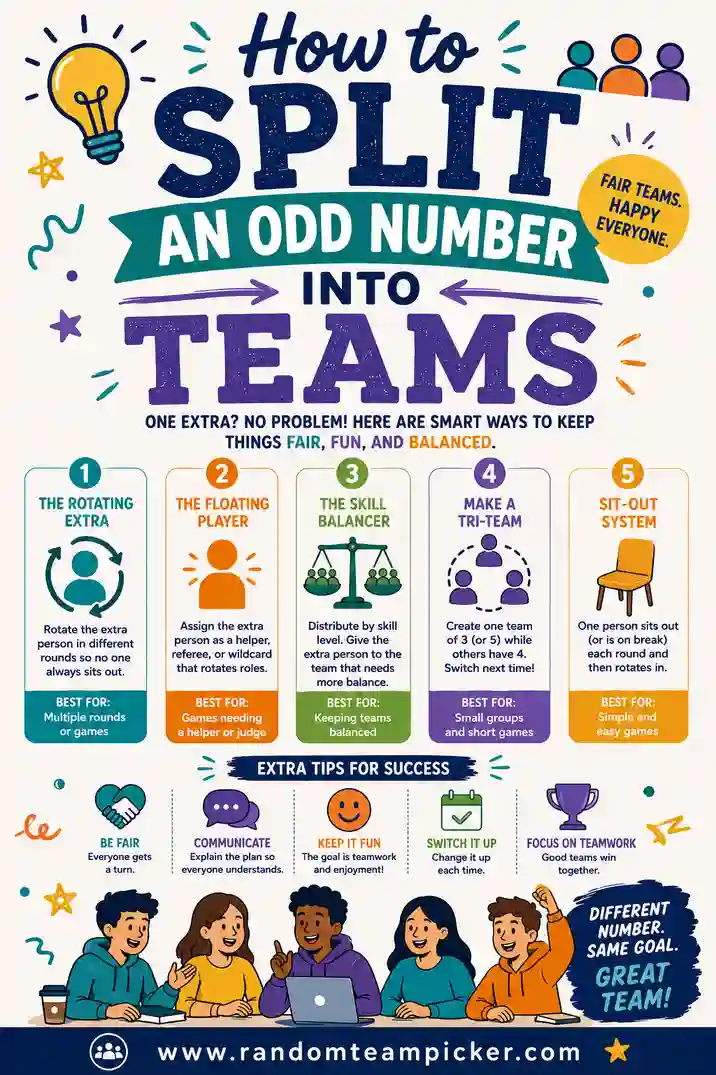
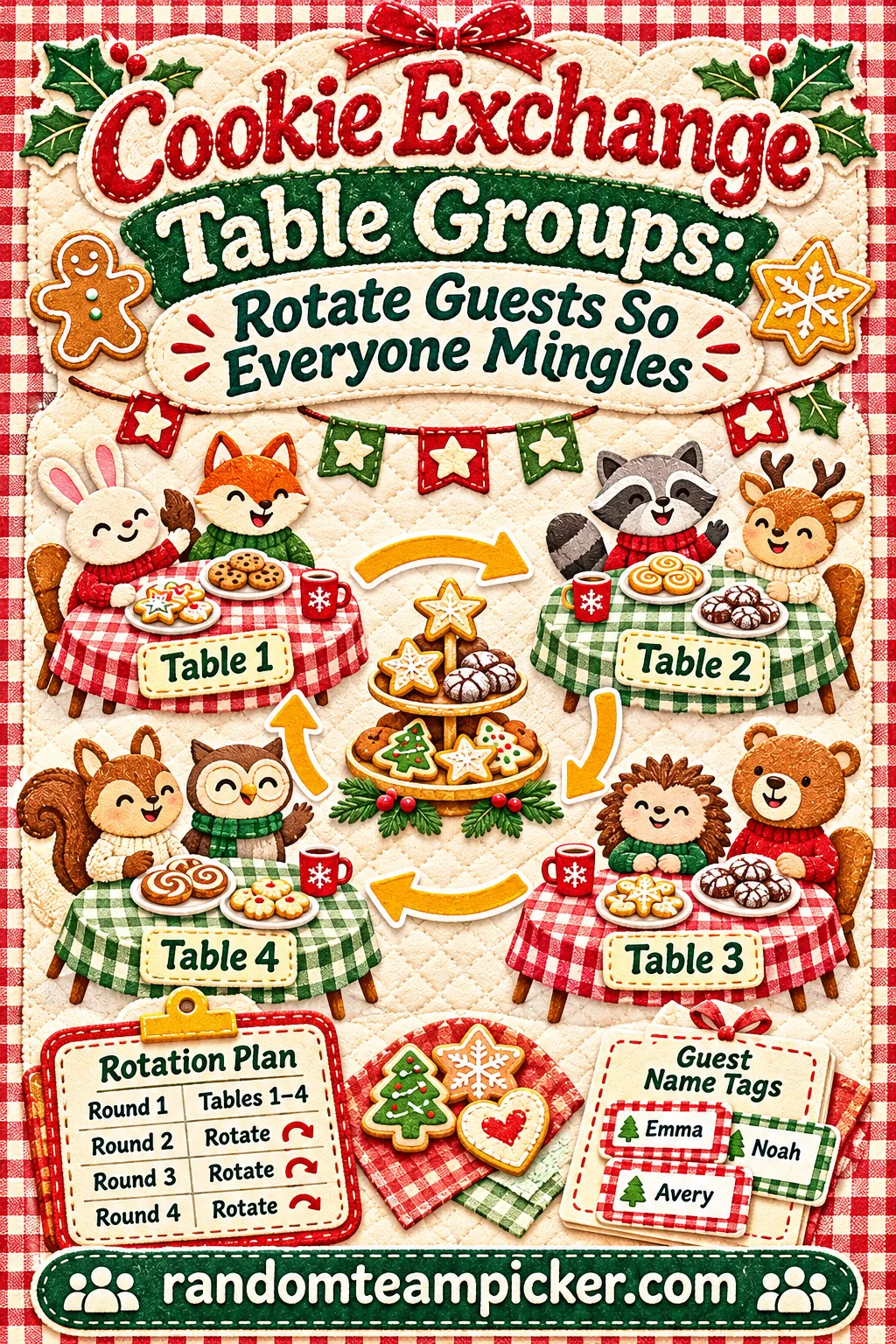
With an odd number of people, a team of two next to teams of three is fine. Give the smaller team a smaller kit, or let them pick candy first. Our guide to splitting an odd number into teams has more fixes, and how many people per team is best explains the general rule. If someone in the group has a food allergy, check every candy label ahead of time and keep a separate bowl of safe candy. On a tight budget, graham cracker houses cost much less than kits and work just as well for judging. If you're also hosting a cookie swap that week, the cookie exchange table groups use the same mixing trick.
Quick answers about gingerbread house contest teams
How many people should be on a gingerbread house team?
Two to four. Two works for small kits, three is the sweet spot for most houses, and four is the most that can fit around one house without someone just watching. Five or more usually means one person ends up eating the candy instead of building.
Should kids and adults be on the same gingerbread team?
For a family contest, yes. Put at least one grown-up or older kid on each team to handle the icing and the walls, and let the younger kids run the decorating. It keeps teams fair, the roofs standing and everyone involved from start to finish.
How do you run an office gingerbread house contest?
Split coworkers into random teams of three or four across departments, give every team the same kit and candy, set a timer for 60 to 90 minutes, and let the whole office vote on categories like Most Creative and Best Use of Candy using numbered houses and sticky notes.
How long should a gingerbread house competition last?
About 60 minutes for kids and families, and 90 minutes for adults or office teams. Give a ten-minute warning so teams can finish the details, and leave time afterwards for judging, photos and cleanup.
What are good categories for judging gingerbread houses?
Most Creative, Best Use of Candy, Best Roof, Most Festive, the Leaning Tower Award and Most Likely to Survive Until New Year's. With enough categories, most teams win something, which keeps the mood happy for the youngest builders.
Can you use graham crackers instead of gingerbread?
Yes. Graham crackers around a small milk carton or box make a sturdy base, and they're much cheaper for big groups and classrooms. Just give every team the same supplies so the contest stays fair.
How do you stop gingerbread walls from falling down?
Use thick royal icing, about like toothpaste, and build on a sturdy base. Prop the walls with cans or small boxes and let them set for 10 to 15 minutes before adding the roof. Rushing the roof is the most common reason houses collapse.
What's the fairest way to pick gingerbread teams?
Split at random with grown-ups spread evenly, and keep parents apart from their own kids if you'd like the family to mix. The full team picker can also pick a captain for each house and print the teams for the table.